The Federal Bar Association and Federal Appellate Brief Word Count Standards in 2026
Introduction
The intersection of professional legal organizations and procedural court rules creates a complex landscape that every appellate practitioner must navigate carefully. The Federal Bar Association (FBA), founded in 1920, stands as one of the most influential legal organizations serving the federal legal community, while the Federal Rules of Appellate Procedure (FRAP) establish the technical requirements that govern how attorneys present arguments to the nation’s circuit courts. As we move through 2026, understanding the relationship between these professional standards and the precise word count limitations for appellate briefs has become more critical than ever for legal practitioners seeking to maintain compliance and present persuasive arguments effectively.
The Federal Bar Association serves approximately 20,000 members including federal judges, attorneys, and law students across the United States and its territories. This organization plays a pivotal role in shaping discourse about federal legal practice, including the ongoing debates about brief writing standards and procedural efficiency. While the FBA does not itself establish binding word count rules—that authority rests with the Supreme Court and the Judicial Conference of the United States through the FRAP—the Association significantly influences how practitioners understand and implement these requirements through continuing legal education, publications, and advocacy.
The word count limitations for federal appellate briefs underwent substantial changes in 2016, and these rules remain fully in effect throughout 2026. Understanding these standards requires examining both the technical requirements of FRAP 32 and the practical guidance provided by professional organizations like the FBA. This comprehensive guide explores every aspect of these requirements, from the historical development of word count rules to practical strategies for compliance, offering practitioners the knowledge necessary to navigate federal appellate practice successfully.
The Federal Bar Association: History, Mission, and Role in Appellate Practice
Origins and Organizational Structure
The Federal Bar Association emerged from the recognition that attorneys practicing in federal courts required specialized knowledge and professional support distinct from state bar associations. Established in 1920, the FBA has grown into a national organization with chapters throughout the federal circuit court jurisdictions. The Association’s membership includes private practitioners, government attorneys, federal public defenders, corporate counsel, and the federal judiciary itself, creating a unique forum for dialogue about federal practice standards.
The FBA’s organizational structure reflects the geographical organization of the federal court system, with chapters typically aligned with federal judicial districts or circuits. This structure enables the Association to address both national concerns about federal practice and local variations in implementation. The national headquarters, located in Washington, D.C., coordinates policy initiatives, publications, and the annual meeting, while local chapters provide networking opportunities and region-specific continuing education.
The Association’s relationship to appellate practice is multifaceted. Through its Council of Appellate Lawyers, the FBA has historically participated in the rulemaking process by submitting comments to the Advisory Committee on Appellate Rules regarding proposed amendments to the FRAP. This advocacy role positions the FBA as a bridge between the practicing bar and the judiciary, ensuring that practitioner perspectives inform procedural rule development.
Professional Development and Appellate Advocacy
The Federal Bar Association’s commitment to appellate advocacy manifests through specialized programming designed to enhance practitioner skills. Annual conventions regularly feature sessions dedicated to brief writing techniques, oral advocacy, and procedural compliance. These educational initiatives address the practical challenges attorneys face when working within word count constraints, offering strategies for concise yet comprehensive argumentation.
The FBA’s publications, including The Federal Lawyer magazine, frequently contain articles analyzing appellate practice trends, including discussions of word count management and brief writing efficiency. These resources serve as valuable tools for practitioners seeking to refine their approach to federal appellate work. The Association’s appellate practice sections provide forums for members to share experiences and strategies regarding compliance with technical requirements like word count limitations.
Moreover, the FBA’s civics education initiatives, including the annual Civics Essay Contest for high school students, demonstrate the organization’s commitment to fostering legal writing skills at early stages. While distinct from the technical requirements of federal appellate briefs, these programs reflect the broader organizational emphasis on clear, concise legal communication within specified parameters—skills directly transferable to professional appellate practice.
Advocacy in Rulemaking and Policy Development
The Federal Bar Association’s most significant impact on word count standards occurs through its participation in the federal rulemaking process. When the Advisory Committee on Appellate Rules considers amendments to the FRAP, the FBA provides formal comments representing the views of its membership. This participation ensures that practitioner experiences inform judicial decision-making about procedural requirements.
In the lead-up to the 2016 amendments that reduced word count limits, the FBA’s Council of Appellate Lawyers submitted detailed comments regarding the proposed changes. These submissions highlighted practical concerns about the impact of reduced word limits on complex cases while acknowledging judicial interest in more focused briefing. The Council’s suggestions for alternative approaches, including potential structural changes to brief requirements and typography modifications, demonstrate the FBA’s role in shaping discourse about appellate efficiency.
The Association continues to monitor implementation of existing rules and advocates for adjustments when practical experience reveals unintended consequences. This ongoing engagement ensures that word count requirements remain subject to professional scrutiny and potential refinement based on actual practice conditions.
The Federal Bar Association and Federal Appellate Brief
Federal Appellate Brief Word Count Requirements: The 2026 Framework
Current Regulatory Structure
As of 2026, the word count limitations for federal appellate briefs remain governed by the amendments to the Federal Rules of Appellate Procedure that took effect on December 1, 2016. These rules, found primarily in FRAP 32 (Form of Briefs, Appendices, and Other Papers) and FRAP 28.1 (Cross-Appeals), establish precise type-volume limitations that practitioners must observe when preparing documents for the United States Courts of Appeals.
The current regulatory framework represents a significant shift from the historical page-based limitations that preceded the 1998 amendments. The transition to word count standards reflected the judiciary’s recognition that page limits created inequities based on font selection, spacing, and margin specifications. Word counts provide a more uniform standard that focuses on the actual volume of substantive argumentation rather than physical page dimensions.
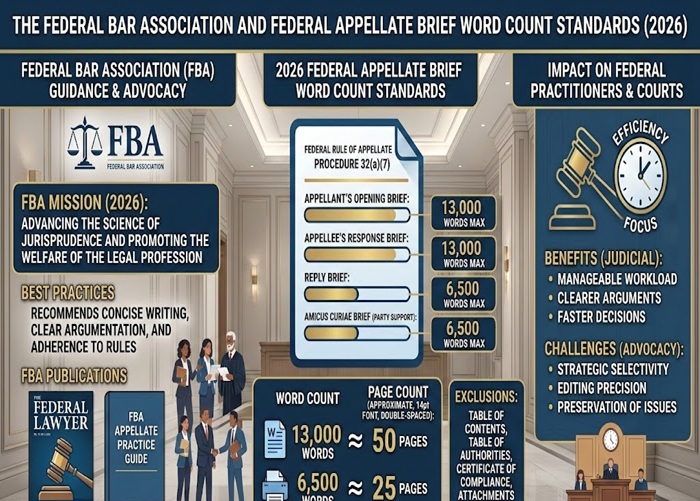
Under the 2016 amendments, which remain in full force throughout 2026, principal briefs in cases without cross-appeals are limited to 13,000 words, while reply briefs are limited to 6,500 words
. These represent reductions from the previous limits of 14,000 and 7,000 words, respectively. The amendments also established word count limitations for various motions and petitions, extending the type-volume certification requirements beyond briefs to encompass the full range of appellate filings.
Detailed Word Count Specifications
The 2026 word count framework establishes specific limitations based on document type and procedural posture. For cases involving no cross-appeal, the limitations are straightforward: the appellant’s principal brief must not exceed 13,000 words, and the reply brief must not exceed 6,500 words
. The appellee’s principal brief operates under the same 13,000-word limitation, though it serves the dual function of responding to the appellant’s arguments and presenting its own case for affirmance.
Cross-appeals introduce additional complexity to the word count framework. Under FRAP 28.1, the appellant’s principal brief remains limited to 13,000 words. However, the appellee’s combined principal and response brief receives an expanded allowance of 15,300 words (reduced from the previous 16,500-word limit) to address both the appellee’s defensive arguments and its cross-appeal issues
. The appellant’s subsequent response and reply brief is limited to 13,000 words, while the appellee’s reply brief must not exceed 6,500 words.
Motions and petitions filed during appellate proceedings are subject to their own word count limitations. Petitions for permission to appeal under FRAP 5(c) are limited to 5,200 words, with replies to such petitions limited to 2,600 words
. Motions under FRAP 27(d)(2) generally must not exceed 5,200 words, with responses limited to the same length and replies to responses limited to 2,600 words. Petitions for extraordinary writs under FRAP 21(d) may extend to 7,800 words.
The framework also addresses amicus curiae participation. Amicus briefs filed during initial consideration of a case on the merits are limited to one-half the length permitted for a party’s principal brief—typically 6,500 words in non-cross-appeal cases
. Amicus briefs filed during consideration of rehearing are limited to 2,600 words. These limitations ensure that non-party participation remains supplementary rather than overwhelming to the principal adversarial presentations.
Exclusions from Word Count Calculations
FRAP 32(f) establishes specific items that do not count toward word count limitations, recognizing that certain structural and administrative components of briefs serve necessary functions without contributing to substantive argument length. These exclusions include the cover page, disclosure statement required by FRAP 26.1, table of contents, table of citations, statement regarding oral argument, addendum containing statutes or regulations, certificates of counsel, signature block, and proof of service
The exclusion of these items reflects practical considerations about brief formatting and administrative requirements. The table of contents and table of authorities, while essential for navigation and citation verification, do not present substantive legal argumentation. Similarly, the disclosure statement serves conflict-checking purposes unrelated to the merits of the appeal. The addendum exclusion acknowledges that reproduction of controlling legal texts, while necessary for judicial reference, does not constitute original advocacy.
Practitioners should note that headings, footnotes, and quotations do count toward word count limitations. This inclusion has significant strategic implications for brief writing, as extensive footnoting or lengthy block quotations consume the limited word budget without advancing original argumentation. The 2016 amendments maintained this inclusive approach despite suggestions from commenters that footnotes might be excluded to encourage more substantive text-based argumentation.
Certification Requirements and Compliance Verification
FRAP 32(g) mandates that briefs submitted under the word count limitations must include a certificate of compliance signed by the attorney or unrepresented party. This certificate must state the number of words in the document (or lines of monospaced type, if applicable) and may rely on the word count generated by the word-processing system used to prepare the document
. Form 6 in the Appendix of Forms provides an acceptable template for this certification.
The certification requirement serves multiple functions. It places responsibility for compliance squarely on the filing party, creates a formal record of the word count for judicial review, and provides a basis for sanctions if the certification proves inaccurate. Courts have demonstrated willingness to enforce these requirements strictly, with some circuits rejecting filings that lack proper certification or that exceed word count limitations.
The reliance on word-processing system counts reflects practical recognition of the difficulty in manual word counting for lengthy documents. However, practitioners must ensure that their software settings align with the document’s actual content, excluding items that FRAP 32(f) excludes from the count. Different word processing programs may handle certain elements differently, requiring careful verification that the generated count accurately reflects the rules’ requirements.
The 2016 Amendments: Context and Impact
Historical Development of Word Count Standards
The 2016 amendments that established the current word count framework did not emerge in isolation but rather represented the culmination of decades of evolution in appellate procedure. The Federal Rules of Appellate Procedure were originally promulgated in 1968, replacing a patchwork of local rules that had governed circuit court practice. The initial rules employed page-based limitations, typically restricting principal briefs to 50 pages and reply briefs to 25 pages.
The transition to word count limitations occurred in 1998, when the Rules were amended to provide alternatives to page limits. This change recognized that technological advances in word processing had rendered page counts susceptible to manipulation through font selection, spacing adjustments, and margin modifications. The 1998 amendments established word count alternatives of 14,000 words for principal briefs and 7,000 words for reply briefs—limits that remained stable for nearly two decades.
The stability of these limitations between 1998 and 2016 allowed practitioners to develop consistent expectations and writing practices around the 14,000/7,000-word framework. The 2016 amendments disrupted these expectations, reducing limits by approximately 7% to the current 13,000/6,500-word structure
. This reduction reflected judicial concerns about brief length and the need for more focused advocacy, but also generated significant practitioner opposition regarding the adequacy of space for complex cases.
The Amendment Process and Practitioner Opposition
The 2016 amendments underwent extensive review through the Advisory Committee on Appellate Rules, including public comment periods that generated substantial feedback from the bar. The Federal Bar Association, through its Council of Appellate Lawyers, participated actively in this process, submitting comments that opposed the proposed reductions and suggested alternative approaches to improving brief quality
Initial proposals suggested reducing principal brief limits to 12,500 words—a more substantial reduction than ultimately adopted. Opposition from practitioners, including FBA submissions, resulted in the final compromise of 13,000 words
. Commenters argued that the existing limits were working well and that arbitrary reductions would penalize knowledgeable lawyers handling complex cases involving lengthy records, multiple parties, or sophisticated legal issues.
The Council of Appellate Lawyers suggested that the Advisory Committee consider alternative approaches to improving brief quality, including eliminating the summary of argument requirement or modifying brief structure to reduce repetition
. They also proposed adopting modern typography principles that would enhance readability while potentially reducing physical bulk without restricting substantive content. These suggestions reflected the profession’s view that brief quality depends more on writing skill than arbitrary length limitations.
Judicial supporters of the amendments, including Judge Laurence Silberman of the D.C. Circuit, argued that briefs had become excessively long and that page limits encouraged lawyers to “write briefs to match the page limits, whether or not that is actually justified”
. Proponents contended that over-long briefs obscure core legal arguments through excessive factual discussion or marginal arguments, ultimately proving less effective than focused presentations.
Empirical Analysis and Practical Impact
The debate over word count reductions generated empirical analysis regarding actual brief lengths under the previous regime. A study conducted by the Clerk of the Eighth Circuit Court of Appeals examining principal briefs filed in 2008 found that 82% of briefs filed under FRAP 32(a)(7)(B)(i) were under 12,500 words in length—below even the initially proposed reduced limit
. This data suggested that the majority of practitioners were not utilizing the full 14,000-word allowance and that the proposed reductions would affect only a minority of cases.
However, critics noted that the 18% of briefs exceeding 12,500 words likely represented the most complex and significant appeals—precisely the cases where adequate space for thorough argumentation matters most. The data could not reveal whether the longer briefs resulted from inefficient writing or genuine complexity requiring extended discussion.
In the years since implementation, practitioners have adapted to the reduced limits through various strategies. The 13,000-word limit has become the standard benchmark for principal brief planning, with appellate specialists developing techniques for condensing arguments without sacrificing substance. The impact has been most pronounced in complex litigation involving multiple issues, where attorneys must now make difficult choices about which arguments to emphasize and which to streamline or omit.
Circuit-Specific Variations and Local Rules
The Relationship Between FRAP and Local Rules
While the Federal Rules of Appellate Procedure establish baseline requirements applicable across all circuits, individual United States Courts of Appeals maintain local rules that supplement or modify these standards. The 2026 landscape of appellate practice requires careful attention to these circuit-specific variations, as non-compliance with local rules can result in rejection of filings or procedural complications.
The interaction between FRAP and local rules follows a hierarchical structure: local rules cannot contradict FRAP provisions but may impose additional requirements or specify implementation details left open by the federal rules. Regarding word counts, most circuits adopt the FRAP 32 standards without modification, but practitioners must verify that no circuit-specific variations apply to their particular case.
Some circuits have issued guidance regarding the interpretation of word count rules or the handling of certification requirements. For example, the Tenth Circuit has specified that while the court prefers 14-point type as required by FRAP 32(a)(5)(A), 13-point type remains acceptable
. The same circuit has addressed the interaction between word counts and glossaries, providing that glossaries required by local rule may be excluded from word count calculations in addition to the items listed in FRAP 32(f)
Common Local Variations and Requirements
Circuit courts have addressed various aspects of word count implementation through local rules and internal operating procedures. Some circuits specify technical requirements for the certificate of compliance, including its placement within the brief or specific language that must accompany the word count statement. Others have established procedures for seeking leave to exceed word count limitations in extraordinary circumstances.
The Tenth Circuit’s approach to motions to exceed word counts illustrates how local practice can supplement FRAP standards. The circuit’s local rules specify that “Motions to exceed word counts are disfavored” and “will be denied unless extraordinary and compelling circumstances can be shown”
. Additionally, motions filed within 14 days of the brief’s due date must demonstrate why earlier filing was not possible. This stringent approach discourages routine requests for additional space and places a heavy burden on attorneys seeking exceptions.
Other circuits have addressed specific formatting issues that affect word count compliance. Requirements regarding font size, line spacing, and margin specifications can influence how much content fits within word count limitations. While FRAP 32 establishes minimum standards (14-point proportional font or 10.5 characters per inch monospaced, double-spacing, one-inch margins), local variations may impose additional restrictions.
Practitioners must also be aware of circuit-specific requirements regarding the content and structure of briefs that may indirectly affect word count management. Some circuits require specific organizational structures, issue statements, or summaries that consume word budget while serving local procedural preferences. Familiarity with these requirements before drafting begins allows for more effective allocation of limited word resources.
Electronic Filing and Word Count Verification
The universal adoption of electronic filing systems (CM/ECF) across the federal circuit courts has streamlined the submission process while introducing new considerations for word count compliance. Electronic filing systems typically require attorneys to upload PDF versions of briefs, with the word count certification included as part of the document.
The electronic context creates both opportunities and challenges for word count management. Word processing software provides accurate word counts that can be readily inserted into certification pages, but attorneys must ensure that the version uploaded to CM/ECF matches the version for which the count was generated. Last-minute edits after certification require updated word counts and new certifications.
Some circuits have implemented technical checks that compare stated word counts against actual document metrics, though these systems vary in sophistication. Practitioners should not rely on court clerks to catch word count discrepancies but should instead implement their own verification procedures. Best practices include generating the final word count only after all edits are complete and double-checking the count against the specific software settings used for the final version.
The electronic filing environment also facilitates access to examples of compliant briefs, allowing practitioners to review how experienced appellate counsel manage word count limitations in similar cases. Many circuits make filed briefs publicly available through PACER, creating a resource for studying effective brief writing within word count constraints.
The Federal Bar Association and Federal Appellate Brief
Strategic Approaches to Word Count Management
Pre-Writing Planning and Issue Selection
Effective management of word count limitations begins before the first sentence is drafted. Strategic issue selection determines how the limited word budget will be allocated across the various components of the brief. In complex appeals presenting multiple potential issues, attorneys must make difficult decisions about which arguments to develop fully, which to present more concisely, and which to omit entirely.
The 13,000-word limit for principal briefs requires careful allocation across the mandatory sections specified in FRAP 28(a). The jurisdictional statement, statement of issues, statement of the case, summary of argument, and argument sections each require sufficient space to fulfill their distinct functions. Experienced appellate practitioners typically allocate word budgets proportionally to the complexity and significance of each component, reserving the majority of words for the argument section while ensuring that preliminary sections provide adequate context.
Issue selection in the 13,000-word environment favors depth over breadth. Rather than presenting numerous underdeveloped arguments, effective briefs typically focus on two to four well-developed issues that present the strongest grounds for relief. This approach recognizes that judges, like all readers, benefit from focused presentation rather than scattered treatment of many points. The word count limitation, while constraining, can serve as a discipline that improves brief quality by forcing hard choices about which arguments merit development.
Pre-writing outlining should include word count targets for each section, with flexibility built in for sections that prove more or less complex during drafting. Some practitioners allocate specific percentages: 10% for preliminary sections (jurisdictional statement, issues, case statement), 10-15% for summary of argument, and 75-80% for the argument itself. These allocations vary based on case complexity and the number of issues presented.
Writing Techniques for Concise Advocacy
The constraints of modern word count limitations demand writing techniques that maximize persuasive impact within limited space. These techniques include tight organization, efficient sentence structure, strategic use of parentheticals, and careful management of quotations and record citations.
Organization serves as the foundation of concise advocacy. Clear issue statements, distinct argument headings, and logical flow between points enable judges to follow complex arguments without wasted words. Each paragraph should advance the argument meaningfully, avoiding redundancy or tangential discussion. Transitions between sections should be brief but sufficient to maintain logical coherence.
Sentence-level efficiency contributes significantly to word count management. Active voice constructions typically require fewer words than passive voice while creating more forceful advocacy. Precise word choice eliminates the need for explanatory phrases or qualifiers. However, compression should not come at the expense of clarity or professionalism; the goal is efficient communication, not merely short sentences.
Parenthetical explanations following case citations offer an efficient mechanism for conveying key holdings or distinguishing precedents without extensive textual discussion. Well-crafted parentheticals can substitute for longer explanatory sentences, conserving words while providing necessary legal support. Similarly, record citations should be precise and limited to essential references, avoiding lengthy quotations from the record that can be summarized more efficiently.
Block quotations present particular challenges under word count limitations. While FRAP 32 does not exclude quotations from word counts, extended quotations consume substantial word budget without advancing original analysis. Effective briefs use block quotations sparingly, reserving them for language that requires precise analysis or that carries particular precedential weight. Shorter quotations integrated into textual analysis or paraphrased with citation typically serve the same purpose more efficiently.
Editing Strategies and Word Count Reduction
The editing process provides the final opportunity to refine briefs within word count constraints. Effective editing requires distance from the initial draft, allowing the attorney to evaluate the text critically for redundancy, verbosity, and unnecessary elaboration. Multiple editing passes, each focused on different aspects of the text, typically yield the best results.
Initial editing should address macro-level concerns: issue selection, organizational structure, and the relative weight given to different arguments. This stage may involve eliminating entire arguments or sections that prove less compelling upon reflection, freeing words for stronger content. Structural editing ensures that the brief presents a coherent narrative that guides the court efficiently through the issues.
Subsequent editing passes address sentence and paragraph level concerns. Common targets for reduction include introductory phrases (“It is important to note that,” “The Court should be aware that”), redundant citations, over-elaboration of undisputed points, and excessive qualification. Each sentence should be examined for necessary contribution to the argument; sentences that merely restate or elaborate obvious points should be eliminated or condensed.
Technical editing ensures compliance with word count limitations and proper completion of the certification requirement. This stage involves generating the final word count, verifying exclusions under FRAP 32(f), and preparing the certificate of compliance. Attorneys should verify that their word processing software settings align with the final document format, as changes in font, spacing, or margins between drafting and finalization could affect page counts (though not word counts).
Modern word processing tools facilitate word count management through features that display running counts, track changes, and compare versions. Some practitioners use specialized legal writing software that provides additional functionality for citation management and formatting compliance. Regardless of tools used, final verification should involve manual review to ensure that the word count accurately reflects the document to be filed.
The Future of Word Count Standards: Trends and Considerations
Ongoing Debates About Brief Length
The reduction of word count limitations in 2016 did not resolve ongoing debates about optimal brief length, and these discussions continue to influence discourse within the Federal Bar Association and the broader appellate community. Judges remain concerned about brief bloat and the inefficiency of over-long submissions, while practitioners continue to express concerns about adequate space for complex litigation.
Some commentators have suggested that word count limitations represent an imperfect proxy for the actual concern: brief quality. Arbitrary word limits may encourage gamesmanship in formatting or citation practices without improving substantive advocacy. Alternative approaches might include standards based on argument complexity, tiered limitations based on case type, or greater reliance on judicial discretion to order expanded briefing when warranted.
The Federal Bar Association and similar organizations continue to monitor the impact of current limitations and advocate for adjustments based on practical experience. This ongoing dialogue between the bench and bar ensures that word count standards remain subject to refinement as appellate practice evolves. Any future amendments would follow the same notice-and-comment process that produced the 2016 changes, providing opportunities for practitioner input.
Technological Influences on Brief Writing
Advances in legal technology continue to reshape appellate practice, with implications for word count management. Artificial intelligence tools now assist with legal research, citation verification, and even drafting assistance. These technologies may influence how attorneys approach brief writing within word count constraints, potentially enabling more efficient research and drafting processes.
However, technology also presents challenges for word count compliance. The ease of generating text through AI assistance could lead to longer initial drafts requiring more extensive editing. Additionally, the integration of hyperlinks, multimedia elements, or interactive features in electronic briefs raises questions about how such content should be counted or whether future rule amendments might address digital briefing formats.
The 2026 landscape already includes considerations of generative AI use in court filings, with some jurisdictions implementing disclosure requirements for AI-assisted drafting. While these developments do not directly affect word count calculations, they reflect the broader technological transformation of legal writing that may eventually influence how brief length and content are regulated.
Educational Initiatives and Professional Development
The Federal Bar Association’s role in shaping future briefing practices extends beyond rulemaking comments to direct education of the appellate bar. Through continuing legal education programs, publications, and mentoring initiatives, the FBA helps practitioners develop the skills necessary to work effectively within word count constraints.
Law schools and legal writing programs have similarly adapted curricula to emphasize concise, focused advocacy that prepares students for modern practice constraints. Moot court competitions, including those sponsored by the FBA and other organizations, increasingly incorporate word or page limitations that simulate actual appellate conditions. These educational experiences develop the discipline of concise writing early in legal careers.
The FBA’s civics initiatives, including the annual essay contest with its 1,000-word limitation, introduce high school students to the concept of constrained legal writing
. While distinct from professional appellate practice, these programs foster appreciation for the relationship between length limitations and effective communication—foundational concepts for future legal professionals.
Practical Compliance Checklist for 2026
Pre-Drafting Preparation
Before beginning work on a federal appellate brief in 2026, practitioners should complete several preparatory steps to ensure compliance with word count requirements:
First, verify the applicable word count limitations based on the document type and procedural posture. Confirm whether the case involves cross-appeals that would trigger the modified limits of FRAP 28.1. Review the local rules of the specific circuit court for any variations or additional requirements that might affect word count calculations.
Second, establish a word budget allocation for each section of the brief based on the complexity of the case and the issues to be presented. Create a detailed outline that assigns target word counts to each section, ensuring that the total does not exceed the applicable limitation. Build in flexibility for sections that may require more or less space than initially anticipated.
Third, gather and review the record materials, lower court opinions, and key authorities to assess the scope of necessary discussion. Identify the strongest arguments and supporting precedents to prioritize in the word budget. Preliminary assessment of record citation needs helps prevent last-minute additions that might push the brief over limit.
Drafting and Editing Protocols
During the drafting process, implement practices that facilitate word count compliance:
Use word processing software that displays running word counts and set up the document with the final formatting specifications (font, spacing, margins) from the outset. This ensures that the word count displayed during drafting accurately reflects the final document metrics.
Draft preliminary sections (jurisdictional statement, statement of issues, statement of the case) with attention to conciseness. These sections should provide necessary context without consuming excessive word budget. The summary of argument should be genuinely summative, not merely repetitive of the full argument.
Develop arguments with focused organization, using clear headings and efficient transitions. Avoid block quotations except where essential; instead, integrate key language from authorities into textual analysis. Use parentheticals efficiently to convey case holdings without extensive discussion.
During editing, conduct multiple review passes focusing on different levels: structural organization, paragraph development, sentence efficiency, and word-level precision. Eliminate redundancy, unnecessary qualification, and verbose constructions. Verify that each sentence contributes meaningfully to the persuasive objective.
Final Verification and Filing
Before filing, complete comprehensive compliance verification:
Generate the final word count using the word processing software, ensuring that the document reflects all final edits and formatting. Review FRAP 32(f) to confirm that all excluded items (cover page, disclosure statement, table of contents, table of citations, statement regarding oral argument, addendum, certificates, signature block, proof of service) have been properly omitted from the count.
Prepare the certificate of compliance using Form 6 or circuit-specific variations, accurately stating the word count and confirming compliance with type-volume limitations. Include the certificate in the appropriate location within the brief, typically following the conclusion and signature block.
Review the local rules one final time to confirm that all circuit-specific requirements have been met. Verify that the certificate language and placement comply with local expectations. Confirm that the brief format (font size, spacing, margins) meets both FRAP and local standards.
File the brief through CM/ECF with adequate time before the deadline to address any technical issues. Retain copies of the filed brief and the word processing document for future reference and potential motion practice.
4250 N. Fairfax Dr., Suite 301, Arlington, VA 22203
U.S. Courts Administrative Office
Contact Type
Information
Public Affairs Office
(202) 502-2600
Purpose
Questions about AO support and federal court information
Federal Circuit Court of Appeals
Department
Phone Number
Main Line & General Information
(202) 275-8000
Attorney Services
(202) 275-8035
PACER Help Desk
800-676-6856
Emergency Filings
(202) 275-8049
Supreme Court of the United States
Contact Type
Information
General Telephone
202-479-3000
TTY
202-479-3472
Clerk’s Office
202-479-3011
Public Information Office
202-479-3211
Important Notes
⚠️ Scam Warning: The U.S. Courts will never ask anyone to provide personal information or discuss legal matters by phone or email. If you receive such calls claiming to be from the U.S. Courts, do not provide the requested information .
Circuit-Specific Contacts: Each of the 13 U.S. Courts of Appeals has its own Clerk’s Office with specific contact information. For example:
Seventh Circuit (Chicago): (312) 435-5850
Sixth Circuit (Cincinnati): 513.564.7000
You should contact the specific circuit court where your case is pending for questions about local rules and filing procedures.
Frequently Asked Questions (FAQ)
Q: Does the Federal Bar Association set word count rules for appellate briefs?
A: No. The Federal Bar Association is a professional organization that serves the federal legal community but does not establish binding procedural rules. Word count limitations for federal appellate briefs are established by the Federal Rules of Appellate Procedure (FRAP), specifically Rule 32 and Rule 28.1, which are promulgated by the Supreme Court and the Judicial Conference of the United States. The FBA does, however, participate in the rulemaking process by submitting comments and provides education about compliance with these rules.
Q: What are the current word count limits for federal appellate briefs in 2026?
A: As of 2026, principal briefs in cases without cross-appeals are limited to 13,000 words, and reply briefs are limited to 6,500 words. In cross-appeal cases, the appellant’s principal brief is limited to 13,000 words; the appellee’s principal and response brief is limited to 15,300 words; the appellant’s response and reply brief is limited to 13,000 words; and the appellee’s reply brief is limited to 6,500 words. These limits have been in effect since December 1, 2016.
Q: Do footnotes count toward the word count limitation?
A: Yes. Under FRAP 32, footnotes count toward word count limitations. This includes both substantive footnotes and citation footnotes. Practitioners should factor footnote content into their word budget planning and avoid excessive footnoting that consumes limited word resources without advancing the main argument.
Q: What items are excluded from word count calculations?
A: FRAP 32(f) specifies that the following items do not count toward word count limitations: cover page, disclosure statement, table of contents, table of citations, statement regarding oral argument, addendum containing statutes, rules, or regulations, certificates of counsel, signature block, and proof of service. Some circuits may allow additional exclusions, such as glossaries required by local rule.
Q: What happens if my brief exceeds the word count limitation?
A: Courts may reject briefs that exceed word count limitations or lack proper certification of compliance. Some circuits treat non-compliant briefs as not filed, requiring resubmission within the correct limits. Courts may also strike non-compliant briefs or impose sanctions for violation of procedural rules. Motions to exceed word count limitations are generally disfavored and granted only upon a showing of extraordinary and compelling circumstances.
Q: How do I certify compliance with word count limitations?
A: FRAP 32(g) requires a certificate of compliance stating the number of words in the document. You may rely on the word count generated by your word-processing system. The certificate must be signed by the attorney or unrepresented party and should follow Form 6 in the Appendix of Forms unless your circuit specifies a different format. The certificate should be included in the brief, typically following the conclusion.
Q: Can I use monospaced font instead of word count?
A: Yes. FRAP 32 provides an alternative to word count limitations for documents using monospaced typeface (such as Courier). Principal briefs using monospaced type may not exceed 1,300 lines of text, and reply briefs may not exceed 650 lines. This alternative accommodates attorneys who prefer typewriter-style formatting, though proportional fonts are more commonly used in modern practice.
Q: Do local rules ever modify the FRAP word count limitations?
A: Local rules cannot contradict FRAP provisions, but they may supplement them with additional requirements or specifications. Some circuits have specific requirements regarding certificate formatting, font sizes, or procedures for seeking leave to exceed limitations. Always consult the local rules of the specific circuit court where your appeal is pending to ensure full compliance.
Q: How have word count limits changed over time?
A: Word count limits were introduced in 1998 as an alternative to page limits, initially set at 14,000 words for principal briefs and 7,000 words for reply briefs. These limits remained stable until December 1, 2016, when they were reduced to the current 13,000 and 6,500 words respectively. The 2016 amendments also extended word count requirements to motions and petitions that previously used page limits.
Q: What strategies help manage brief writing within word count constraints?
A: Effective strategies include careful pre-writing planning with word budget allocation, focusing on the strongest two to four issues rather than numerous marginal arguments, using efficient sentence structures and active voice, limiting block quotations, utilizing parentheticals for case explanations, and conducting multiple editing passes to eliminate redundancy. Experienced appellate practitioners treat word count limitations as a discipline that improves brief quality by forcing focus on essential arguments.
This article provides general information about federal appellate procedure and the Federal Bar Association as of 2026. It does not constitute legal advice or establish an attorney-client relationship. Federal appellate rules and local court rules are subject to amendment, and practitioners should always consult the current version of the Federal Rules of Appellate Procedure, applicable circuit court local rules, and relevant authorities for the most up-to-date requirements. The information presented here reflects the author’s understanding of current rules and practices but should not be relied upon as a substitute for independent legal research or consultation with qualified appellate counsel. Individual circumstances vary, and specific legal questions should be addressed to attorneys licensed to practice in the relevant jurisdiction. The Federal Bar Association does not endorse this article, and any views expressed are those of the author alone.