
Legal Representation How to Find the Right Lawyer
Introduction: Understanding What a Lawyer Is
A lawyer — also commonly known as an attorney, counsel, or legal representative — is a licensed professional who has been trained and authorized to provide legal advice, represent clients in legal proceedings, and navigate the complexities of the law on behalf of individuals, organizations, corporations, and government bodies. The term “lawyer” is a general term for legal representation and encompasses a vast range of specializations, responsibilities, and functions within the legal system.
Whether you are facing a criminal charge, going through a divorce, starting a business, dealing with a workplace dispute, or managing the estate of a deceased loved one, a lawyer serves as your guide, advocate, and protector within the legal framework. Understanding who a lawyer is, what they do, and how they can help you is not just useful knowledge — it is essential in today’s increasingly complex legal landscape.
This comprehensive guide covers everything you need to know about lawyers as a general term for legal representation: their roles, types, how the legal profession is structured, how to choose the right lawyer, what to expect when working with one, and much more. By the end of this article, you will have a thorough understanding of why legal representation matters and how it can make a decisive difference in your life.
1. The Origin and Meaning of the Term “Lawyer”
The word “lawyer” derives from Middle English and Old French roots, essentially meaning one who is trained in the law. Historically, lawyers emerged as a profession in ancient Rome and Greece, where educated individuals specialized in interpreting laws and advising citizens and rulers alike. The modern conception of a lawyer as a general term for legal representation evolved significantly over centuries, particularly following the establishment of formal bar associations, law schools, and legal codes in the 18th and 19th centuries.
Today, the term “lawyer” is used broadly and interchangeably with terms such as:
- Attorney (short for attorney-at-law)
- Counsel or Counselor
- Advocate (used in some countries such as the UK and India)
- Solicitor or Barrister (British legal system)
- Legal Representative
- Esquire (abbreviated as Esq., used as a title)
Regardless of the specific title used in different jurisdictions, a lawyer remains the general term for legal representation in most English-speaking legal contexts. Understanding this linguistic flexibility helps when researching legal help across different countries and legal systems.
2. What Does a Lawyer Do? Core Roles and Responsibilities
The responsibilities of a lawyer are broad and deeply varied, but they generally fall into several core categories. As the general term for legal representation, the role of a lawyer goes far beyond simply appearing in court. Most of the work that lawyers do happens behind the scenes — researching, advising, drafting documents, and strategizing.
2.1 Legal Advice and Counseling
One of the most fundamental functions of a lawyer is to provide legal advice. Clients come to lawyers with questions about their rights, obligations, risks, and options in a given situation. The lawyer studies the relevant laws, reviews the facts of the case, and provides professional guidance. This advisory role is central to what makes a lawyer the general term for legal representation — they translate complex legal language into practical guidance.
2.2 Representation in Court
Lawyers represent clients in civil and criminal courts, tribunals, arbitration panels, and administrative hearings. This courtroom advocacy is perhaps the most publicly visible aspect of what a lawyer does. In criminal cases, a lawyer known as a defense attorney fights to protect the accused’s rights, while a prosecutor (also a lawyer) represents the state. In civil disputes, lawyers on both sides present arguments, cross-examine witnesses, introduce evidence, and make legal arguments to judges or juries.
2.3 Drafting Legal Documents
Another critical function of a lawyer as a general term for legal representation is the drafting and reviewing of legal documents. Contracts, wills, trusts, deeds, court filings, motions, agreements, and countless other documents are prepared by lawyers to ensure they are legally sound, enforceable, and protective of their client’s interests. A poorly drafted contract or will can lead to catastrophic legal consequences — a skilled lawyer prevents these outcomes.
2.4 Negotiation
Lawyers are professional negotiators. Many legal matters — from business deals to personal injury settlements — are resolved without going to court. Lawyers negotiate on behalf of their clients to achieve favorable outcomes, whether in settlement discussions, contract negotiations, plea bargain talks, or alternative dispute resolution processes like mediation and arbitration.
2.5 Legal Research
Effective legal representation requires deep legal research. Lawyers study statutes, case law, regulations, and legal precedents to build strong arguments and provide accurate advice. Legal research is the backbone of a lawyer’s work, and it is an area where experience, knowledge, and analytical skill make a significant difference.
2.6 Compliance and Risk Management
For businesses and organizations, lawyers play a vital role in ensuring compliance with laws and regulations. They identify potential legal risks, help companies structure their operations to minimize liability, and advise on regulatory requirements. Corporate lawyers, compliance officers, and in-house counsel serve this function daily.
3. Types of Lawyers: Specializations in Legal Representation
Because the law is so expansive and complex, most lawyers choose to specialize in a particular area of law. The general term for legal representation covers a wide range of specialist roles, each serving distinct client needs. Here is a detailed overview of the most common types of lawyers:
3.1 Criminal Defense Lawyer
A criminal defense lawyer represents individuals accused of crimes, ranging from minor misdemeanors to serious felonies. These lawyers protect their clients’ constitutional rights, challenge the prosecution’s evidence, and strive to achieve the best possible outcome — whether that is an acquittal, a reduced charge, or a minimized sentence. Criminal defense is one of the most high-stakes areas of legal representation.
3.2 Personal Injury Lawyer
Personal injury lawyers represent victims of accidents, negligence, or intentional harm in civil lawsuits. They help clients recover compensation for medical expenses, lost wages, pain and suffering, and other damages. Personal injury lawyers typically work on a contingency fee basis, meaning they only get paid if they win. Car accidents, slip and falls, medical malpractice, and product liability cases are common areas within this specialty.
3.3 Family Lawyer
Family lawyers handle matters involving family relationships, including divorce, child custody and support, adoption, prenuptial agreements, domestic violence protection, and guardianship. Family law is emotionally charged, and a skilled family lawyer serves not only as a legal representative but also as a steady professional guide through deeply personal legal battles.
3.4 Corporate and Business Lawyer
Corporate lawyers advise businesses on legal matters related to their formation, operations, mergers and acquisitions, contracts, intellectual property, employment law, and regulatory compliance. Every business — from startups to multinational corporations — needs a lawyer at some point. Corporate legal representation is essential for protecting business interests and enabling sustainable growth.
3.5 Estate Planning and Probate Lawyer
Estate planning lawyers help individuals plan for the distribution of their assets after death, including the drafting of wills, trusts, and powers of attorney. Probate lawyers manage the legal process of settling an estate after someone passes away, including validating the will, paying debts, and distributing assets to heirs. Legal representation in estate matters ensures your final wishes are honored.
3.6 Immigration Lawyer
Immigration lawyers assist clients with visa applications, green cards, citizenship applications, deportation defense, asylum claims, and other immigration matters. As immigration law is complex and constantly evolving, having proper legal representation in this area is often the difference between staying in a country and being deported.
3.7 Employment and Labor Lawyer
Employment lawyers handle workplace-related legal issues including wrongful termination, discrimination, harassment, wage theft, workers’ compensation, and labor union disputes. Both employees and employers seek legal representation in employment matters, and these lawyers play a critical role in enforcing workplace rights and standards.
3.8 Real Estate Lawyer
Real estate lawyers assist clients in buying, selling, leasing, and developing property. They review contracts, conduct title searches, handle closings, resolve property disputes, and advise on zoning and land use issues. In many jurisdictions, having a real estate lawyer during a property transaction is not just advisable — it is required.
3.9 Intellectual Property (IP) Lawyer
Intellectual property lawyers protect the creations of the mind — inventions, literary and artistic works, designs, brand names, and trade secrets. They assist with patents, trademarks, copyrights, and trade secret law. As the digital economy grows, IP legal representation has become increasingly vital for creators and innovators.
3.10 Bankruptcy Lawyer
Bankruptcy lawyers assist individuals and businesses who are unable to meet their financial obligations. They guide clients through the bankruptcy filing process, help protect assets, negotiate with creditors, and work toward debt discharge or restructuring. Legal representation in bankruptcy proceedings can significantly improve outcomes and help clients rebuild their financial lives.
3.11 Civil Rights Lawyer
Civil rights lawyers fight to protect individuals from violations of their fundamental rights guaranteed by the Constitution and civil rights laws. They handle cases involving police misconduct, racial or gender discrimination, voting rights, freedom of speech, and other civil liberties. This form of legal representation often has profound social and political significance.
3.12 Tax Lawyer
Tax lawyers specialize in complex tax matters including tax disputes with the IRS or other tax authorities, tax planning for businesses and individuals, estate tax planning, and international taxation. When facing audits, tax fraud accusations, or complex tax structuring needs, professional legal representation by a tax lawyer is invaluable.
4. How Lawyers Are Educated and Licensed
Becoming a lawyer is a rigorous process that involves years of academic study and professional examination. Understanding this process helps appreciate why legal representation carries significant authority and why it matters to choose a qualified lawyer.
4.1 Undergraduate Education
In the United States, prospective lawyers first complete a four-year undergraduate degree. While there is no required “pre-law” major, many aspiring lawyers study political science, history, English, philosophy, or business. Strong writing, research, and analytical skills developed during this phase are critical to success in law school.
4.2 Law School (Juris Doctor Degree)
After completing an undergraduate degree, candidates attend law school for three years to earn a Juris Doctor (J.D.) degree. Law school curriculum covers constitutional law, contracts, torts, criminal law, civil procedure, property law, and more. Law students also develop practical skills through moot court competitions, law review, and legal clinics.
4.3 The Bar Examination
To become a licensed lawyer in the United States, graduates must pass the bar examination in the state where they intend to practice. The bar exam is a rigorous multi-day test covering both general legal principles and state-specific law. Passing the bar and being admitted to the bar is what officially makes someone a lawyer authorized to practice legal representation in that jurisdiction.
4.4 Continuing Legal Education (CLE)
Once licensed, lawyers are required to complete continuing legal education (CLE) credits regularly to maintain their license and stay current with evolving laws and legal practices. This ensures that the quality of legal representation stays high throughout a lawyer’s career.
5. The Attorney-Client Relationship
The relationship between a lawyer and their client is one of the most important professional relationships in any society. It is governed by strict ethical rules and fundamental principles designed to protect the client and maintain the integrity of the legal system.
5.1 Confidentiality and Attorney-Client Privilege
One of the cornerstones of legal representation is confidentiality. Everything you share with your lawyer — facts, intentions, fears, and strategies — is protected by attorney-client privilege. This means your lawyer cannot disclose what you tell them without your consent, with very limited exceptions. This privilege is what allows clients to be fully honest with their lawyers, which is essential for effective legal representation.
5.2 Fiduciary Duty
A lawyer owes a fiduciary duty to their client — meaning they must act in the client’s best interest at all times, avoid conflicts of interest, and handle the client’s affairs with loyalty and care. This duty is what separates professional legal representation from mere advice.
5.3 Competence
Lawyers are ethically bound to provide competent legal representation. This means they must have or acquire the knowledge, skill, thoroughness, and preparation reasonably necessary to handle the matter at hand. If a lawyer lacks competence in a particular area, they are obligated to associate with a more experienced colleague or decline the representation.
5.4 Communication
A good lawyer keeps their client informed about the status of their case, explains legal developments in plain language, and responds promptly to client inquiries. Clear and open communication is a hallmark of effective legal representation and one of the qualities to look for when hiring a lawyer.
6. How to Choose the Right Lawyer
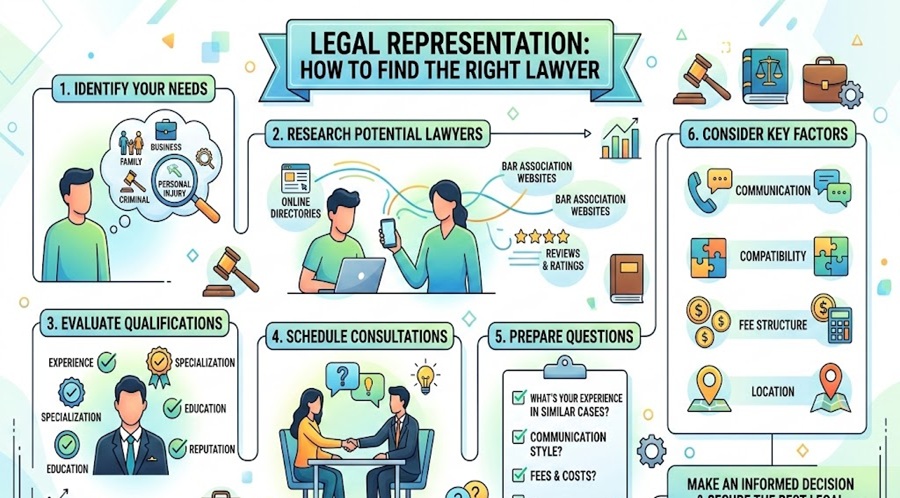
Finding the right lawyer can feel overwhelming, especially when you are already dealing with a stressful legal situation. However, selecting the appropriate legal representation is one of the most important decisions you will make. Here is a step-by-step guide:
6.1 Identify the Type of Legal Help You Need
The first step is understanding what kind of lawyer you need. Since lawyer is a general term for legal representation across many specializations, start by identifying the area of law your issue falls under — criminal, family, civil, business, immigration, real estate, etc. This narrows your search significantly.
6.2 Research and Gather Referrals
Ask trusted friends, family members, or colleagues for referrals. You can also use state bar association directories, legal aid organizations, online legal marketplaces, and lawyer review platforms to find qualified lawyers in your area. Look for lawyers with experience specifically in the type of legal representation you need.
6.3 Evaluate Experience and Track Record
When reviewing potential lawyers, consider their years of experience, areas of specialization, track record of outcomes in similar cases, and peer reputation. An experienced lawyer who has handled many cases like yours will likely provide more effective legal representation than a generalist.
6.4 Schedule Initial Consultations
Most lawyers offer free or low-cost initial consultations. Use this opportunity to discuss your situation, evaluate the lawyer’s communication style, assess their understanding of your case, and get a sense of whether you feel comfortable working with them. Comfort and trust are important in any legal representation relationship.
6.5 Understand Fee Structures
Lawyers charge fees in several ways, including hourly rates, flat fees for specific services, retainer agreements (an upfront fee against which hourly work is billed), and contingency fees (a percentage of the recovery, common in personal injury cases). Make sure you clearly understand how your lawyer charges before entering into a legal representation agreement.
6.6 Verify Credentials and Disciplinary History
Before hiring a lawyer, verify that they are licensed and in good standing with the state bar association. Most state bars have online directories where you can check a lawyer’s status and see if they have any disciplinary history. Working with a credentialed and ethical lawyer is fundamental to getting quality legal representation.
7. The Importance of Legal Representation in Different Life Situations
Legal issues can arise at virtually any stage of life. Understanding when and why you need a lawyer — as opposed to trying to handle matters on your own — can protect your rights, your assets, your freedom, and your future.
7.1 Criminal Cases
If you are facing criminal charges, having a qualified lawyer is not just advisable — it is your constitutional right in the United States (Sixth Amendment). Criminal defense legal representation can mean the difference between conviction and acquittal, or between a lengthy prison sentence and probation. Never attempt to navigate criminal proceedings without a lawyer.
7.2 Divorce and Family Matters
While uncontested divorces might seem simple, any divorce involving children, significant assets, or conflict requires legal representation. A family lawyer ensures that custody arrangements, property division, and support agreements are fair, legally binding, and in the best interests of all parties involved — especially children.
7.3 Starting or Running a Business
Entrepreneurs and business owners face numerous legal decisions: choosing the right business structure, drafting contracts, protecting intellectual property, hiring employees, and maintaining regulatory compliance. A business lawyer provides ongoing legal representation that protects the company from costly legal mistakes.
7.4 Buying or Selling Real Estate
Real estate transactions involve large sums of money and complex legal agreements. Legal representation during property transactions ensures that contracts are fair, titles are clear, and your interests are protected from the beginning of the deal to the closing.
7.5 Estate Planning
Planning for the future and ensuring your wishes are honored after death requires proper legal documentation. A lawyer specializing in estate planning ensures that your will, trust, and other documents are legally valid and structured to minimize taxes and legal disputes among heirs.
7.6 Workplace Disputes
If you face discrimination, harassment, wrongful termination, or wage theft at work, an employment lawyer provides the legal representation needed to assert your rights and seek appropriate remedies. Many employment disputes are resolved through negotiation, but having a lawyer significantly strengthens your position.
8. Legal Aid and Access to Justice
Not everyone can afford private legal representation, and this creates significant access-to-justice challenges. Fortunately, several resources exist to help individuals who cannot afford a lawyer:
- Legal Aid Organizations: Nonprofit organizations that provide free or low-cost legal representation to low-income individuals in civil matters.
- Public Defenders: Court-appointed lawyers who provide criminal defense legal representation to defendants who cannot afford a private lawyer.
- Law School Clinics: Many law schools operate clinics where supervised law students provide free legal services to the community.
- Pro Bono Services: Many private lawyers and law firms dedicate a portion of their time to providing free legal representation to those in need.
- Limited Scope Representation: Also known as “unbundled” legal services, this allows clients to hire a lawyer for specific tasks only, reducing overall costs.
- Online Legal Resources: While not a substitute for professional legal representation, legal websites and self-help portals can help people understand their rights and options.
Access to legal representation is fundamentally linked to justice. Societies that invest in making lawyers accessible to all citizens tend to have stronger rule of law, less inequality, and more effective legal systems.
9. The Digital Age and the Evolving Role of Lawyers
The legal profession, like every other field, has been significantly shaped by technology and digital transformation. The role of a lawyer as a general term for legal representation continues to evolve in exciting and sometimes challenging ways.
9.1 Legal Technology (LegalTech)
Legal technology tools — from AI-powered contract analysis software to document management platforms, e-discovery tools, and virtual law firms — are transforming how lawyers work. These tools allow lawyers to work more efficiently, reduce costs for clients, and provide better legal representation at scale.
9.2 Online Legal Services
Platforms that offer online legal assistance, document templates, and virtual consultations have made basic legal representation more accessible to individuals and small businesses. While these services are not a replacement for a qualified lawyer in complex matters, they fill an important gap in legal access.
9.3 Remote Legal Representation
Following the widespread adoption of video conferencing during the COVID-19 pandemic, many courts and legal proceedings have moved online. Remote legal representation is now common, allowing lawyers to serve clients across greater geographic areas and making legal help more accessible to people in rural or underserved regions.
9.4 Artificial Intelligence and the Future of Legal Work
Artificial intelligence is beginning to automate certain tasks traditionally performed by lawyers, such as legal research, contract review, and due diligence. However, the core functions of a lawyer — judgment, strategy, human empathy, advocacy, and ethical decision-making — remain uniquely human. The future of legal representation will likely involve lawyers working alongside AI tools rather than being replaced by them.
10. Ethical Obligations of Lawyers
Lawyers are bound by a comprehensive set of professional ethical rules that govern their conduct in providing legal representation. These rules are enforced by state bar associations and can result in disciplinary sanctions — including suspension or disbarment — for violations.
- Duty of Competence: Lawyers must provide competent, thorough, and diligent legal representation.
- Duty of Loyalty: Lawyers must act in the best interests of their clients and avoid conflicts of interest.
- Duty of Confidentiality: Lawyers must protect client secrets and not disclose privileged information.
- Duty of Candor: Lawyers must be honest with courts and tribunals; they cannot assist clients in presenting false evidence.
- Duty of Communication: Lawyers must keep clients informed and consult with them on major decisions.
- Duty to Avoid Improper Conduct: Lawyers must not engage in dishonest, fraudulent, or criminal behavior.
- Duty of Fairness: Lawyers must treat opposing parties and their counsel with basic professional courtesy.
These ethical obligations are what distinguish a qualified lawyer from an unlicensed person offering legal advice. When you hire a lawyer for legal representation, you are engaging someone who is accountable to these professional standards and can be disciplined for violating them.
11. Common Myths About Lawyers
Despite the prevalence of lawyers in society and popular culture, many misconceptions persist about the legal profession and what legal representation actually involves.
Myth 1: Lawyers Are Only Needed for Court Cases
Reality: The vast majority of a lawyer’s work happens outside the courtroom — in negotiations, document drafting, advisory sessions, and compliance work. Most legal disputes are resolved without going to trial.
Myth 2: Lawyers Are Too Expensive for Ordinary People
Reality: While some legal representation can be costly, many lawyers offer payment plans, sliding scale fees, free consultations, and pro bono services. Legal aid organizations and public defenders also provide free representation. The cost of not having a lawyer in a complex legal matter often far exceeds the cost of hiring one.
Myth 3: All Lawyers Are the Same
Reality: Lawyer is a general term for legal representation, but the profession is highly specialized. A corporate lawyer, a criminal defense lawyer, and a family lawyer all have vastly different skills and knowledge bases. Choosing the right type of lawyer for your specific situation matters enormously.
Myth 4: You Can Handle Legal Matters Yourself With Online Resources
Reality: While self-representation (known as pro se representation) is permitted in most courts, it carries significant risks, especially in complex matters. Legal procedures, deadlines, and rules of evidence are intricate. A mistake in a legal proceeding can have lasting consequences. Professional legal representation dramatically reduces this risk.
Myth 5: If You’re Innocent, You Don’t Need a Lawyer
Reality: Innocence alone does not guarantee a favorable legal outcome. Without proper legal representation, even innocent people can be convicted due to procedural errors, lack of knowledge about their rights, or inability to effectively challenge evidence. The legal system is complex, and navigating it without a lawyer is a serious risk.
Why Lawyers Matter
A lawyer — as the general term for legal representation — is one of the most important professionals you may ever need in your life. From protecting your freedom in criminal proceedings to safeguarding your assets in business deals, from navigating the emotional complexity of family law to ensuring your voice is heard in civil disputes, the value of professional legal representation cannot be overstated.
Understanding what a lawyer is, the many roles they fill, the specializations they offer, the ethical standards they uphold, and how to choose the right one empowers you to navigate the legal world with greater confidence. Whether you need a lawyer today or simply want to be prepared for the future, this knowledge is genuinely valuable.
The legal system exists to protect rights, resolve disputes, enforce agreements, and ensure justice. Lawyers are the professionals who make that system work — for individuals, for businesses, and for society as a whole. When in doubt, consult a lawyer. The investment in professional legal representation is almost always worth it.
Frequently Asked Questions (FAQ) About Lawyers and Legal Representation
Q1. What is the difference between a lawyer and an attorney?
In everyday usage, the terms “lawyer” and “attorney” are used interchangeably. Technically, a lawyer is anyone trained in law, while an attorney (short for attorney-at-law) is specifically someone who has passed the bar exam and is licensed to practice law. In the United States, all licensed legal representatives are both lawyers and attorneys.
Q2. Do I always need a lawyer, or can I represent myself?
You have the right to represent yourself (called pro se representation) in most legal proceedings. However, this is rarely advisable in complex matters. Legal procedures, deadlines, and rules of evidence can be extremely difficult to navigate without professional training. In criminal cases especially, self-representation carries substantial risks.
Q3. How do I know if a lawyer is qualified and trustworthy?
Verify that the lawyer is licensed and in good standing with the state bar association. You can typically check this through the bar association’s online directory. Look for reviews, ask for referrals, review their experience in cases similar to yours, and trust your instincts during the initial consultation.
Q4. What should I bring to my first meeting with a lawyer?
Bring any relevant documents related to your legal matter — contracts, court notices, correspondence, financial records, identification, and any evidence you have. Also prepare a timeline of events and a list of questions. The more information you provide, the more effective the legal representation can be from the start.
Q5. How much does a lawyer cost?
Legal fees vary widely depending on the type of case, the lawyer’s experience, and geographic location. Lawyers may charge hourly rates (commonly ranging from $100 to $500+ per hour), flat fees for specific services, retainer fees, or contingency fees (typically 25–40% of the recovery in personal injury cases). Always discuss fees openly and get a written fee agreement before proceeding.
Q6. What happens if I cannot afford a lawyer?
If you cannot afford a lawyer, you may qualify for free legal representation through legal aid organizations, public defender services (in criminal cases), law school clinics, or pro bono programs offered by private firms. Contact your local bar association for a referral to appropriate resources.
Q7. Can one lawyer represent both sides in a dispute?
No. Representing both parties in a disputed matter is an ethical violation known as a conflict of interest. Each party in a legal dispute should have their own lawyer to ensure independent and undivided legal representation. This is a fundamental rule of legal ethics.
Q8. What is attorney-client privilege and how does it protect me?
Attorney-client privilege is a legal protection that keeps communications between you and your lawyer confidential. Your lawyer cannot disclose what you share with them without your consent, with very limited exceptions (such as preventing imminent serious harm). This privilege is what allows you to speak openly and honestly with your legal representative.
Q9. Can a lawyer guarantee a specific outcome in my case?
No ethical lawyer will guarantee a specific outcome. Legal proceedings involve unpredictable variables, including judicial decisions, jury behavior, and opposing arguments. A good lawyer can assess the strengths and weaknesses of your case and give you a realistic assessment, but guarantees are unethical and unreliable.
Q10. How long does it take to resolve a legal matter?
The timeline varies enormously depending on the type of case, jurisdiction, complexity, and whether the matter goes to trial. Simple matters may be resolved in weeks; complex litigation can take years. Your lawyer should provide you with a realistic timeline estimate at the outset of your legal representation relationship.
1️⃣ American Bar Association (ABA)
Purpose: National organization of lawyers; provides lawyer referral services and legal resources.
🌐 Website:
https://www.americanbar.org
🔎 Find Legal Help Page:
https://www.americanbar.org/groups/legal_services/flh-home/
📞 Phone (Main Office):
+1-312-988-5000
2️⃣ Legal Services Corporation (LSC)
Purpose: Government-funded organization providing free civil legal aid to low-income Americans.
🌐 Website:
https://www.lsc.gov
🔎 Find Free Legal Aid Near You:
https://www.lsc.gov/about-lsc/what-legal-aid/get-legal-help
📞 Phone:
+1-202-295-1500
3️⃣ USA.gov
Purpose: Official U.S. government website with legal help directory.
🌐 Legal Help Section:
https://www.usa.gov/legal-aid
📞 Government Helpline:
1-844-872-4681
4️⃣ National Legal Aid & Defender Association (NLADA)
Purpose: Helps locate public defenders and civil legal aid providers.
🌐 Website:
https://www.nlada.org
📞 Phone:
+1-202-452-0620
5️⃣ National Association of Consumer Advocates (NACA)
Purpose: Find consumer protection lawyers (credit, debt collection, fraud cases).
🌐 Find a Lawyer Tool:
https://www.consumeradvocates.org/findanattorney
📞 Phone:
+1-202-452-1989
6️⃣ American Immigration Lawyers Association (AILA)
Purpose: Find verified immigration lawyers.
🌐 Lawyer Search:
https://www.aila.org
📞 Phone:
+1-202-507-7600
7️⃣ Emergency & Criminal Help (Public Defender Information)
If someone is arrested in the U.S., they can request a Public Defender in court if they cannot afford a private lawyer. This is a constitutional right under the Sixth Amendment.
For emergency situations:
🚨 Emergency (Police): 911
📞 Non-Emergency Police (varies by state)
For More infomation Visit Home Click Here
Disclaimer
This article is intended solely for general informational and educational purposes and does not constitute legal advice. The information provided here is not a substitute for professional legal representation or consultation with a qualified and licensed lawyer in your jurisdiction. Laws, regulations, and legal procedures vary significantly by location and can change over time. If you have a specific legal issue or question, you should consult a licensed lawyer who can provide advice tailored to your individual circumstances. Reading this article does not create an attorney-client relationship between the reader and the author or publisher.