
How to file Civil Suit for Recovery of Money
A Comprehensive Legal Guide Understanding Your Rights, Remedies, and the Road to Justice
Introduction
When someone owes you money and refuses to pay — whether it is a contractor who vanished after taking an advance, a business partner who failed to honor an agreement, a tenant who defaulted on rent, or a borrower who never returned a loan — the law gives you a powerful tool: a civil suit for the recovery of money. This legal remedy exists in virtually every modern legal system and allows individuals, businesses, and other entities to approach a court of law and demand what is rightfully theirs.
Unlike criminal proceedings, where the state prosecutes an accused for an offence against society, a civil money recovery suit is a private legal action. The goal is not punishment — it is compensation. The plaintiff, meaning the person or entity bringing the suit, seeks a court order directing the defendant to pay back the owed amount, along with any applicable interest and legal costs.
This article walks you through everything you need to know about civil suits for the recovery of money: what they are, when they apply, how to file one, what happens in court, what defences the other side might raise, and how a court judgment ultimately gets enforced. Whether you are a layperson trying to recover a personal loan or a business owner dealing with a defaulting client, this guide is designed to give you a clear and practical understanding of the entire process.
1. What Is a Civil Suit for Recovery of Money?
A civil suit for the recovery of money — sometimes called a money recovery suit or a suit for recovery of dues — is a legal proceeding filed before a civil court by a creditor (the plaintiff) against a debtor (the defendant) to recover money that is legally owed. The underlying claim may arise from various relationships and transactions, but the core of every such suit is the same: money was owed, money was not paid, and the court is being asked to compel payment.
This type of suit falls under civil law and is governed, depending on the jurisdiction, by codes such as the Code of Civil Procedure (in countries like India, Pakistan, and Bangladesh), the Civil Practice Law and Rules (in New York), or the Civil Procedure Rules (in England and Wales). Despite procedural variations across jurisdictions, the fundamental principles remain remarkably consistent worldwide.
The plaintiff must establish three core elements to succeed in a money recovery suit. First, there must be a legal obligation — the defendant must actually owe the money under a contract, promissory note, court order, statute, or some other recognized legal basis. Second, there must be a breach or default — the defendant must have failed to pay what was due. Third, the plaintiff must have suffered a quantifiable loss — the amount claimed must be specific and capable of being calculated with reasonable precision.
Common Causes of Action
A civil money recovery suit can arise from an enormous range of situations. Some of the most common include:
- Breach of contract — one party fails to pay for goods delivered or services rendered.
- Recovery of loans — money lent informally or formally that has not been repaid.
- Dishonoured cheques — in many jurisdictions, a bounced cheque gives rise to both criminal and civil remedies.
- Unpaid rent or security deposits — landlords recovering arrears or tenants seeking return of deposits.
- Recovery of salary or wages — employees claiming dues from employers.
- Fraudulent misrepresentation — money paid because of deceit or false promises.
- Unjust enrichment — the defendant retains a benefit at the plaintiff’s expense without any legal justification.
2. Legal Basis and Jurisdiction
Before filing a money recovery suit, it is essential to identify the correct court. Jurisdiction — the legal authority of a court to hear and decide a case — is determined by several factors, and filing in the wrong court can result in your case being dismissed or transferred, wasting valuable time and money.
Territorial Jurisdiction
Territorial jurisdiction refers to the geographic area within which a court has authority. Generally, a money recovery suit may be filed in the court that has jurisdiction over the place where the cause of action arose, or where the defendant resides or carries on business. In some jurisdictions, the plaintiff’s residence or the location of the contract’s performance may also determine jurisdiction.
For example, if a business in Mumbai supplied goods to a buyer in Delhi and payment was not made, the plaintiff might have the option to file either in Mumbai (where the transaction originated) or in Delhi (where the defendant operates). Courts carefully scrutinize this choice, and defendants may challenge jurisdiction as an early tactical move in litigation.
Pecuniary Jurisdiction
Pecuniary jurisdiction relates to the monetary value of the claim and determines which level of court is appropriate. Courts are typically organized in a hierarchy based on the value of disputes they are empowered to hear. Small claims courts or magistrate courts handle disputes up to a certain monetary ceiling — often a few thousand dollars, pounds, or rupees. District or sessions courts handle mid-range claims, while high courts or superior courts may hear higher-value disputes, especially when important legal questions are involved.
Filing in the wrong pecuniary jurisdiction is a common mistake. If you file a high-value claim in a small claims court, the court will lack the authority to grant full relief. Conversely, unnecessarily filing a small claim in a high court increases costs and formality without real benefit.
Limitation Period
Every civil suit is subject to a limitation period — a strict statutory deadline within which the lawsuit must be filed. Once this window closes, the claim becomes time-barred, and no court will entertain it regardless of its merits. In most common law jurisdictions, the limitation period for contract-based money recovery suits ranges from three to six years from the date the cause of action arose — typically the date of default or the last date of payment.
The clock starts ticking from the moment the debt became due and payable. For example, if a loan was to be repaid on a specific date and was not, the limitation period begins on that date. In some cases, the period may be extended — for instance, if the debtor made a partial payment or a written acknowledgment of the debt, many jurisdictions treat this as a fresh starting point for the limitation period.
3. Essential Documents and Evidence
The strength of a money recovery suit depends heavily on documentation. Courts cannot simply take a plaintiff’s word — they require evidence. Gathering and organizing your evidence before filing is one of the most important steps you can take.
Written Contracts and Agreements
A written and signed contract is the gold standard of evidence in a money recovery suit. It clearly sets out the parties’ obligations, the amount to be paid, the payment schedule, and any other terms. If you have a written contract — be it a formal agreement, a purchase order, a service agreement, or even a detailed email chain followed by a payment receipt — your case is significantly stronger. Courts treat written contracts as reliable evidence of the parties’ mutual intentions.
However, the absence of a written contract does not doom your case. Oral contracts are legally enforceable in most jurisdictions, though proving their existence and terms is considerably more difficult. Witness testimony, circumstantial evidence, partial performance (such as goods actually delivered), and conduct of the parties over time can all help establish an oral agreement.
Promissory Notes and Negotiable Instruments
A promissory note is a written promise by one person to pay a specified sum of money to another, either on demand or on a specified date. Promissory notes are negotiable instruments — they carry significant evidentiary weight and are treated almost like cash in a courtroom. If the defendant signed a promissory note, the plaintiff generally has a very strong case.
Similarly, cheques and bills of exchange serve as powerful evidence. A dishonoured cheque, for instance, is not merely a civil matter — in many jurisdictions, including India, it constitutes a criminal offence under statutes like Section 138 of the Negotiable Instruments Act. However, the civil remedy for cheque bounce remains available regardless of any criminal action.
Correspondence and Communication Records
In the digital age, email threads, WhatsApp messages, text messages, and other forms of electronic communication are routinely admitted as evidence in civil courts. Preserve all communication with the debtor — demands for payment, promises to pay, acknowledgments of the debt, and explanations for non-payment. This paper trail can be extremely persuasive, particularly when the defendant later claims no debt was owed.
It is also advisable to send a formal legal notice before filing the suit. This notice, usually drafted by an advocate, formally demands payment within a specified time (often 15 to 30 days) and puts the debtor on notice that legal proceedings will follow. Courts often look favorably on plaintiffs who made genuine efforts to settle the matter before approaching the court.
Bank Statements and Financial Records
Bank statements, account books, invoices, delivery challans, receipts, and ledger entries all serve as documentary evidence of the financial transactions involved. They can establish that money was transferred, goods were delivered, or services were rendered — and that the promised payment never arrived. If your claim involves a loan, bank transfer records showing the exact amount sent are particularly valuable.
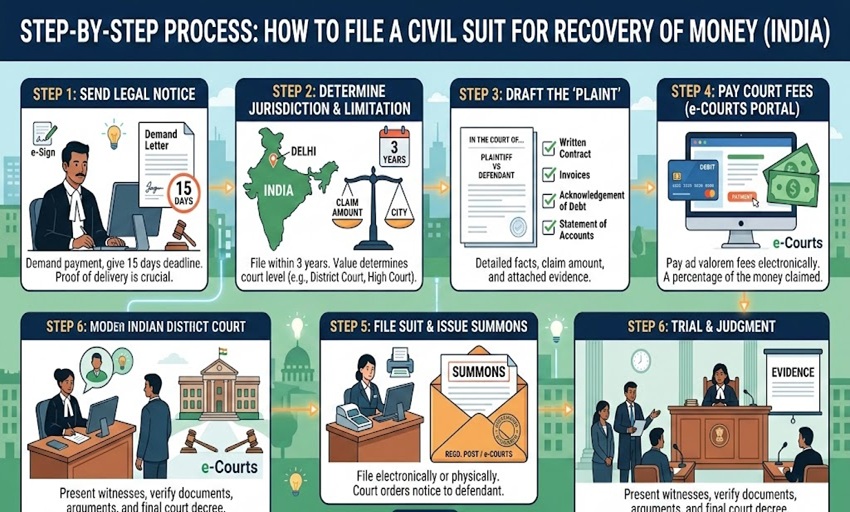
4. Filing the Suit: Step-by-Step Process
Filing a civil money recovery suit involves a structured series of steps. While the specifics vary by jurisdiction, the general process follows a consistent pattern.
Step 1: Consult a Lawyer
While it is technically possible to file a civil suit without legal representation — a practice called appearing ‘in propria persona’ or ‘pro se’ — it is strongly advisable to engage an experienced civil litigation attorney. A lawyer will assess the merits of your claim, advise on the appropriate court and jurisdiction, draft the plaint accurately, and represent you effectively throughout the proceedings.
Step 2: Draft the Plaint
The plaint is the formal written statement filed by the plaintiff to initiate the suit. It is the most important document in the case and must be prepared with care. A well-drafted plaint includes: the names and addresses of both parties, a clear statement of the facts giving rise to the claim, the legal basis of the claim, the specific amount being sought with a detailed breakdown, a statement about jurisdiction and limitation, and the relief requested from the court.
The plaint must be accompanied by a court fee, which is typically calculated as a percentage of the amount claimed. In most jurisdictions, the court fee is paid by affixing stamps or through online payment, and failure to pay the correct fee can result in rejection of the plaint.
Step 3: Filing and Registration
Once the plaint is prepared and the court fee is paid, it is filed at the appropriate court registry. The court assigns a case number and schedules a date for the first hearing. The defendant is then served with a copy of the plaint and a court summons, notifying them of the suit and requiring them to appear and file a written statement (their response) within a specified time.
Step 4: Written Statement by Defendant
The defendant has the opportunity to file a written statement — their formal response to the plaint. In this document, they may admit the debt (rare), deny the claim entirely, raise specific defences (such as the debt was already paid, the suit is time-barred, or the plaintiff has no legal standing), or even file a counterclaim if they believe the plaintiff actually owes them money.
Step 5: Framing of Issues
After the initial pleadings are filed, the court examines both the plaint and the written statement to identify the specific legal and factual questions in dispute. These are formally called ‘issues.’ For example, an issue might be: ‘Was there a valid and enforceable contract between the parties?’ or ‘Is the suit within the prescribed limitation period?’ The trial proceeds along these framed issues, with both parties presenting evidence relevant to each.
Step 6: Evidence and Trial
The trial stage is where both parties present their evidence. The plaintiff goes first, placing all documentary evidence on record and examining witnesses (including themselves). The defendant’s lawyer then cross-examines the plaintiff’s witnesses to challenge their credibility. The defendant then presents their own evidence and witnesses, who are in turn cross-examined by the plaintiff’s lawyer.
Documentary evidence — contracts, promissory notes, bank records, correspondence — is marked and formally exhibited. Witness testimony is recorded, often verbatim, and forms part of the permanent court record.
Step 7: Arguments and Judgment
Once all evidence is recorded, both sides make final legal arguments — citing relevant laws and case precedents to support their position. The judge then deliberates and delivers a judgment. If the plaintiff succeeds, the court passes a decree directing the defendant to pay the claimed amount, along with applicable interest and costs. If the plaintiff fails to establish their claim, the suit is dismissed.
5. Interest, Costs, and Ancillary Relief
A court decree in a money recovery suit typically encompasses more than just the principal amount. Courts have the power to award several additional components that can significantly increase the total recovery.
Pre-Suit and Pendente Lite Interest
Interest plays a major role in money recovery suits. Most jurisdictions allow the plaintiff to claim interest from the date the debt became due until the date of filing the suit (pre-suit interest) and from the date of filing until the date of judgment (pendente lite interest). The rate of interest may be specified in the contract, or the court may award it at a rate it considers reasonable — often anywhere from 6% to 18% per annum depending on the jurisdiction and the nature of the debt.
Additionally, courts may award post-decree interest, which accrues from the date of the judgment until the actual payment is made by the defendant. This continued interest acts as a pressure on the defendant to promptly satisfy the decree.
Costs of Litigation
Courts routinely award costs — the expenses of litigation — to the winning party. This can include court fees paid, lawyer’s fees (at least in part), and other legitimate litigation expenses. While cost awards rarely cover the full expense of litigation, they provide some reimbursement to the successful plaintiff. The quantum of costs awarded is at the discretion of the court.
Interim Relief and Attachment Before Judgment
One of the most powerful tools available in money recovery litigation is the ability to seek interim relief before the suit is finally decided. If a plaintiff can demonstrate that the defendant is attempting to dissipate or conceal assets to defeat a potential decree, they can apply for attachment before judgment. The court may then temporarily freeze or attach the defendant’s property or bank accounts, ensuring that assets remain available to satisfy the decree if the plaintiff succeeds.
This remedy is extraordinary and requires the plaintiff to make a strong preliminary showing. But when granted, it dramatically reduces the risk that a successful judgment will turn out to be unenforceable because the defendant has hidden or disposed of their assets.
6. Common Defences Raised by Defendants
Understanding the defences that defendants commonly raise helps plaintiffs prepare more effectively. A well-prepared plaintiff anticipates these arguments and gathers evidence to counter them.
Full or Partial Payment
The most common defence is that the debt was already paid — either in full or in part. Defendants will often produce receipts, bank statements, or witness testimony to substantiate this claim. Plaintiffs should maintain careful records of all payments received and clearly document any outstanding balances. Where partial payment was made, the plaintiff must clearly articulate how the remaining amount was calculated.
Limitation / Time Bar
If the plaintiff has waited too long to file the suit and the limitation period has expired, the defendant will raise a time-bar defence. Courts take limitation periods seriously — a claim that is even one day past the deadline can be dismissed. However, the defendant bears the burden of proving the limitation issue, and the plaintiff may counter by arguing that the limitation was extended by part-payment, acknowledgment of debt, or fraud by the defendant.
Absence of Valid Contract or Consideration
A defendant might argue that no enforceable contract ever existed — for example, that the agreement lacked consideration (something of value exchanged between the parties), was based on mutual mistake, or was illegal in its purpose. Without a valid contract, the contractual basis of the claim collapses, though the plaintiff may still be able to seek recovery on alternative grounds such as unjust enrichment.
Novation or Settlement
If the parties subsequently modified the original agreement or reached a settlement, the defendant may argue that the original debt was discharged by novation (replaced with a new agreement) or that a full and final settlement was already reached. Plaintiffs must be cautious about signing any document that could be interpreted as settling all claims, particularly ‘no dues’ certificates or final receipts.
Set-Off and Counterclaim
A defendant who believes the plaintiff owes them money can raise a set-off (deducting what the plaintiff owes from what the defendant owes) or file a counterclaim (an independent claim by the defendant against the plaintiff). This can complicate the litigation and potentially shift the financial result significantly.
7. Execution of a Money Decree
Winning the suit and obtaining a decree is not the end of the journey. If the defendant does not voluntarily comply with the court’s order, the plaintiff must take steps to enforce it — a process called execution.
Attachment and Sale of Property
The most common execution method is attaching (seizing) the defendant’s property and selling it to satisfy the decree. This can include immovable property (land and buildings), movable property (vehicles, machinery, goods), bank accounts, and shares or investments. The court appoints an officer or bailiff to carry out the attachment, and the attached property is sold at a public auction if the defendant still fails to pay.
Garnishee Proceedings
If the defendant is owed money by a third party — for example, if the defendant has a salary, a bank balance, or a receivable from another business — the decree-holder can apply for a garnishee order. This order directs the third party (the garnishee, such as the defendant’s employer or bank) to pay the amount directly to the decree-holder instead of to the defendant.
Arrest and Detention
In limited circumstances, courts may order the arrest and civil detention of a judgment debtor who willfully refuses to comply with a decree. This is not imprisonment for debt in the traditional sense — it is a coercive measure to compel payment. Courts exercise this power sparingly and typically only when there is clear evidence that the debtor has the means to pay but is deliberately evading the decree.
Receivership
In complex cases involving business disputes, courts may appoint a receiver to take over and manage the defendant’s business or assets, using the proceeds to satisfy the decree. This is an exceptional remedy reserved for situations where ordinary execution methods are inadequate.
8. Alternative Dispute Resolution
While a full civil trial is sometimes necessary, courts and legal practitioners increasingly encourage parties to explore alternative dispute resolution (ADR) mechanisms before or during litigation. These include mediation, arbitration, and conciliation.
Mediation involves a neutral third party helping the disputing parties negotiate a mutually acceptable settlement. It is non-binding — either party can walk away — but many disputes, including money recovery claims, settle successfully through mediation. It is faster, cheaper, and less adversarial than court proceedings.
Arbitration is a private adjudication process where parties agree to have their dispute decided by an arbitrator rather than a court. In commercial contracts, arbitration clauses are common. An arbitral award, once passed, has the same binding force as a court decree and can be enforced in court if the losing party refuses to comply.
Courts in many jurisdictions are empowered — and in some cases required — to refer parties to mediation before proceeding to trial. This shift toward ADR reflects a global recognition that litigation, with its associated cost, delay, and adversarial nature, is not always the best way to resolve money disputes.
9. Summary Suits and Expedited Procedures
Recognizing that some money recovery claims are straightforward and should not require prolonged litigation, many legal systems have created expedited procedures. In India, for instance, Order XXXVII of the Code of Civil Procedure provides for ‘summary suits’ in cases involving bills of exchange, hundis, promissory notes, and written contracts for the payment of money. In a summary suit, the defendant does not automatically get the right to defend — they must first seek leave (permission) from the court to file a defence, demonstrating that they have a genuine triable defence. This shifts the burden significantly and allows creditors to obtain decrees far more quickly in clear-cut cases.
Similarly, small claims courts in many Western jurisdictions are specifically designed to handle money disputes below a certain threshold quickly and inexpensively, often without the need for lawyers on either side. The procedural rules are relaxed, hearings are informal, and decisions are usually delivered on the same day. These courts have been highly effective at making civil justice accessible to ordinary people with relatively modest claims.
10. Practical Tips for Strengthening Your Claim
Beyond the legal technicalities, there are practical steps that any creditor can take to significantly strengthen their position in a money recovery suit.
- Document everything from day one. Before any business transaction or personal loan, insist on a written agreement. Even a simple one-page document signed by both parties is vastly better than a handshake deal.
- Act promptly. Do not wait years before taking action. Delay weakens evidence, allows assets to be dispersed, and may result in your claim becoming time-barred.
- Send a formal legal notice. A properly drafted legal notice signals seriousness, sometimes prompts voluntary payment, and demonstrates good faith to the court.
- Preserve all electronic evidence. Save all emails, text messages, and digital communications. Do not delete anything that might be relevant to the dispute.
- Choose the right forum. File in the correct court. An experienced attorney can help you identify whether a civil court, arbitration tribunal, or specialized court (such as a commercial court) is most appropriate.
- Consider the defendant’s ability to pay. A judgment is only valuable if it can be enforced. Before investing heavily in litigation, assess whether the defendant actually has assets from which recovery can be made.
- Stay organized and cooperative. Courts expect parties to follow procedural rules and meet deadlines. A plaintiff who is disorganized or fails to cooperate with the judicial process can inadvertently weaken their own case.
11. Cross-Border Money Recovery
In today’s globalized economy, money disputes increasingly involve parties in different countries. Cross-border money recovery adds layers of complexity involving private international law, foreign judgments, and international treaties.
If you obtain a decree against a foreign defendant, enforcing it abroad typically requires the courts of the defendant’s country to recognize your judgment — a process governed by bilateral treaties, principles of reciprocity, or domestic foreign judgment enforcement statutes. Countries that are parties to the New York Convention on the Recognition and Enforcement of Foreign Arbitral Awards have a relatively smoother path for enforcing arbitral awards across borders, which is one reason arbitration is often preferred in international commercial contracts.
For intra-regional disputes, mechanisms like the EU’s European Payment Order Procedure allow creditors to recover uncontested money claims across EU member states with relative ease. Similarly, international commercial courts in jurisdictions like the Dubai International Financial Centre (DIFC), Singapore, and London have been specifically established to handle sophisticated cross-border money disputes efficiently.
In view of the above final conclusion.
A civil suit for recovery of money is one of the most fundamental tools that a legal system provides to protect economic relationships and ensure that obligations are honoured. It represents the rule of law in its most direct commercial form — the state stepping in to enforce private rights and restore financial equilibrium where one party has failed in their duties.
The process is not simple. It demands patience, organization, careful documentation, and often a significant investment of time and resources. But for those who approach it with clear facts, solid evidence, and competent legal guidance, it is a reliable path to justice. Courts take these matters seriously, and plaintiffs who prepare thoroughly and proceed in good faith stand a strong chance of obtaining not just a decree, but actual recovery.
Whether your dispute involves a small personal loan or a multimillion-dollar commercial contract, the principles discussed in this article apply. Know your rights, understand the process, gather your evidence, and never let the fear of court proceedings deter you from pursuing what is legitimately yours. The law is on the side of those who are owed what they were promised.
Official Legal Aid Resources by Country
| Country | Resource | Website | Helpline Number | Details |
|---|---|---|---|---|
| INDIA | National Legal Services Authority (NALSA) | nalsa.gov.in | 15100 (Toll-Free) | 24/7 helpline in 10 languages; free legal aid for civil suits including money recovery |
| INDIA | NALSA Email | nalsa.gov.in | nalsa-dla@nic.in | For online applications and legal assistance |
| INDIA | District Legal Services Authority (DLSA) | Via NALSA Portal | Through 15100 | Local legal aid at district court level |
| USA | Legal Services Corporation (LSC) | lsc.gov | (202) 295-1500 | Federal funder of legal aid; find local providers by zip code |
| USA | LawHelp.org | lawhelp.org | Varies by state | State-by-state legal aid directory for low-income individuals |
| USA | American Bar Association Free Legal Answers | abafreelegalanswers.org | Online only | Free Q&A for civil legal issues (no criminal) |
| USA | New York City Small Claims Help | legalaidnyc.org | 888-663-6880 | Legal Aid Society Consumer Law Project (Mon-Fri 10am-3pm) |
| USA | Small Claims Court Action Center (NY) | nypirg.org | 800-566-5020 | Free advice hotline for small claims |
| USA | North Carolina Legal Aid | legalaidnc.org | 866-219-5262 | Helpline for small claims and civil matters |
| USA | Texas Legal Aid Line | texaslawhelp.org | 888-529-5277 | Legal Aid of NorthWest Texas intake line |
| USA | Maryland Courts Self-Help Center | mdcourts.gov | 410-260-1392 | Free civil legal help by phone/chat (Mon-Fri 8:30am-8pm) |
| CANADA | Legal Aid Ontario | legalaid.on.ca | 1-800-668-8258 / 416-979-1446 | Toll-free; Mon-Fri 8am-5pm; civil law assistance |
| CANADA | Pro Bono Ontario | probonoontario.org | 1-855-255-7256 | Free legal advice hotline; Mon-Fri 9am-5pm; civil matters only |
| CANADA | British Columbia Legal Aid | legalaid.bc.ca | 604-408-2172 / 1-866-577-2525 | Greater Vancouver and rest of BC; Mon-Fri 9am-3:30pm |
| CANADA | Access Pro Bono BC | accessprobono.ca | 604-878-7400 / 1-877-762-6664 | Lawyer referral and free clinics |
| CANADA | Alberta Legal Aid | legalaid.ab.ca | 1-866-845-3425 | Provincial legal aid services |
| CANADA | Quebec Legal Aid | aidelaleale.ca | 1-800-842-2213 | Commission des services juridiques |
Key Points for Money Recovery Suits
India
-
Eligibility: Free legal aid available if annual income below ₹1,00,000 or belonging to SC/ST/women/children/disabled categories
-
Process: Call 15100 or apply online at nalsa.gov.in for assignment of panel advocate
-
Pre-Suit Requirement: Legal notice mandatory before filing money recovery suit
USA
-
Small Claims Court: Most money recovery suits under $10,000 handled here; no lawyer required in most states
-
State Variations: Each state has different monetary limits and procedures; use LawHelp.org to find state-specific resources
-
Self-Representation: Many courts offer self-help centers with free forms and guidance
Canada
-
Provincial System: Legal aid is province-specific; Ontario and BC have comprehensive services
-
Civil Coverage: Legal Aid Ontario covers some civil matters; Pro Bono Ontario specifically handles civil cases including debt recovery
-
Lawyer Referral: Most provinces offer 30-minute free consultation through lawyer referral services
Important Notes
-
Limitation Periods:
-
India: 3 years from date of default
-
USA: Varies by state (typically 3-6 years)
-
Canada: Varies by province (typically 2-6 years)
-
-
Court Fees: All three countries offer fee waivers for low-income litigants; apply for “in forma pauperis” status (USA) or “indigent” status (India/Canada)
-
Alternative Dispute Resolution: All three jurisdictions encourage mediation before trial; often mandatory in small claims courts
For More Information Visit Home Click Here
Disclaimer:
This article is published only for educational and informational purposes. The information provided herein should not be considered as legal advice. Readers are advised to consult a qualified professional or expert before taking any action based on the content of this article.
— End of Article —
This article is intended for informational purposes only and does not constitute legal advice. For specific legal matters, consult a qualified attorney.