
Punjab and Haryana High Court
Complete Guide Procedures, Documentation, and Digital Transformation
Introduction and Historical Overview
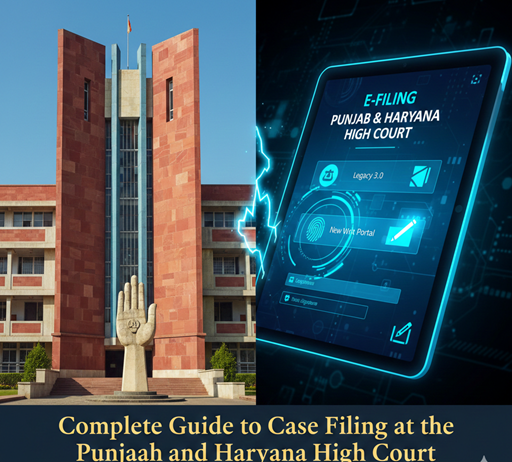
The Punjab and Haryana High Court stands as one of India’s most architecturally magnificent judicial institutions, serving as the common High Court for the states of Punjab and Haryana and the Union Territory of Chandigarh. Located in Sector-1, Chandigarh, this historic court was originally established as the Lahore High Court on 21 March 1919, with jurisdiction covering undivided Punjab and Delhi. Following India’s independence and partition in 1947, the court was relocated to Shimla temporarily before finding its permanent home in Chandigarh on 17 January 1955. The current building, known as the Palace of Justice, was designed by the legendary French architect Le Corbusier and was inscribed as a UNESCO World Heritage Site in July 2016, making it a significant landmark for both legal professionals and architecture enthusiasts.
The jurisdiction of this High Court extends across the territories of Punjab, Haryana, and Chandigarh, handling matters ranging from constitutional issues, civil disputes, criminal appeals, to writ petitions under Articles 226 and 227 of the Constitution. With a sanctioned strength of 85 judges comprising 64 permanent judges and 21 additional judges, the court manages an extensive caseload while continuously modernizing its processes through digital initiatives.
Understanding the E-Filing Revolution
The Punjab and Haryana High Court has embraced digital transformation through comprehensive e-filing systems that have revolutionized how legal practitioners and litigants interact with the judicial process. The court currently operates two parallel e-filing portals: the legacy E-Filing 3.0 system for general matters and a new specialized portal specifically designed for writ petitions. This dual-system approach ensures that while routine matters continue through established channels, high-volume categories like writ petitions benefit from enhanced, specialized processing capabilities.
The transition to mandatory e-filing represents a significant shift in judicial administration. As per the latest guidelines issued in January 2025, mandatory e-filing has been relaxed and made optional until 10 March 2025 for most categories, though it remains compulsory for existing specified categories. Notably, for writ petitions concerning land laws before single benches, hard copies have been completely dispensed with when filed through the new e-filing software effective from 7 January 2025. This paperless initiative marks a substantial step toward environmental sustainability and operational efficiency.
Detailed Registration Process for Advocates
Prerequisites for Registration
Before initiating the registration process on the e-filing portal, advocates must ensure they have several essential documents and details readily available. The registration process is time-bound and must be completed within 18 minutes, making preparation crucial. Required materials include a functional mobile number and email address registered with the court database, Bar Council enrollment number, a digital photograph in JPEG format between 5KB and 5MB, and identity proof such as PAN card, Aadhar card, voter card, driving license, or Bar Registration certificate in similar digital format.
Step-by-Step Registration Procedure
The registration process begins by visiting the official e-filing portal at https://efiling-phc.ecourts.gov.in/. Upon accessing the portal, advocates must select the registration option and choose the “Advocate” category from the available options. The registration form requires comprehensive personal and professional details including name, contact information, Bar Council enrollment number, and permanent address.
The verification process involves receiving One-Time Passwords (OTPs) on both registered mobile number and email address. In some instances, a single OTP may be received on the mobile number alone, which should be entered in the designated field. Following successful OTP verification, advocates must create a secure password containing minimum eight characters including one uppercase letter, one lowercase letter, one number, and one special character.
The next phase involves uploading the digital photograph and identity proof, ensuring both files meet the specified size and format requirements. For advocates without digital copies, smartphone photographs or scanned images using any scanning application are acceptable, provided they meet the technical specifications. Finally, entering the captcha code and clicking the register button completes the process, generating a “Registered successfully” confirmation message.
Profile Management and Dashboard Navigation
Upon successful registration, advocates gain access to a comprehensive dashboard that serves as the central command center for all e-filing activities. The dashboard provides real-time tracking capabilities under two primary heads: “My e-filing status” and “My e-filed cases.” The e-filing status section displays cases pending for acceptance, cases not accepted, cases with deficit court fees, cases pending for scrutiny, and defective cases requiring rectification.
A particularly valuable feature is the Draft section, where advocates can store incomplete filings ready for final submission. This functionality enables preparation of multiple cases simultaneously without immediate submission pressure. The dashboard also facilitates generation of party details through the case parties option, streamlining the process of managing complex litigation with multiple parties.
Comprehensive Case Filing Procedures
Initiating a New Case Filing
The actual case filing process begins by logging into the e-filing portal using the registered username and password, followed by captcha verification. Once authenticated, the advocate accesses the filing interface where various case categories are displayed. Selection of the appropriate case type triggers a detailed form requiring comprehensive information about the parties, subject matter, relief sought, and procedural history.
For writ petitions, which constitute a significant portion of the High Court’s jurisdiction, the new specialized portal offers enhanced features. These petitions challenging administrative actions, seeking enforcement of fundamental rights, or requesting prerogative writs require meticulous documentation including certified copies of impugned orders, supporting affidavits, and detailed grounds. The portal guides users through category-specific requirements, ensuring all mandatory documents are uploaded before submission.
Document Preparation and Technical Specifications
All pleadings must conform to the Rules and Orders of the Punjab and Haryana High Court and instructions issued periodically. Documents must be converted to PDF format, preferably with Optical Character Recognition (OCR) capability to enable text searching. For files exceeding prescribed size limits, advocates must visit designated e-Sewa Kendras or e-Filing Help Desks where intranet facilities enable large file submissions.
The court mandates specific formatting standards including proper bookmarking for lengthy documents, sequential page numbering, and clear indexing. Digital signatures must be appended to all filings, with the system accommodating both single and multiple digital signatures where required. The portal provides comprehensive help videos demonstrating conversion procedures, signature appending techniques, and bookmarking methodologies.
Physical Document Submission Requirements
While e-filing has significantly reduced physical documentation, certain categories still require hard copy submission. For writ petitions approved and registered through the e-filing portal, original signed Vakalatnama or Power of Attorney, Special Power of Attorney or General Power of Attorney where applicable, Resolution or Authorization Letters, certified copies of orders, and affidavits must be submitted along with the e-filing acknowledgement slip at the DRR Section filing counter between 10:00 AM and 4:00 PM. These documents are retained as “Part B” of the case file.
Cases re-filed through e-filing after initial objections are scrutinized in subsequent slots, with priority given to fresh filings of the day. Importantly, no printouts or original documents are accepted for cases pending scrutiny or lying in objection, emphasizing the court’s commitment to paperless processing.
Advocate Enrollment and Professional Registration
Bar Council Enrollment Process
Before practicing in the Punjab and Haryana High Court, law graduates must enroll with the Bar Council of Punjab and Haryana, located at Law Bhawan, Sector 37-A, Chandigarh. The enrollment process requires submission of Form No. 1-B prescribed under Section 25 of the Advocates Act, 1961, along with extensive supporting documentation.
Required documents include the original provisional LL.B certificate and two self-attested photocopies (or two self-attested photocopies of the original LL.B degree if already issued), original attendance certificate demonstrating minimum 70% attendance in each year of the LL.B course, self-attested photocopies of all Detailed Marks Cards (DMCs) for both LL.B and graduation courses, matriculation certificate with date of birth, 10+2 certificate with percentage calculation, and graduation degree with percentage.
Additional requirements encompass affidavits regarding law degree authenticity, stamp duty compliance, and All India Bar Examination (AIBE) clearance undertaking, self-attested residence proof of Punjab, Haryana, or Chandigarh, reserve category certificate if applicable, service certificate for government employees, and gap affidavits if applicable. Three stamp-size photographs are required, with two affixed to the form and one attached separately.
Enrollment Fees and Payment Procedures
The enrollment fee structure comprises Rs. 600 for general category candidates and Rs. 100 for Scheduled Caste/Scheduled Tribe candidates payable to the Bar Council of Punjab and Haryana, plus Rs. 150 for general category and Rs. 25 for SC/ST candidates payable to the Bar Council of India. Payment is accepted exclusively through QR code or bank drafts payable at Chandigarh, with cash transactions strictly prohibited. QR code payments must be made on the submission day from the applicant’s own account, with UPI/UTR details recorded in the application form.
Certificate of Practice and Professional Standing
Following enrollment and successful AIBE clearance, advocates must obtain a Certificate of Practice from the Bar Council. This requires submission of Form-A along with proof of practice, including certified copies of at least five Vakalatnamas or other documents establishing active practice for the preceding five years. For advocates associated with registered law firms or engaged in conveyancing practice, additional documentation including firm certificates or conveyancing documents for the last three years is required.
The Certificate of Practice enables voting rights in Bar Council elections and establishes professional standing for appearance before the High Court and subordinate courts. Annual renewal and compliance with continuing legal education requirements maintain this professional authorization.
Detailed Fee Structure and Financial Requirements
Court Fees for Various Categories
The Punjab and Haryana High Court maintains a comprehensive fee structure governed by the Court Fees Act, 1870, and state-specific amendments. For civil suits, the fee varies based on jurisdiction value: suits up to Rs. 200 jurisdiction attract Rs. 25 court fee, while those up to Rs. 400 jurisdiction require Rs. 55. Rent petitions command Rs. 15, miscellaneous applications Rs. 10, and execution proceedings Rs. 10.
Arbitration matters under Section 34 of the Arbitration and Conciliation Act require Rs. 300, while Section 9 applications need Rs. 150. Cases under the Guardian and Wards Act, Indian Succession Act, and transfer applications each attract Rs. 10. Hindu Marriage Act proceedings require Rs. 25, and motor accident claim petitions Rs. 10.
Criminal proceedings maintain uniform fees: bail applications, criminal miscellaneous applications, maintenance proceedings under Section 125 Cr.P.C., criminal revisions, and criminal appeals each require Rs. 10 court fee. Civil appeals follow the fee structure mentioned in the decree sheet, while civil miscellaneous appeals and rent appeals require Rs. 10 and Rs. 15 respectively.
Process Fees and Service Charges
Process fees for service of summons and execution of processes follow a structured table based on the value of the subject matter. For amounts up to Rs. 100, the process fee is Rs. 1, escalating progressively to Rs. 75 for amounts between Rs. 990-1,000. Higher value brackets follow incremental increases, reaching Rs. 1,925 for amounts between Rs. 1,95,000-2,00,000, with continued progression for higher values.
The High Court has transitioned to uniform process fee rates through stamp payments, eliminating distance-based variations that previously created inequities. This standardization ensures equal contribution from all litigants toward process service infrastructure regardless of geographical distances involved.
Certified Copy Fees
Certified copies of judgments, orders, or awards attract court fees of Rs. 10 per copy. Orders passed by Rent Controllers require Rs. 20. These fees are subject to periodic revision, with the latest instructions regarding court fees and certified copy filing available through the High Court’s official forms portal.
Litigant Categories and Filing Eligibility
Advocate-Led Filing
Registered advocates constitute the primary filing category, authorized to represent clients across all jurisdictions and case types. Advocate filing requires valid enrollment with the Bar Council of Punjab and Haryana, active Certificate of Practice, and registration on the e-filing portal. Advocates assume responsibility for accuracy of pleadings, proper documentation, and compliance with procedural timelines.
Party-in-Person Filing
Litigants may file cases personally without advocate representation, though this requires separate registration on the e-filing portal as “Party in-person.” Such litigants must submit self-attested identity documents and an affidavit undertaking that they have not engaged an advocate. Should they subsequently retain legal representation, an application must be made to the Administrator for data transfer to the advocate’s account, after which the litigant cannot modify case data without administrative permission.
Special Categories and Priority Processing
The High Court provides priority listing facilities for specific vulnerable categories including senior citizens, NRIs, widows, ex-servicemen, and HIV-positive parties. These categories require submission of specified proformas available on the court’s forms portal, enabling expedited hearing scheduling subject to verification of eligibility criteria.
Essential Forms and Documentation
Primary Filing Forms
The High Court provides comprehensive form repositories accessible through its official website. Key forms include the Process Fee Form for initiating service of processes, Vakalatnama format for advocate appointment, opening sheets for civil appeals and revisions, and inspection slips for record examination. These forms are available in downloadable PDF format with detailed instructions for completion.
Certified Copy Application Procedures
Applications for certified copies can be submitted online through the dedicated e-Copy portal or through traditional paper applications. The online system requires registration with personal details and mobile verification, enabling tracking of application status and digital delivery where applicable. For urgent requirements, the court provides expedited processing subject to additional fees and demonstrated urgency.
Procedural Forms and Performas
Additional essential documentation includes adjournment slips for seeking hearing postponements, urgent application forms for priority processing, and various opening sheets specific to case categories (criminal revisions, criminal appeals). The court also provides specialized forms for government and institutional litigants, ensuring standardized presentation of official matters.
Technical Support and Helpline Infrastructure
E-Filing Support Services
The High Court maintains dedicated helpline number 0172-2718217 for e-filing assistance, operational during court working hours. Physical support is available at the e-Sewa Kendra/e-Filing Help Desk located near the E-Pass Counter and opposite the Multilevel Parking within the court complex. This facility provides hands-on assistance for portal navigation, document upload, and technical troubleshooting.
General Court Contact Information
The main reception and general inquiries can be reached at 0172-2740071. The court complex is located at Sector-1, Chandigarh, with the postal address being High Court of Punjab and Haryana, Chandigarh. Email communications for general feedback should be directed to highcourtchd@indianjudiciary.gov.in, while complaints and vigilance matters are addressed to reg.vig-phc@indianjudiciary.gov.in.
Mediation and Alternative Dispute Resolution
The Mediation and Conciliation Centre, located within the High Court premises, can be contacted at 0172-2718317 and 0172-2718203 for matters suitable for alternative dispute resolution. This facility offers specialized forms and procedures for mediation initiation, complementing the traditional litigation process.
Educational Resources and Training Materials
Video Tutorials and Help Guides
The High Court provides comprehensive video tutorials in multiple languages including English, Hindi, and Punjabi, demonstrating e-filing procedures, case status checking, and video conferencing participation. These resources are accessible through the “Help Videos” section of the official website, offering step-by-step visual guidance for all portal functionalities.
Specific video content includes e-filing help videos in Punjabi, procedures for accessing case information, steps for joining video conferencing hearings, and documentary presentations on the paperless court initiative. These resources prove invaluable for new practitioners and litigants unfamiliar with digital platforms.
User Manuals and Written Guides
Detailed user manuals supplement video content, providing written instructions for portal navigation, document preparation standards, and troubleshooting common technical issues. The e-Filing User Manual specifically addresses advocate registration, case initiation, document upload protocols, and post-filing procedures including scrutiny responses and defect rectification.
Important Links and Digital Resources
Official Portals and Access Points
| Resource Category | Description | Access Link |
|---|---|---|
| Main Website | Official High Court portal | https://highcourtchd.gov.in |
| Case Status System | Real-time case tracking | https://phhc.gov.in |
| E-Filing Portal 3.0 | Legacy filing system | https://efiling-phc.ecourts.gov.in |
| New E-Filing Portal | Writ petition specialized portal | Accessible through main website |
| Video Conferencing | VC hearing participation | Available through case status system |
| Certified Copy Application | Online copy requests | https://phhc.gov.in/E_COPY/user_register.php |
| RTI Application | Right to Information requests | https://phhc.gov.in/E_RTI/user_register.php |
| Forms and Performas | Downloadable documentation | https://highcourtchd.gov.in/?mod=form_performas |
| Court Fee Information | Fee structure details | https://highcourtchd.gov.in/index.php/sub_pages/left_menu/Court%20Fees/ |
| Help Videos | Tutorial content | https://highcourtchd.gov.in/?mod=help_video |
External National Resources
| Resource | Purpose | Link |
|---|---|---|
| National e-Filing Portal | Centralized filing system | https://efiling.ecourts.gov.in |
| eCourts Help Videos | National judicial tutorials | https://ecourts.gov.in/ecourts_home/static/helpvideos.php |
| Process Fee Form | Standardized fee documentation | https://ecourts.gov.in/ecourts_home/forms/Process%20fee%20form.pdf |
| Vakalatnama Form | Advocate appointment format | https://ecourts.gov.in/ecourts_home/forms/Vakalatnama%20form.pdf |
Best Practices and Professional Recommendations
Pre-Filing Preparation
Successful filing requires meticulous preparation including thorough review of impugned orders for appeals, comprehensive drafting of grounds, accurate valuation for fee calculation, and verification of all party details. Advocates should utilize the draft storage facility for complex matters, enabling multiple review cycles before final submission.
Post-Filing Compliance
Following e-filing submission, regular dashboard monitoring ensures prompt response to scrutiny objections and deficiency notices. The court’s guideline specifying that re-filed cases after objection are scrutinized in subsequent slots underscores the importance of first-attempt accuracy. Physical document submission for applicable categories must occur within prescribed timelines to prevent listing delays.
Continuous Professional Development
Given the rapid evolution of e-filing systems and procedural amendments, regular consultation of official notifications and guideline updates is essential. Participation in court-organized training sessions, review of updated help videos, and engagement with peer learning networks facilitate adaptation to technological and procedural changes.
IN VIEW OF THE ABOVE INFORMATION FINAL CONCLUSION
The Punjab and Haryana High Court has successfully transitioned into a modern, digitally-enabled judicial institution while preserving its architectural heritage and judicial traditions. The comprehensive e-filing infrastructure, combined with robust support systems and clear procedural guidelines, enables efficient case management for legal practitioners and litigants alike. Understanding and utilizing these systems effectively requires initial investment in learning and preparation, but yields significant dividends in terms of time efficiency, cost reduction, and enhanced access to justice.
As the court continues refining its digital processes, stakeholders must remain adaptable and proactive in embracing new technologies. The commitment to paperless operations, evidenced by mandatory e-filing expansions and hard copy dispensation for major categories, signals a definitive shift toward sustainable, accessible, and efficient judicial administration. Success in this environment demands not only legal acumen but also technological proficiency and diligent attention to procedural compliance.
For More Update Visit Home Click Here
Disclaimer
This guide is prepared for informational purposes based on publicly available information and official court guidelines. Judicial procedures and fee structures are subject to periodic amendment. Users are advised to verify current requirements through official High Court channels before initiating legal proceedings. This content does not constitute legal advice, and specific legal matters should be addressed through consultation with qualified legal professionals.