
Original Jurisdiction of the Supreme Court
A Comprehensive Guide to Direct Access Litigation
Understanding the Foundation: What Original Jurisdiction Truly Means
When most Americans envision the Supreme Court, they picture nine justices reviewing appeals from lower federal courts or state supreme courts. Yet few realize that the Constitution establishes a unique pathway allowing certain disputes to bypass the entire appellate system entirely. This pathway—original jurisdiction—transforms the nation’s highest tribunal into something it rarely becomes: a trial court.
Article III, Section 2 of the United States Constitution explicitly designates specific categories of disputes that may commence directly before the Supreme Court. Unlike the Court’s appellate jurisdiction, which Congress can modify through legislation, original jurisdiction represents a constitutional mandate that remains largely beyond congressional control. This distinction matters profoundly for understanding the separation of powers and the special status accorded to particular types of legal controversies.
The concept of original jurisdiction reflects the Framers’ recognition that certain disputes possess such significance or involve such parties that they deserve immediate attention from the most authoritative judicial body in the land. When the Supreme Court exercises original jurisdiction, it functions differently than its typical role. The justices become triers of fact, witnesses testify before them, evidence is presented in traditional courtroom fashion, and special masters often handle preliminary proceedings.
The Constitutional Framework: Text, History, and Interpretation
The constitutional provision establishing original jurisdiction reads: “In all Cases affecting Ambassadors, other public Ministers and Consuls, and those in which a State shall be a Party, the supreme Court shall have original Jurisdiction.” This seemingly straightforward language has generated centuries of interpretation, refinement, and occasional controversy.
The Framers drew upon diverse influences when crafting this provision. The Articles of Confederation had created significant problems by lacking any effective mechanism for resolving interstate disputes. States engaged in bitter territorial conflicts, trade wars, and boundary disputes without any authoritative arbiter. The Constitutional Convention specifically addressed this deficiency by ensuring that the new federal government could peacefully resolve conflicts between sovereign states.
Alexander Hamilton defended this arrangement in Federalist No. 80, arguing that the peace of the Union required a neutral forum for state-versus-state controversies. He recognized that without such a mechanism, states might resort to force or endless diplomatic wrangling. The inclusion of cases involving foreign diplomats reflected practical necessities of international relations, ensuring that matters affecting diplomatic immunity and foreign sovereignty received appropriate judicial attention.
Early constitutional interpretation, particularly during the Marshall Court era, established important precedents regarding the scope and nature of original jurisdiction. Chief Justice John Marshall’s opinion in Marbury v. Madison (1803), while primarily addressing judicial review, also clarified that Congress could not expand the Supreme Court’s original jurisdiction beyond constitutional limits. This holding reinforced the special constitutional status of these direct-access cases.
Category One: Interstate Disputes and Sovereign Conflict Resolution
The Nature of State-versus-State Litigation
Disputes between states constitute the most frequent and substantively significant category of original jurisdiction cases. These controversies implicate fundamental questions of federalism, sovereignty, and the peaceful resolution of conflicts between semi-autonomous governmental entities. When states sue each other, they invoke the Supreme Court’s authority as the ultimate arbiter of intergovernmental boundaries—both geographical and jurisdictional.
Boundary disputes historically dominated this category. As the nation expanded westward, imprecise colonial charters, conflicting land grants, and ambiguous natural boundaries generated countless controversies. The Supreme Court resolved disputes between Virginia and Tennessee over their shared border, between Georgia and South Carolina regarding the Savannah River boundary, and between numerous western states concerning their precise territorial limits. These cases required extensive historical research, surveyor testimony, and interpretation of colonial-era documents.
Water rights disputes have emerged as particularly contentious in recent decades. States sharing major river systems—the Colorado, the Rio Grande, the Missouri, the Columbia—have repeatedly clashed over allocation of increasingly scarce water resources. These cases involve complex hydrological evidence, competing claims based on prior appropriation versus riparian rights doctrines, and delicate balancing of economic development against environmental preservation. The Supreme Court’s role in apportioning interstate waters has become crucial for western state survival and growth.
Modern Interstate Controversies
Contemporary interstate litigation extends far beyond traditional boundary and water disputes. States have sued each other over environmental pollution crossing state lines, with downwind or downstream states seeking relief from upwind or upstream pollution sources. These cases raise challenging questions about extraterritorial regulation, scientific causation, and the appropriate balance between state autonomy and interstate responsibility.
Taxation disputes have also generated original jurisdiction litigation. When one state taxes income earned in another, or asserts jurisdiction over businesses operating across state lines, affected states may challenge these assertions directly before the Supreme Court. These cases implicate the dormant Commerce Clause, due process limitations on state taxing authority, and the fundamental principle that states should not unduly burden interstate commerce.
Criminal jurisdiction occasionally produces interstate conflicts. When crimes occur near state boundaries, or when criminal activity spans multiple states, questions arise regarding which state may prosecute, extradition obligations, and the allocation of enforcement resources. While many such disputes are resolved through interstate compacts or federal intervention, some require judicial resolution through original jurisdiction proceedings.
Procedural Complexities in Interstate Cases
Interstate original jurisdiction cases follow distinctive procedures reflecting their unique status. The state initiates the action by filing a complaint directly with the Supreme Court, rather than commencing in a lower court. The defendant state must respond, and the Court determines whether to permit the filing—exercising substantial discretion in accepting or declining these cases.
Given the complexity of factual disputes between states, the Supreme Court routinely appoints special masters to handle evidentiary proceedings. These masters—typically experienced federal judges or legal scholars—conduct hearings, receive evidence, and prepare detailed reports recommending findings of fact and conclusions of law. The Supreme Court then reviews these recommendations, accepting or modifying them as appropriate.
This special master system serves crucial functions. It allows for efficient handling of voluminous evidence without requiring the justices to preside over lengthy trials. It brings specialized expertise to complex technical questions, particularly regarding boundary surveys or water engineering. And it provides a mechanism for thorough factual development while preserving the Supreme Court’s ultimate decision-making authority.
Category Two: Diplomatic and Foreign Sovereign Immunity Cases
The Special Status of Foreign Diplomats
Cases involving ambassadors, other public ministers, and consuls represent the second constitutional category of original jurisdiction. This provision reflects the imperative of protecting diplomatic personnel and ensuring appropriate judicial treatment of matters affecting international relations. The Framers recognized that disputes involving foreign diplomats implicated national dignity, international law obligations, and the conduct of foreign affairs.
The category encompasses several distinct subgroups. Ambassadors represent the highest rank of diplomatic officials, enjoying full diplomatic immunity under international law. Public ministers include various diplomatic representatives below ambassadorial rank. Consuls perform more limited functions, typically related to trade, visas, and protection of their nationals abroad, with correspondingly more restricted immunities.
Original jurisdiction over these cases serves multiple purposes. It ensures that matters affecting foreign sovereigns receive immediate attention from the nation’s highest judicial authority, avoiding any suggestion that foreign diplomats are subject to inferior courts. It centralizes decisions regarding diplomatic immunity, preventing inconsistent rulings from various lower courts. And it enables the Supreme Court to consider the foreign relations implications of its decisions, coordinating judicial outcomes with executive branch diplomatic objectives.
Scope and Limitations of Diplomatic Cases
Despite the constitutional mandate, cases actually invoking this category of original jurisdiction remain remarkably rare. Several factors explain this scarcity. First, diplomatic immunity typically shields foreign officials from civil and criminal jurisdiction, preventing most disputes from reaching litigation. Second, when disputes do arise, diplomatic negotiation or arbitration often provides preferable resolution mechanisms. Third, the State Department typically handles incidents involving foreign diplomats through administrative or political channels.
When cases do reach the Supreme Court under this category, they often involve questions about the scope of diplomatic immunity rather than the underlying merits of disputes. Courts must determine whether particular individuals qualify as covered diplomats, whether their alleged conduct falls within official functions, and whether any exceptions to immunity apply. These determinations require careful analysis of international conventions, particularly the Vienna Convention on Diplomatic Relations, as well as domestic implementing legislation.
The Supreme Court has interpreted this category narrowly in some respects. The constitutional text extends to cases “affecting” ambassadors and other diplomats, suggesting broad coverage. However, the Court has required that such cases actually involve diplomats as parties, rather than merely affecting diplomatic interests indirectly. This limitation prevents the category from swallowing the entire docket of cases with foreign relations implications.
Contemporary Applications and Challenges
Modern diplomatic practice has complicated the application of this original jurisdiction category. The proliferation of international organizations, the expansion of consular functions, and the evolution of diplomatic law have created new questions about coverage. Whether officials of international organizations enjoy equivalent protections, how to treat honorary consuls, and how to address terrorism concerns while respecting diplomatic immunity all present ongoing challenges.
The rise of e-filing court systems and electronic case management has also affected diplomatic cases. While traditional diplomatic communications emphasized formal written exchanges, modern efiling systems enable more efficient document submission and case tracking. However, special protocols often apply to efiling in cases involving foreign sovereigns, ensuring appropriate security and diplomatic courtesy. The efilingcourt infrastructure must accommodate both transparency values and sensitive international relations considerations.
Category Three: State-Federal Government Conflicts
Federalism and Direct State Challenges
Cases between a state and the federal government represent perhaps the most constitutionally significant category of original jurisdiction. These disputes directly implicate federalism, testing the boundaries between national and state authority. When a state sues the United States, or vice versa, the Supreme Court serves as the neutral arbiter of this fundamental constitutional relationship.
Such cases arise in diverse contexts. States have challenged federal statutes as exceeding congressional authority under the Commerce Clause or infringing upon state sovereignty under the Tenth Amendment. They have contested federal regulations implementing environmental, labor, or healthcare laws. They have disputed the federal government’s management of public lands within state borders, allocation of federal grants with attached conditions, and assertion of supremacy over state regulatory schemes.
The Supreme Court’s role in these cases extends beyond ordinary dispute resolution. By providing a forum for direct state-federal confrontation, the Court facilitates the ongoing constitutional dialogue between national and state governments. These cases enable structured resolution of federalism conflicts that might otherwise fester politically or erupt into constitutional crises.
Historical Evolution of State-Federal Litigation
Early American history witnessed relatively few state-federal original jurisdiction cases, as the federal government’s limited scope generated fewer conflicts. The New Deal expansion of federal power, however, dramatically increased potential for state-federal litigation. States challenged federal regulatory programs, wage and hour laws, and social welfare initiatives as unconstitutional intrusions upon state functions.
The federalism revolution of the 1990s and early 2000s produced renewed state-federal litigation. In cases involving gun control near schools, violence against women, and mandatory Medicaid expansion, states directly challenged federal statutes before the Supreme Court. These cases resulted in significant limitations on federal power, revitalizing judicial enforcement of federalism constraints.
More recently, states have challenged federal immigration enforcement policies, environmental regulations, and healthcare mandates through original jurisdiction proceedings. These cases often involve politically charged disputes where the Supreme Court must navigate between legal principle and political reality. The Court’s decisions in such cases shape not only specific policy outcomes but broader understandings of the state-federal relationship.
Procedural and Jurisdictional Complexities
State-federal cases present distinctive procedural challenges. Determining whether particular controversies properly invoke original jurisdiction requires careful analysis. Not every dispute between state and federal officials qualifies; the case must present a true controversy between sovereign entities rather than merely involving state and federal parties in their individual capacities.
The United States typically appears through the Department of Justice, which handles federal litigation. States appear through their attorneys general, who possess authority to represent state interests in federal court. Given the high stakes and political sensitivity of these cases, both sides typically deploy substantial legal resources, producing extensive briefing and sophisticated argumentation.
Special master appointment proves particularly valuable in state-federal cases involving complex factual records. Environmental disputes, for example, may require extensive scientific evidence regarding pollution sources, ecological impacts, and regulatory alternatives. The special master system enables thorough factual development while allowing the Supreme Court to focus on ultimate legal questions.
Practical Realities: How Original Jurisdiction Actually Functions
The Gatekeeping Function
Despite the constitutional mandate, the Supreme Court exercises substantial discretion in accepting original jurisdiction cases. The Court has established that it will not exercise jurisdiction when alternative forums provide adequate relief, when the dispute is unripe or moot, or when the case presents essentially political questions inappropriate for judicial resolution.
This gatekeeping function reflects practical necessity. The Court’s limited institutional capacity cannot accommodate every dispute technically falling within original jurisdiction. By declining cases where lower courts could provide adequate resolution, the Court preserves its resources for matters truly requiring immediate Supreme Court attention.
The Court has also developed doctrines regarding the appropriate form of original jurisdiction actions. While the Constitution speaks of “cases,” the Court has interpreted this term broadly to encompass both traditional lawsuits and petitions for extraordinary writs. However, the Court remains reluctant to exercise original jurisdiction when the requesting party could obtain relief through ordinary appellate processes.
The Role of Special Masters
Special masters constitute the institutional backbone of modern original jurisdiction practice. These judicial officers handle the heavy lifting in complex cases, managing discovery, presiding over hearings, and preparing comprehensive reports. The Supreme Court retains ultimate authority, but special masters enable efficient handling of procedurally intensive matters.
Appointment of special masters involves careful consideration. The Court seeks individuals possessing relevant expertise, judicial temperament, and availability for time-consuming assignments. Former federal judges often serve in this capacity, bringing substantial experience to the role. The Court provides detailed instructions regarding the master’s mandate, scope of authority, and reporting requirements.
Special master proceedings resemble traditional litigation in many respects. Parties engage in discovery, present evidence through witnesses and documents, and submit briefs arguing legal issues. The master may hold hearings across multiple locations, particularly in boundary or water disputes requiring site visits. Upon completion, the master submits a detailed report with proposed findings and recommendations.
Parties may object to special master reports, and the Supreme Court reviews these objections de novo on legal questions and under clearly erroneous standards for factual findings. This review process ensures that special master proceedings remain subordinate to the Court’s ultimate authority while benefiting from specialized expertise and efficient fact-finding.
Efiling and Modern Case Management
The digital transformation of court operations has significantly affected original jurisdiction practice. Efiling systems now enable efficient document submission, reducing paper burdens and facilitating remote participation. The Supreme Court’s efiling infrastructure accommodates original jurisdiction cases alongside its appellate docket, though special procedures often apply.
Efilingcourt systems offer particular advantages for original jurisdiction litigation involving multiple parties across diverse geographic locations. Attorneys can submit pleadings, motions, and exhibits electronically, ensuring immediate access by all parties and the Court. This efficiency proves especially valuable in complex interstate or state-federal cases where parties may be located thousands of miles apart.
However, efiling in original jurisdiction cases also presents distinctive challenges. Cases involving sensitive diplomatic matters or national security concerns may require special security protocols beyond standard efiling safeguards. The Supreme Court must balance transparency values against legitimate confidentiality needs, sometimes establishing secure efiling procedures for classified or sensitive materials.
The e-filing court infrastructure continues evolving to meet original jurisdiction needs. Enhanced security features, improved user interfaces, and integration with special master proceedings all represent ongoing developments. As original jurisdiction cases grow more complex, efiling capabilities must correspondingly advance to ensure efficient case management.
Significant Precedents and Their Lasting Impact
Foundational Cases Shaping Original Jurisdiction
Several landmark decisions have fundamentally shaped original jurisdiction doctrine. Marbury v. Madison (1803) established that Congress cannot constitutionally expand the Supreme Court’s original jurisdiction beyond Article III limits, reinforcing the provision’s mandatory character while acknowledging its boundaries.
Cohens v. Virginia (1821) clarified that the Supreme Court possesses appellate jurisdiction over state court decisions involving federal law, even when a state is a party. This holding distinguished original from appellate jurisdiction, establishing that states could appear before the Court in either capacity depending on the case’s procedural posture.
Kansas v. Colorado (1907) addressed the Court’s authority to apportion interstate waters, establishing that original jurisdiction extends to equitable apportionment of shared natural resources. This decision enabled the Court to function as a kind of “super water master” for interstate river systems, a role it continues exercising today.
South Carolina v. Katzenbach (1966) upheld the Voting Rights Act against constitutional challenge, demonstrating that original jurisdiction accommodates major constitutional litigation between states and the federal government. The case illustrated how original jurisdiction provides a forum for testing the validity of landmark federal legislation.
Modern Precedents and Evolving Doctrine
Contemporary original jurisdiction cases have addressed increasingly sophisticated legal questions. New Jersey v. New York (1998) resolved a century-old boundary dispute involving Ellis Island, applying complex historical analysis to determine sovereignty over the iconic immigration station. The case demonstrated original jurisdiction’s capacity for resolving long-festering territorial controversies.
Nebraska v. Wyoming (1995) and subsequent cases have refined the law of interstate water apportionment, developing doctrines regarding equitable allocation, changed circumstances, and the relationship between prior appropriation and riparian rights. These decisions establish frameworks for managing scarce water resources across political boundaries.
Massachusetts v. EPA (2007), while technically an appellate case, originated as state litigation that could have invoked original jurisdiction. The case illustrated how states use federal courts to challenge federal agency action on major policy issues, highlighting the continuing relevance of state standing to pursue environmental and regulatory claims.
Texas v. California (2020) presented the Supreme Court with a dispute regarding the constitutionality of the Affordable Care Act, with multiple states aligned on each side. The Court’s handling of this case demonstrated both the potential and limitations of original jurisdiction for addressing major national controversies.
Contemporary Challenges and Future Directions
Environmental and Resource Scarcity
Climate change and resource depletion promise to generate increasing original jurisdiction litigation. Interstate water disputes will intensify as drought conditions worsen and demand grows. States may sue each other over responsibility for climate impacts, allocation of carbon emissions, or adaptation costs. The Supreme Court’s role in managing these disputes will expand correspondingly.
Environmental original jurisdiction cases present novel scientific and legal challenges. Courts must evaluate complex climate science, assess responsibility for diffuse pollution sources, and fashion remedies spanning decades and political boundaries. The traditional tools of interstate litigation—special masters, equitable apportionment, injunctive relief—may require adaptation to address these unprecedented challenges.
Technology and Jurisdictional Evolution
Technological change affects original jurisdiction in multiple dimensions. Cybersecurity incidents may generate interstate disputes regarding responsibility for cross-border digital attacks. Intellectual property conflicts spanning multiple states may require original jurisdiction resolution. The efiling systems supporting original jurisdiction litigation must evolve to handle electronic evidence, remote testimony, and digital security concerns.
The rise of remote proceedings, accelerated by pandemic experience, may transform original jurisdiction practice. Virtual hearings before special masters could reduce costs and increase efficiency, particularly for parties located far from Washington. However, concerns about due process, public access, and the dignified conduct of high-stakes litigation may limit virtual proceedings in sensitive cases.
Federalism in an Era of Polarization
Increasing political polarization threatens to politicize original jurisdiction litigation. As states divide along partisan lines, state-federal and interstate disputes may become proxies for national political conflicts. The Supreme Court’s role as neutral arbiter becomes more challenging when cases implicate deeply contested ideological divisions.
This polarization may also affect interstate relations directly. States with divergent policy preferences may engage in regulatory competition, border enforcement conflicts, or economic retaliation that generates original jurisdiction litigation. The Court must navigate these disputes while maintaining its institutional legitimacy and avoiding appearance of partisan alignment.
Conclusion: The Enduring Significance of Original Jurisdiction
Original jurisdiction represents a distinctive and enduring feature of American constitutional architecture. By providing direct access to the Supreme Court for specific categories of disputes, the Constitution ensures that certain matters receive immediate attention from the nation’s highest judicial authority. This mechanism serves crucial functions in maintaining interstate harmony, protecting diplomatic relations, and preserving federalism balance.
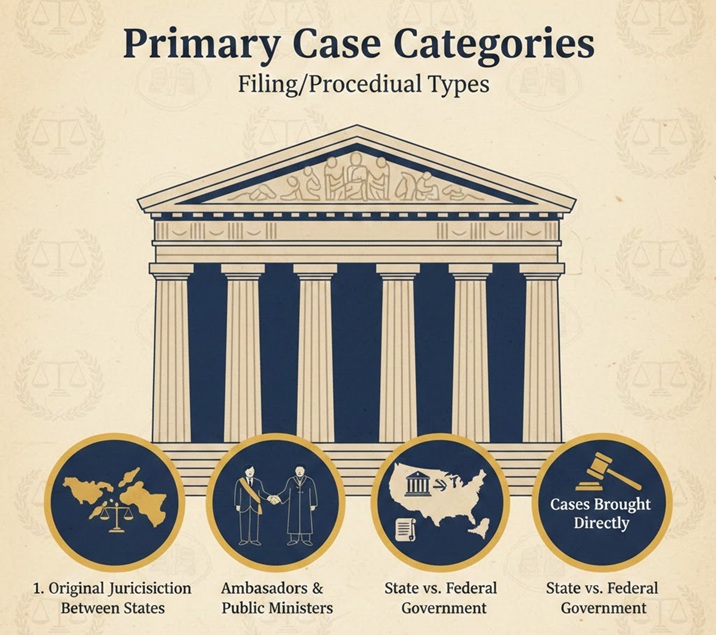
The categories of original jurisdiction cases—disputes between states, matters involving foreign diplomats, and controversies between states and the federal government—reflect the Framers’ wisdom in identifying disputes requiring special judicial treatment. These cases implicate sovereignty, international relations, and fundamental constitutional structure in ways that justify bypassing ordinary appellate processes.
Modern practice has adapted original jurisdiction to contemporary needs while preserving its constitutional core. Special masters enable efficient handling of complex disputes. Efiling systems facilitate case management across geographic distances. Evolving doctrines address new challenges of environmental regulation, resource scarcity, and technological change.
Yet original jurisdiction also faces ongoing challenges. The Supreme Court’s limited capacity requires careful gatekeeping to prevent overwhelming its docket. Political polarization threatens to transform interstate and state-federal litigation into partisan battlegrounds. Resource constraints and increasing case complexity strain existing institutional arrangements.
Despite these challenges, original jurisdiction remains essential to American federalism and the rule of law. It provides a peaceful, authoritative mechanism for resolving conflicts between sovereign entities that might otherwise escalate into confrontation or constitutional crisis. As the nation confronts new challenges of climate change, technological disruption, and political division, the Supreme Court’s original jurisdiction role will likely expand in importance.
Understanding original jurisdiction requires appreciating both its constitutional foundations and its practical operation. From the appointment of special masters to the implementation of efiling protocols, from boundary surveys to water apportionment formulas, original jurisdiction practice combines high constitutional principle with granular procedural detail. This combination reflects the broader character of American law, where grand theory meets practical necessity in the resolution of concrete disputes.
For practitioners, scholars, and citizens alike, original jurisdiction offers a window into the workings of American federalism. It demonstrates how constitutional structure shapes actual governance, how sovereign entities interact within a legal framework, and how the Supreme Court adapts its procedures to meet distinctive litigation challenges. As long as states remain vital governmental units and international relations require diplomatic protection, original jurisdiction will continue serving its essential constitutional function.
The future of original jurisdiction will likely see continued evolution in response to changing circumstances. Climate change may generate new categories of interstate disputes. Technological advancement may transform litigation procedures. Political realignment may alter the nature of state-federal conflicts. Through all these changes, the constitutional mandate of Article III, Section 2 will remain, providing the enduring foundation for this unique and vital aspect of American judicial power.
The efiling revolution in court administration promises to enhance original jurisdiction efficiency while presenting new challenges for security and access. As e-filing court systems mature, they will undoubtedly incorporate specialized features for original jurisdiction cases, balancing transparency against sensitivity, efficiency against deliberation, and innovation against tradition. The integration of efiling into original jurisdiction practice represents merely the latest chapter in the long history of adapting constitutional procedures to contemporary needs.
Ultimately, original jurisdiction embodies the aspiration that even the most powerful governmental entities—states, the federal government, foreign sovereigns—can resolve their differences through law rather than force. This aspiration, rooted in constitutional text and historical practice, continues to guide the Supreme Court’s exercise of its most distinctive jurisdiction.
Here are useful resources related to Original Jurisdiction Cases organized in columns:
| Resource Type | Description | Link/Contact |
|---|---|---|
| Main Website | Supreme Court of the United States Official Website | www.supremecourt.gov |
| E-Filing Portal | Supreme Court Electronic Filing System (ECF) | www.supremecourt.gov/efiling.aspx |
| Case Status Inquiry | Docket Search and Case Status | www.supremecourt.gov/docket/docket.aspx |
| Filing Guidelines | Guide for Filing Original Jurisdiction Cases | www.supremecourt.gov/filingandrules.aspx |
| Rules & Forms | Supreme Court Rules and Filing Forms | www.supremecourt.gov/ctrules/2024RulesoftheCourt.pdf |
| Clerk’s Office Helpline | General Filing and Procedural Questions | (202) 479-3011 |
| Electronic Filing Help Desk | E-Filing Technical Support | (202) 479-3066 |
| Press Office | Media Inquiries and Public Information | (202) 479-3211 |
| Visitor Services | Public Hours and Tour Information | (202) 479-3030 |
| Library Services | Legal Research and Case Records | (202) 479-3176 |
Additional State-Federal Resources:
| Resource Type | Description | Link/Contact |
|---|---|---|
| National Center for State Courts | Interstate Litigation Resources | www.ncsc.org |
| Department of Justice Civil Division | Federal Defensive Litigation | www.justice.gov/civil |
| National Association of Attorneys General | State Litigation Coordination | www.naag.org |
Note: Links and contact numbers are subject to change. Please verify current information through the official Supreme Court website before initiating any filing or inquiry.
For More Update Visit Home Click Here
Disclaimer
The information provided in this article is intended solely for general awareness and educational purposes. It does not constitute legal advice, nor should it be relied upon as a substitute for professional legal counsel. The content reflects general principles of United States constitutional law regarding Supreme Court original jurisdiction as of the date of publication, but laws, procedures, and judicial interpretations are subject to change.
Readers should not act or refrain from acting based on this information without seeking appropriate legal or professional guidance tailored to their specific circumstances. The author and publisher disclaim any liability for any loss or damage arising from reliance on the materials presented herein. For specific legal questions or concerns, please consult a qualified attorney or legal professional licensed in the relevant jurisdiction.