
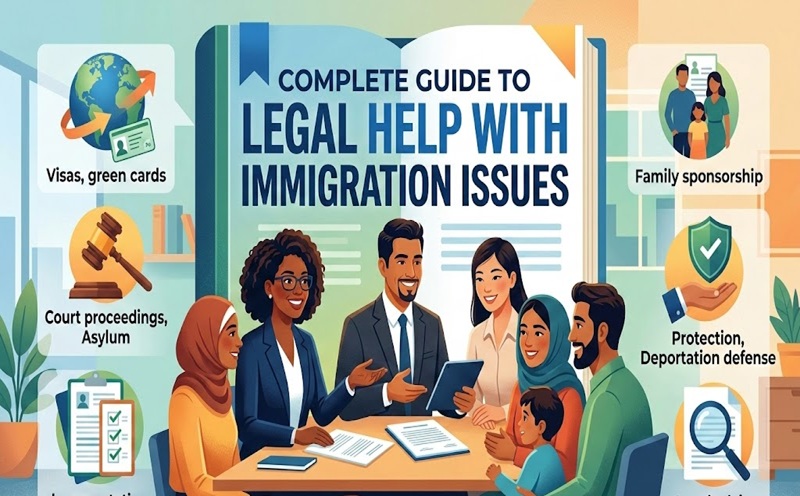
Complete Guide to Legal Help With Immigration Issues
Everything You Need to Know About Immigration Lawyers, Visas, Green Cards, Citizenship, Deportation Defense, and Finding the Right Legal Help
Introduction: Why an Immigration Lawyer Is Essential
Immigration law is one of the most complex, constantly changing, and high-stakes areas of legal practice in the world. Whether you are moving to a new country for work, reuniting with family, fleeing persecution, building a business across borders, or fighting to remain in a country you have called home for years, navigating immigration systems without proper guidance can be overwhelming — and the consequences of mistakes can be life-altering.
An immigration lawyer — a legal professional who specializes in providing legal help with immigration issues — is the single most valuable resource available to anyone involved in the immigration process. An immigration lawyer understands the intricate web of federal statutes, administrative regulations, agency policies, and international agreements that govern who can enter a country, how long they can stay, what they can do while there, and under what circumstances they must leave.
This comprehensive guide covers everything you need to know about immigration lawyers and the legal help they provide with immigration issues: what they do, when you need one, the types of immigration cases they handle, how the immigration process works, how to find and choose the right immigration lawyer, what to expect during your case, and much more. Whether you are just beginning your immigration journey or facing a critical immigration crisis, this guide will help you understand why expert legal help with immigration issues can make all the difference.
1. What Is an Immigration Lawyer?
An immigration lawyer is a licensed attorney who focuses their legal practice on immigration law — the body of law that governs the movement of people across national borders, the conditions under which they may reside in a country, the acquisition of citizenship, and the consequences of violating immigration rules. As a specialist in providing legal help with immigration issues, an immigration lawyer possesses deep knowledge of an area of law that changes frequently due to shifts in legislation, executive policy, agency interpretation, and court decisions.
Immigration lawyers serve a remarkably diverse clientele. Their clients include:
- Individuals and families seeking visas to visit, work, or live in another country
- Skilled workers and professionals pursuing employment-based immigration pathways
- Entrepreneurs and investors seeking business immigration visas
- Students applying for study visas and related permits
- Refugees and asylum seekers fleeing persecution and violence
- Individuals facing deportation or removal proceedings
- Long-term residents pursuing permanent residency or naturalized citizenship
- Businesses and employers sponsoring foreign national employees
- Victims of trafficking, domestic violence, or other crimes who qualify for special immigration relief
In every one of these situations, an immigration lawyer provides legal help with immigration issues that is tailored to the client’s unique circumstances, goals, and the specific immigration laws that apply to their case. The stakes in immigration matters are uniquely high — the outcome directly affects where a person lives, works, and builds their future. This is why professional legal help with immigration issues is not merely a convenience but often a necessity.
2. The Role of an Immigration Lawyer: Core Functions
Understanding what an immigration lawyer actually does day-to-day helps clarify the enormous value they provide. The legal help with immigration issues that an immigration lawyer offers goes far beyond simply filling out forms. Here are the core functions they perform:
2.1 Case Evaluation and Strategy
Every immigration journey begins with a thorough evaluation. An immigration lawyer reviews the client’s background, immigration history, family situation, employment circumstances, criminal record (if any), and goals to identify the best available immigration pathway. This strategic assessment is the foundation of effective legal help with immigration issues. A skilled immigration lawyer sees options and solutions that a layperson — or even a less experienced practitioner — might miss.
2.2 Application Preparation and Filing
Immigration applications involve extensive paperwork, supporting documents, biometric appointments, and strict deadlines. An immigration lawyer prepares petitions, applications, and supporting documentation with precision, ensuring that every form is correctly completed, every required document is included, and every deadline is met. Errors or omissions in immigration applications can result in delays, denials, or even bans from future applications. This is one of the most critical areas where legal help with immigration issues pays dividends.
2.3 Representation Before Government Agencies
Immigration lawyers represent clients before a range of government agencies including U.S. Citizenship and Immigration Services (USCIS), the Department of Homeland Security (DHS), the Department of State (DOS), and Immigration and Customs Enforcement (ICE) in the United States — and equivalent agencies in other countries. This representation ensures that the client’s voice is heard, their rights are protected, and their case is presented in the most favorable light.
2.4 Courtroom Advocacy in Immigration Court
When an individual faces removal (deportation) proceedings, their case is heard in immigration court before an immigration judge. An immigration lawyer serves as their courtroom advocate — presenting legal arguments, introducing evidence, cross-examining government witnesses, and making appeals. Without competent legal help with immigration issues in immigration court, many individuals face removal who might otherwise have valid defenses or relief options.
2.5 Appeals
If an immigration application is denied or an immigration court rules against a client, an immigration lawyer can pursue appeals to higher administrative bodies such as the Board of Immigration Appeals (BIA), and further to federal circuit courts if necessary. The appeals process is highly technical and requires deep legal expertise. Legal help with immigration issues at the appellate level can reverse life-altering decisions.
2.6 Advising on Rights and Obligations
An immigration lawyer advises clients on their rights at every stage of the immigration process — including what to say (and what not to say) to immigration officers, how to respond to requests for evidence, what activities are permitted on a given visa type, and how to avoid immigration violations. This proactive legal guidance prevents costly mistakes.
2.7 Employer Compliance and Business Immigration
For employers, immigration lawyers provide compliance guidance on I-9 verification requirements, H-1B visa caps and lotteries, Labor Condition Applications, and the legal obligations that come with sponsoring foreign workers. They also assist with government audits and investigations. This form of legal help with immigration issues protects businesses from serious legal penalties.
3. Types of Immigration Cases: A Comprehensive Overview
Immigration law encompasses a broad spectrum of case types. An immigration lawyer who provides legal help with immigration issues may work across several of these areas or specialize in particular ones. Here is a detailed look at the major categories of immigration cases:
3.1 Family-Based Immigration
Family-based immigration allows U.S. citizens and lawful permanent residents (green card holders) to sponsor certain family members for immigration benefits. An immigration lawyer helps navigate the complex preference system that governs which family relationships qualify, manages priority dates, prepares immigrant visa petitions (Form I-130), and guides families through the consular processing or adjustment of status process. Reuniting families is one of the most emotionally significant areas where legal help with immigration issues matters most.
3.2 Employment-Based Immigration
Employers who wish to hire foreign nationals on a permanent basis must navigate the employment-based immigration system, which includes labor certification (PERM), immigrant visa petitions, and priority date management across five employment preference categories. An immigration lawyer guides both the employer and the prospective immigrant through this multi-step process, which can take months or years depending on the applicant’s country of birth and visa category.
3.3 Nonimmigrant Visas (Temporary Visas)
Nonimmigrant visas allow foreign nationals to enter and remain in a country for a temporary, specific purpose. An immigration lawyer provides legal help with immigration issues across a wide range of nonimmigrant visa categories, including:
- H-1B Visa: For specialty occupation workers (e.g., engineers, IT professionals, scientists)
- H-2A and H-2B Visas: For temporary agricultural and non-agricultural workers
- L-1 Visa: For intracompany transferees in managerial, executive, or specialized knowledge roles
- O-1 Visa: For individuals with extraordinary ability in their field
- TN Visa: For Canadian and Mexican professionals under the USMCA
- E-1 and E-2 Visas: For treaty traders and investors
- F-1 and J-1 Visas: For international students and exchange visitors
- B-1/B-2 Visas: For business visitors and tourists
- K-1 Visa: The fiancé visa for foreign nationals engaged to U.S. citizens
Each nonimmigrant visa category has its own eligibility requirements, application procedures, processing timelines, and conditions. Legal help with immigration issues from a qualified immigration lawyer ensures that the correct visa is selected and the application is properly prepared.
3.4 Green Card (Lawful Permanent Residence)
Obtaining a green card — lawful permanent resident status — is one of the most sought-after immigration goals. A green card allows a foreign national to live and work permanently in the United States (or the equivalent permanent residency in other countries). Immigration lawyers provide legal help with immigration issues related to green cards obtained through family sponsorship, employment, the Diversity Visa Lottery, refugee or asylee status, and special immigrant categories. The path to a green card involves multiple forms, biometric appointments, medical exams, interviews, and often years of waiting. Expert legal guidance is critical.
3.5 Asylum and Refugee Status
Individuals who have suffered persecution or have a well-founded fear of persecution based on race, religion, nationality, political opinion, or membership in a particular social group may be eligible for asylum or refugee status. Asylum law is one of the most complex and emotionally intense areas requiring legal help with immigration issues. An immigration lawyer helps asylum seekers document their claims, prepare for asylum interviews and hearings, and navigate the often adversarial proceedings before immigration judges. The stakes — return to danger vs. safety and protection — could not be higher.
3.6 Deportation Defense and Removal Proceedings
When the government seeks to remove (deport) a foreign national, that individual is placed in removal proceedings before an immigration court. An immigration lawyer provides critical legal help with immigration issues in this context by identifying all possible defenses and forms of relief — including cancellation of removal, voluntary departure, adjustment of status, waivers, asylum, and withholding of removal. Many individuals facing deportation have valid legal defenses they are unaware of without proper legal help. Immigration lawyers have saved countless families from forced separation through skilled deportation defense.
3.7 Naturalization and Citizenship
Naturalization is the legal process by which a lawful permanent resident becomes a citizen of their adopted country. An immigration lawyer helps clients determine eligibility for naturalization, prepare and file the N-400 Application for Naturalization, prepare for the civics and English tests and the naturalization interview, and address any complications — such as prior criminal matters or extended absences — that might affect eligibility. Citizenship is the ultimate form of immigration security, and legal help with immigration issues during this final step ensures a smooth process.
3.8 DACA and Deferred Action
The Deferred Action for Childhood Arrivals (DACA) program provides temporary protection from deportation and work authorization to certain individuals brought to the United States as children without documentation. An immigration lawyer helps eligible individuals apply for DACA and renewals, understand their rights and limitations under the program, and explore pathways to more permanent immigration status. Given DACA’s ongoing legal and political uncertainty, having legal help with immigration issues is especially important for DACA recipients.
3.9 U Visa, T Visa, and VAWA Protections
U.S. immigration law provides special protections for vulnerable individuals, including crime victims (U Visa), trafficking victims (T Visa), and victims of domestic violence under the Violence Against Women Act (VAWA). An immigration lawyer provides sensitive, trauma-informed legal help with immigration issues for these clients, guiding them through special application processes that can lead to legal status and, eventually, permanent residency.
3.10 Consular Processing and Visa Interviews
Many immigration cases require processing through a U.S. embassy or consulate abroad — a process known as consular processing. An immigration lawyer prepares clients for consular interviews, ensures all required documents are in order, and addresses any issues that arise — such as prior visa denials, criminal history, or prior immigration violations. Legal help with immigration issues at the consular processing stage prevents costly interview failures and visa denials.
3.11 Waivers of Inadmissibility
Certain past actions — prior immigration violations, criminal convictions, fraud, prior deportations, unlawful presence — can make a foreign national inadmissible to the United States or another country. In many cases, waivers are available that allow individuals to overcome these grounds of inadmissibility. Preparing a successful waiver application requires compelling legal argumentation and thorough documentation — a task squarely within the expertise of an immigration lawyer providing legal help with immigration issues.
4. Understanding the Immigration System
To appreciate the value of legal help with immigration issues, it helps to understand how the immigration system is structured. Immigration law in the United States — and in most major destination countries — is a layered system involving multiple government agencies, bodies of law, and adjudicative forums.
4.1 Key U.S. Immigration Agencies
The U.S. immigration system involves several federal agencies, each with distinct roles:
- USCIS (U.S. Citizenship and Immigration Services): The primary agency responsible for processing immigration benefits applications, including green cards, naturalization, asylum, and nonimmigrant petitions.
- CBP (Customs and Border Protection): Manages the entry of individuals at ports of entry, including airports, land borders, and seaports.
- ICE (Immigration and Customs Enforcement): Enforces immigration law within the United States, including conducting deportations and operating immigration detention facilities.
- DOS (Department of State): Processes immigrant and nonimmigrant visas through U.S. embassies and consulates abroad.
- EOIR (Executive Office for Immigration Review): Administers the immigration court system, including immigration courts and the Board of Immigration Appeals.
- DOL (Department of Labor): Involved in employment-based immigration, including the PERM labor certification process.
Navigating interactions with multiple agencies — each with its own forms, procedures, processing times, and standards — is one of the primary reasons why legal help with immigration issues from a qualified immigration lawyer is so valuable.
4.2 The Concept of Immigration Status
Everyone present in a country has some form of immigration status — or lacks legal status (undocumented). Status determines what a person is permitted to do: work, study, travel, and ultimately remain. Status can be temporary (nonimmigrant) or permanent (immigrant/permanent resident). An immigration lawyer helps clients understand, maintain, and improve their immigration status and alerts them to actions that could jeopardize it.
4.3 Priority Dates and Visa Backlogs
One of the most frustrating aspects of immigration law — particularly family-based and employment-based immigration — is the concept of visa backlogs. Because the U.S. limits the number of immigrant visas available in most categories each year, applicants from high-demand countries (such as India, China, Mexico, and the Philippines) may wait years or even decades for a visa to become available. An immigration lawyer helps clients track priority dates, understand the Visa Bulletin, and explore strategies to minimize wait times where possible.
5. When Do You Need an Immigration Lawyer?
While some simple immigration matters might seem manageable without professional help, there are many situations where legal help with immigration issues from a qualified immigration lawyer is not just advisable but essential. Here are the key scenarios:
5.1 You Are Facing Deportation or Removal
This is perhaps the most urgent situation in which you need an immigration lawyer immediately. If you or a family member has received a Notice to Appear in immigration court, do not attempt to navigate those proceedings without legal help with immigration issues. An immigration lawyer will identify all possible defenses and relief options and fight aggressively on your behalf.
5.2 You Have a Criminal Record
Even minor criminal convictions — including misdemeanors — can have devastating immigration consequences, including deportation, bars to admission, and ineligibility for immigration benefits. The intersection of criminal law and immigration law (known as crimmigration) is extremely complex. An immigration lawyer with experience in this area provides critical legal help with immigration issues for non-citizens who have or are facing criminal charges.
5.3 You Have Been Denied Previously
A prior denial of a visa or immigration benefit, or a prior deportation or removal from a country, creates complications for future applications. An immigration lawyer can analyze the reasons for the prior denial, assess whether you have grounds to reapply or appeal, and help you present the strongest possible case going forward.
5.4 Your Case Is Complex
Any case involving mixed immigration status within a family, prior overstays, multiple nationalities, complicated employment situations, or unusual personal circumstances benefits greatly from legal help with immigration issues. Immigration law is not one-size-fits-all, and complex cases demand experienced professional guidance.
5.5 You Are Seeking Asylum
The asylum process is legally complex, emotionally demanding, and requires presenting a compelling, well-documented case to immigration authorities. Without an immigration lawyer, asylum seekers face a dramatically lower success rate. Legal help with immigration issues in asylum cases is critical to achieving protection for those who truly need it.
5.6 Your Employer Is Sponsoring You
Employment-based immigration involves both the employer and the employee. While some employers have in-house immigration counsel, many rely on outside immigration lawyers. As the sponsored employee, understanding your rights and the implications of the sponsorship process — including what happens if you change jobs — requires legal help with immigration issues specific to your situation.
5.7 You Are Applying for Naturalization With Complications
While straightforward naturalization cases can sometimes be handled without a lawyer, any complication — extended absences from the country, prior criminal matters, tax issues, or prior immigration violations — makes legal help with immigration issues advisable. A mistake in the naturalization process can delay or permanently bar citizenship.
6. How to Choose the Right Immigration Lawyer
Finding the right immigration lawyer is one of the most important decisions you will make in your immigration journey. The quality of the legal help with immigration issues you receive can directly determine the outcome of your case. Here is a practical guide to selecting the right immigration lawyer:
6.1 Verify Credentials and Bar Membership
Ensure that the person you are consulting is a licensed attorney admitted to the bar of the state where they practice. Be cautious of immigration consultants, notarios, or document preparers who are not lawyers — they are not authorized to provide legal advice or legal help with immigration issues, and many have defrauded immigrants with disastrous results. Verify your lawyer’s credentials through the state bar association’s online directory.
6.2 Look for Immigration Law Specialization
Immigration law is complex enough that you want a lawyer who focuses primarily or exclusively on it — not a generalist who handles immigration cases occasionally. Look for membership in the American Immigration Lawyers Association (AILA) or equivalent national immigration bar associations, which signals dedication to this specialized area of legal help with immigration issues.
6.3 Evaluate Experience With Your Specific Type of Case
An immigration lawyer who excels at employment-based corporate immigration may not be the best choice for a complex asylum case, and vice versa. Ask specifically about their experience handling cases similar to yours — the type of visa or relief you are seeking, your country of origin, and any complicating factors in your background.
6.4 Assess Communication and Accessibility
Immigration cases often involve time-sensitive deadlines and sudden developments. Your immigration lawyer should be accessible, responsive, and communicate clearly — explaining complex immigration concepts in plain language. Poor communication is one of the most common complaints about lawyers in any field, but it is especially problematic in immigration cases where misunderstandings can have serious consequences.
6.5 Understand the Fee Structure
Immigration lawyers typically charge flat fees for specific services (such as preparing a visa application) or hourly rates for complex, ongoing matters (such as deportation defense). Get a written fee agreement that clearly specifies what services are included, what is not included, and how additional charges may arise. Understand what you are paying for when you retain legal help with immigration issues.
6.6 Read Reviews and Ask for References
Online reviews on legal directories, Google, and immigration community forums can provide insight into other clients’ experiences. Ask the lawyer if they can provide references from past clients with similar cases. Hearing directly from others who have received legal help with immigration issues from this lawyer is invaluable.
6.7 Trust Your Instincts at the Consultation
Most immigration lawyers offer a paid initial consultation. Use this time to assess whether the lawyer listens carefully to your situation, asks thoughtful questions, gives a realistic (not falsely optimistic) assessment of your case, and makes you feel respected and understood. Trust and comfort are important elements of a productive legal help with immigration issues relationship.
7. The Immigration Process: Step by Step
While every immigration case is unique, most follow a general process. Understanding this process helps you appreciate the legal help with immigration issues that an immigration lawyer provides at each stage.
Step 1: Initial Consultation and Case Assessment
The process begins with an initial consultation where the immigration lawyer reviews your background, goals, and circumstances. They identify the best immigration pathway for you, assess your eligibility, flag any potential obstacles, and outline the overall strategy. This foundational assessment is the cornerstone of all subsequent legal help with immigration issues.
Step 2: Document Collection and Preparation
Your immigration lawyer provides a detailed list of documents needed to support your application. These may include passports, birth certificates, marriage certificates, financial records, employment records, police clearances, medical exam results, and country condition evidence (in asylum cases). The lawyer reviews all documents for completeness and flags any issues that need to be addressed.
Step 3: Application Preparation and Filing
The immigration lawyer prepares the application or petition with meticulous care, drafts supporting letters, prepares declarations, and compiles the complete filing package. Applications are filed with the appropriate agency — USCIS, the National Visa Center, or a U.S. consulate. Receipt notices confirm that the filing has been accepted.
Step 4: Government Processing and Requests for Evidence
Government agencies process applications over varying timeframes. During this period, the agency may issue a Request for Evidence (RFE) or a Notice of Intent to Deny (NOID) seeking additional information or explanation. An immigration lawyer’s legal help with immigration issues is critical at this stage — a well-crafted response to an RFE can salvage an application that might otherwise be denied.
Step 5: Biometrics and Interviews
Many immigration applications require biometric appointments (fingerprinting and photographs) and in-person interviews. Your immigration lawyer prepares you thoroughly for any interview — explaining what questions to expect, what documents to bring, and how to present yourself and your case clearly and honestly.
Step 6: Decision
The agency issues a decision — approval, denial, or a request for further information. If approved, the next steps are outlined (such as attending a visa interview abroad or attending a green card ceremony). If denied, your immigration lawyer advises on whether to appeal, file a motion to reopen or reconsider, or pursue an alternative pathway. Expert legal help with immigration issues at the decision stage ensures you understand all your options.
Step 7: Appeals and Further Proceedings (If Necessary)
If a denial is issued or if removal proceedings are initiated, your immigration lawyer pursues all available avenues — administrative appeals, federal court review, and motions for relief. The appeals process requires sophisticated legal argumentation and in-depth knowledge of immigration case law.

8. Immigration Lawyer Fees: What to Expect
Understanding how immigration lawyers charge for their legal help with immigration issues helps you plan financially and avoid surprises. Here is a breakdown of common fee structures:
8.1 Flat Fees
Most routine immigration services are charged at a flat fee — a fixed amount for a specific service regardless of how much time it takes. Flat fees are common for nonimmigrant visa petitions (such as H-1B or L-1), green card applications, naturalization applications, and family-based petitions. Flat fees typically range from a few hundred to several thousand dollars depending on the complexity of the service and the lawyer’s experience level.
8.2 Hourly Rates
Complex, ongoing matters — such as deportation defense, corporate immigration compliance programs, or federal court appeals — are often billed hourly. Immigration lawyer hourly rates typically range from $150 to $500+ per hour, depending on geographic location, firm size, and the lawyer’s expertise level. Hourly billing is more common in high-stakes litigation contexts.
8.3 Retainer Arrangements
For ongoing legal help with immigration issues — such as a company retaining an immigration lawyer for employee sponsorship needs throughout the year — a retainer arrangement may be used. The client pays a periodic fee in exchange for a defined scope of immigration services.
8.4 Government Filing Fees
In addition to attorney fees, immigration cases involve government filing fees paid directly to immigration agencies. For example, in the United States, USCIS filing fees for various forms range from under $100 to over $700 per form, and some applications require multiple forms. Your immigration lawyer will clearly outline all government fees in addition to their own fees.
8.5 Is the Cost Worth It?
The cost of legal help with immigration issues is almost always worth it when compared to the cost of a denied application, a missed deadline, a deportation order, or years of processing delays caused by errors. Immigration mistakes can be extraordinarily difficult and expensive to correct — and some are permanently irreversible. Professional legal representation is an investment in your future and your family’s future.
9. Common Immigration Issues and How a Lawyer Helps
Immigration problems come in many forms. Here is how an immigration lawyer provides legal help with immigration issues in some of the most common difficult scenarios:
9.1 Visa Overstay
Overstaying a visa is one of the most common immigration violations. Depending on the length of the overstay, it can trigger bars to reentry (3-year bar for overstays of 180 days to 1 year; 10-year bar for overstays of more than 1 year). An immigration lawyer assesses whether waivers are available, advises on the safest course of action, and helps the individual navigate their options without making their situation worse.
9.2 Denied Visa Applications
A visa denial from a consular officer is often difficult to challenge because consular decisions are generally not subject to judicial review. However, an immigration lawyer can analyze the reason for denial, determine whether a new application is appropriate, prepare additional supporting documentation, and in some cases request supervisory review. Legal help with immigration issues after a denial requires experienced strategic thinking.
9.3 Issues With Adjustment of Status
Adjustment of status — the process of changing from a nonimmigrant status to permanent resident status within the United States — involves complex eligibility requirements and a detailed application process. An immigration lawyer ensures that the adjustment application is properly supported and that the applicant is fully prepared for their USCIS interview.
9.4 Complications From Criminal History
As noted earlier, criminal history can have devastating immigration consequences. An immigration lawyer reviews the criminal record carefully, identifies applicable immigration consequences, explores whether criminal court dispositions can be modified to reduce immigration impact (in coordination with criminal defense counsel), and pursues any available waivers or relief. This intersection of criminal and immigration law is where legal help with immigration issues becomes truly specialized.
9.5 Immigration Fraud and Misrepresentation
Prior misrepresentation or fraud in immigration applications — even unintentional — creates serious grounds of inadmissibility. An immigration lawyer helps clients understand the scope of the problem, assess whether a waiver is available, and prepare the strongest possible case for overcoming this ground of inadmissibility.
10. Immigration Lawyers and the Broader Immigration Debate
Immigration is one of the most hotly debated political topics in many countries. Immigration lawyers operate within this charged environment while maintaining their professional commitment to providing legal help with immigration issues based on existing law — not political opinion. It is important to understand that an immigration lawyer’s role is not to advocate for any particular immigration policy but to help their individual clients navigate the laws and procedures that currently exist.
Regardless of political debates about immigration reform, border security, or pathways to citizenship, the legal reality for millions of people is that they face complex immigration situations right now that require professional legal help. Immigration lawyers serve as essential advocates for their clients within the existing legal framework while those broader policy debates continue.
The work that immigration lawyers do has profound human consequences — keeping families together, protecting vulnerable people from persecution, enabling economic opportunity, and ensuring that people’s rights are respected within the immigration system. This human dimension is what makes legal help with immigration issues so meaningful — and so important.
11. Avoiding Immigration Fraud: Protecting Yourself
Unfortunately, the immigration community is frequently targeted by fraudsters who prey on vulnerable people desperate for legal help with immigration issues. Knowing how to recognize and avoid immigration fraud is essential.
11.1 Notario Fraud
In Latin American countries, the title “notario” refers to a highly qualified legal professional. Immigrants from these countries may mistakenly believe that a “notario” in the United States has similar qualifications. However, in the United States, “notary public” is a very limited role with no authority to provide legal advice. Many unscrupulous individuals hold themselves out as “notarios” to exploit immigrants seeking legal help with immigration issues. Only a licensed attorney can legally advise you on immigration matters.
11.2 Immigration Consultants and Document Preparers
Immigration consultants and document preparers can legally help fill out forms — but they cannot give legal advice, represent you before any government agency or immigration court, or assess your legal options. They are not immigration lawyers, and the legal help with immigration issues they can provide is extremely limited. Many individuals have had their cases damaged or destroyed by relying on unqualified consultants.
11.3 Warning Signs of Immigration Fraud
- Someone guarantees you a visa or immigration benefit — no honest lawyer can guarantee outcomes
- Someone asks you to sign blank forms or forms in a language you do not understand
- The fee seems extraordinarily low compared to other providers
- Someone claims to have special connections at USCIS or the embassy
- The person discourages you from seeking a second opinion
- No written contract or receipt is provided for services rendered
- Someone asks you to list false information on an immigration form
If you suspect immigration fraud, report it to the Federal Trade Commission, your state attorney general’s office, and USCIS. Protect yourself by only seeking legal help with immigration issues from verified, licensed immigration lawyers.
12. Technology and the Future of Immigration Law
Like all areas of law, immigration practice is being transformed by technology. Here is how digital innovation is shaping the legal help with immigration issues that clients receive:
12.1 Online Case Management
Many immigration law firms now offer secure online portals where clients can upload documents, track case status, communicate with their lawyer, and receive updates in real time. This technology makes legal help with immigration issues more transparent, efficient, and accessible — particularly for clients who live far from their lawyer’s office.
12.2 USCIS Online Filing
USCIS has been expanding its online filing system, allowing certain immigration applications to be filed electronically rather than by paper. Immigration lawyers stay current with these evolving filing options to ensure clients benefit from faster, more efficient application processes.
12.3 Remote Consultations and Representation
Video conferencing platforms have made it possible for immigration lawyers to serve clients across the country and around the world without geographic limitation. A client in rural Texas can receive legal help with immigration issues from a highly specialized immigration lawyer in New York. Remote immigration court hearings have also become more common, expanding access to representation.
12.4 Artificial Intelligence in Immigration Practice
AI tools are beginning to assist immigration lawyers with legal research, form preparation, and case management. However, the strategic, human, and ethical dimensions of immigration legal help — assessing individual circumstances, crafting persuasive arguments, advocating in court, and advising vulnerable clients — remain firmly in the domain of qualified human lawyers.
Conclusion: The Irreplaceable Value of an Immigration Lawyer
Immigration law is not a system designed to be navigated alone. It is complex, ever-changing, unforgiving of errors, and carries consequences that can affect every aspect of a person’s life — where they live, whether they can work, whether they can remain with their family, and whether they are safe from persecution. An immigration lawyer — a professional who dedicates their career to providing legal help with immigration issues — is an indispensable ally in this journey.
Whether you are applying for a first visa, reuniting with family, building a business across borders, seeking refuge from danger, or fighting to stay in a country you have built your life in, the legal help with immigration issues that a qualified immigration lawyer provides can be the single most important factor in your case’s outcome.
Do not wait for a crisis to find an immigration lawyer. Proactive legal help with immigration issues — getting proper advice before problems arise — is always better than reactive damage control. Consult a qualified immigration lawyer early, stay informed about your immigration status, and never underestimate the value of expert legal guidance in one of the most consequential areas of your life.
Frequently Asked Questions (FAQ) About Immigration Lawyers and Legal Help With Immigration Issues
Q1. What is the difference between an immigration lawyer and an immigration consultant?
An immigration lawyer is a licensed attorney who has completed law school, passed the bar exam, and is authorized to provide legal advice, represent clients before government agencies and immigration courts, and handle all aspects of immigration matters. An immigration consultant or notario is not a licensed attorney and cannot provide legal advice or represent clients. For meaningful legal help with immigration issues, always consult a licensed immigration lawyer.
Q2. How much does an immigration lawyer cost?
Costs vary widely depending on the type of case and the lawyer’s experience. Simple visa petitions may cost $1,000 to $3,000 in attorney fees. Complex cases such as deportation defense, asylum, or employment-based green cards can range from $3,000 to $15,000 or more in attorney fees, excluding government filing fees. Many immigration lawyers offer payment plans. The cost of legal help with immigration issues is almost always less than the cost of a mistake.
Q3. Can I apply for a visa or green card without an immigration lawyer?
Technically, yes — most immigration applications allow for self-representation. However, the complexity of immigration law, the high rate of errors in self-prepared applications, and the serious consequences of mistakes make professional legal help with immigration issues strongly advisable in most situations. Complex cases — especially those involving any complications in your background — should never be handled without an immigration lawyer.
Q4. How do I find a qualified immigration lawyer?
Start by checking the American Immigration Lawyers Association (AILA) directory at aila.org, your state bar association’s referral service, or immigration community organizations in your area. Verify that any lawyer you consider is licensed and in good standing. Read reviews, ask for referrals, and schedule an initial consultation to assess whether the lawyer is a good fit for your legal help with immigration issues needs.
Q5. What should I do if I receive a Notice to Appear (NTA) in immigration court?
Contact an immigration lawyer immediately. A Notice to Appear initiates removal (deportation) proceedings. You have limited time to respond, and the consequences of not appearing or not responding properly are severe. An immigration lawyer will review your case, identify all available defenses and relief options, and represent you in immigration court. This is one of the most urgent situations requiring legal help with immigration issues.
Q6. Can an immigration lawyer help if my visa application was denied?
Yes, in many cases. An immigration lawyer can analyze the reason for the denial, assess whether an appeal or motion to reopen is appropriate, determine whether a new application is advisable, and identify whether additional documentation could overcome the basis for denial. The availability of legal remedies depends on the type of denial and the circumstances of your case.
Q7. Does having a criminal record prevent me from getting a green card or visa?
It depends on the nature and severity of the criminal conviction. Some convictions are absolute bars to immigration benefits; others create rebuttable grounds of inadmissibility for which waivers may be available; and others have no immigration impact at all. The interaction between criminal law and immigration law is extremely complex. If you have any criminal history, seeking legal help with immigration issues from an immigration lawyer before applying for any immigration benefit is essential.
Q8. How long does the immigration process take?
Processing times vary dramatically depending on the visa category, country of origin, USCIS and consular workloads, and whether any complications arise. Simple nonimmigrant visa applications may be processed in weeks. Family-based green cards for immediate relatives of U.S. citizens can take several months to over a year. Employment-based green cards for applicants from high-demand countries can take many years due to visa backlogs. Your immigration lawyer can give you realistic timing expectations based on current processing data.
Q9. What is the difference between a visa and a green card?
A visa is a document (or electronic authorization) that permits a foreign national to travel to and enter a country and remain for a specified period for a specified purpose — it is generally temporary. A green card (lawful permanent resident card) grants the right to live and work in the United States permanently, without the time and purpose limitations of a nonimmigrant visa. An immigration lawyer provides legal help with immigration issues related to both temporary visa status and the path to permanent residency.
Q10. What happens if I overstay my visa?
Overstaying a visa has serious consequences including accruing unlawful presence, which can trigger 3-year or 10-year bars to re-entry, potential deportation, and ineligibility for certain immigration benefits. The severity depends on how long you overstayed and your specific circumstances. If you have overstayed or are at risk of overstaying, consult an immigration lawyer immediately to understand your options and minimize the damage. Proactive legal help with immigration issues is far better than waiting until the situation becomes a crisis.
| Organization Name | Website | Phone Number | Service Description |
|---|---|---|---|
| USCIS Contact Center | uscis.gov/contact-us | 1-800-375-5283 (TTY: 1-800-767-1833) | Official U.S. Citizenship and Immigration Services helpline for case status, forms, and general immigration questions |
| USCIS Military Help Line | uscis.gov/military | 1-877-CIS-4MIL (1-877-247-4645) | Dedicated support for military members and families regarding immigration benefits |
| National Immigrant Justice Center (NIJC) | immigrantjustice.org | 312-660-1370 (Tue-Thu 8:30am-4:30pm) | Free legal services for citizenship, green cards, visas, and deportation defense for low-income individuals |
| NIJC Immigration Court Helpdesk | immigrantjustice.org | (312) 660-1328 | Assistance for asylum seekers in removal proceedings |
| NIJC Detention Project | immigrantjustice.org | (773) 672-6599 (Tuesdays 11am-2pm) / (312) 583-9721 (collect calls) | Legal help for detained immigrants in Midwest ICE facilities |
| NYS Office of New Americans Immigration Hotline | nyic.org | 1-800-566-7636 (Mon-Fri 9am-8pm ET) | Multi-lingual hotline (200+ languages) for immigration info and referrals; confidential and anonymous |
| MOIA Immigration Legal Support Hotline (NYC) | nyc.gov/immigrants | 800-354-0365 or 311 (say “Immigration Legal”) | Free immigration legal help referrals for NYC residents (Mon-Fri 9am-6pm) |
| NYC Immigrant Affairs Hotline | nyc.gov/immigrants | 212-788-7654 (Mon-Fri 9am-5pm) | Questions about accessing City services regardless of immigration status |
| Beyond Legal Aid Immigration Helpline | beyondlegalaid.org/immigration-helpline | 872-267-2252 | 24/7 national helpline providing free immigration screening and legal consultation in English/Spanish; messages returned within 5 business days |
| Immigrant Law Center of Minnesota (ILCM) | ilcm.org/immigration-help | 1-800-223-1368 (Mon 10am-1pm, Tue 1pm-4pm, Thu 3pm-6pm) | Free immigration legal assistance for low-income immigrants in MN and ND |
| ILCM Detention Line | ilcm.org/immigration-help | 651-641-1011 (Mon-Thu 1pm-3pm) | Information for ICE-detained individuals and families (not legal advice) |
| Nebraska Immigration Legal Assistance Hotline (NILAH) | immigrantlc.org/nilah | 1-855-307-6730 | Centralized hotline for low-income individuals seeking immigration legal assistance; bilingual English/Spanish with language line access |
| Washington Immigrant Solidarity Network (WAISN) Deportation Defense Hotline | waisn.org/deportation-defense | 1-844-724-3737 (Mon-Fri 6am-6pm) | Report ICE activity, get deportation defense resources; 300+ languages, text capable |
| American Bar Association Detention & LOP Info Line | americanbar.org/immigration | Dial 2150# from detention center | Pro se case assistance for detained respondents only |
| RAICES National Hotline | raicestexas.org | 1-800-296-9162 (Laredo) / 1-855-672-4237 (Karnes) | Legal services for asylum seekers and detained immigrants in Texas |
| Immigrant Defense Project Hotline | immigrantdefenseproject.org | 1-888-284-2772 (until 5pm) | For people or families of those facing detention and/or deportation |
Important Notes:
-
For immigration emergencies or if detained by ICE, contact the American Bar Association Detention Line by dialing 2150# from the detention center phone
-
WAISN Hotline is specifically for Washington State residents but serves as a model for deportation defense hotlines nationwide
-
USCIS Contact Center is the official government source for case-specific questions but cannot provide legal advice
-
Most legal aid organizations provide free or low-cost services to eligible low-income immigrants but have specific intake hours and geographic limitations
-
NILAH and similar state-specific hotlines can refer you to DOJ-accredited representatives and nonprofit legal service providers
Visit Home for More Information Click Here
Disclaimer
This article is provided for general informational and educational purposes only and does not constitute legal advice. The information presented here is not a substitute for professional legal counsel from a licensed immigration lawyer qualified to practice in your jurisdiction. Immigration laws, regulations, policies, and processing procedures change frequently and vary significantly by country, state, and individual circumstance. Nothing in this article creates an attorney-client relationship between the reader and the author or publisher. If you have a specific immigration issue or question, you should consult a licensed and qualified immigration lawyer who can evaluate your individual situation and provide advice tailored to your needs.