
How to File Suit for Permanent Injunction
Complete Step-by-Step Legal explain for Indian District Courts
Permanent Injunction Suit | Civil Court Procedure | CPC Order 39 | Specific Relief Act 1963 | Property Disputes | India
1. Introduction: What is a Permanent Injunction?
If someone is continuously encroaching on your land, illegally using your trademark, blocking your right of way, or carrying out any activity that is damaging your legal rights day after day, then simply going to the police or sending legal notices may not be enough. What you actually need is a Court Order that permanently stops that person from doing what they are doing. In Indian law, this Court Order is called a Permanent Injunction.
A Permanent Injunction is a final and binding court order issued under Section 38 to Section 42 of the Specific Relief Act, 1963, read with Order 39 Rules 1 and 2 of the Code of Civil Procedure, 1908 (CPC). Unlike a Temporary Injunction, which is granted for a limited period during the pendency of the suit, a Permanent Injunction is granted after the full trial of the case and remains in force forever unless reversed by a superior court. It is one of the most effective legal remedies available to ordinary citizens of India.
The beauty of a permanent injunction suit is that it can be filed by any person who has a legal right being violated. Whether you are a farmer, a shopkeeper, a homeowner, a company, or a professional, you can approach your local District Court or Civil Court and file this suit. This article is a detailed, practical guide written specifically for people across India who want to understand the complete process of filing a suit for permanent injunction, from drafting the plaint to the final decree.
2. Legal Framework: The Laws Behind Permanent Injunction in India
Before filing your case, it is important to know which laws govern the remedy of permanent injunction in India. The following are the primary statutes and provisions:
2.1 Specific Relief Act, 1963
This is the main substantive law governing injunctions in India. Section 36 defines preventive relief, Section 37 distinguishes between temporary and perpetual (permanent) injunctions, Section 38 explains when a perpetual injunction may be granted, Section 39 deals with mandatory injunctions, Section 40 talks about damages in lieu of or in addition to injunction, and Section 41 lays down cases where injunction cannot be granted. The Specific Relief (Amendment) Act 2018 has also added important provisions, especially for contracts relating to infrastructure projects.
2.2 Code of Civil Procedure, 1908 (CPC)
Order 39 Rules 1 and 2 of CPC deal with temporary injunctions and are invoked during the pendency of the permanent injunction suit to protect the plaintiff’s rights. Order 7 governs how a plaint should be drafted. Section 9 of CPC gives the civil courts jurisdiction to try all suits of civil nature. Section 26 provides for the institution of suits. Section 20 determines territorial jurisdiction of the court.
2.3 Indian Evidence Act, 1872 (Bhartiya Sakshya Adhiniyam, 2023)
The burden of proof lies on the plaintiff to prove that they have a legal right and that the defendant is violating or threatening to violate that right. Documents, photographs, survey records, revenue records, and witness testimonies all fall under the purview of the Evidence Act. Courts rely heavily on documentary evidence in injunction suits.
3. When Can You File a Suit for Permanent Injunction?
As per Section 38 of the Specific Relief Act, 1963, a permanent injunction can be granted to a plaintiff to prevent the breach of an obligation existing in their favour, whether expressly or by implication. The following are the most common situations in India where a suit for permanent injunction is filed:
- Property disputes where a neighbour or relative is encroaching upon your land, building on your boundary, or trying to take possession of your agricultural land or house.
- Blocking of right of way or easement rights where someone is preventing you from using a path or road that you have a legal right to use.
- Trademark and intellectual property infringement where a competitor is using your registered trademark, trade name, logo, or passing off their goods as yours.
- Defamation and publication disputes where someone is publishing false statements or defamatory material about you.
- Nuisance cases where a factory, establishment, or neighbour is causing continuous damage to your property or health.
- Family property disputes especially in joint family matters or partition suits where one coparcener is misappropriating joint property.
- Breach of contractual obligations in commercial matters where a party is acting in violation of a specific agreement.
- Illegal construction or demolition on disputed land.
4. Key Legal Requirements to Prove for Permanent Injunction
The courts in India have consistently held, relying on the landmark judgement in Dalpat Kumar v. Prahlad Singh (AIR 1993 SC 276), that to succeed in a suit for permanent injunction, the plaintiff must prove three essential elements:
4.1 Prima Facie Case
The plaintiff must demonstrate that they have a genuinely arguable legal case. At the final stage of the permanent injunction, the court requires full proof of the right claimed, not merely a prima facie case. You must prove your ownership, possession, or other legal right through documentary evidence, revenue records, sale deeds, agreements, or other authentic documents.
4.2 Balance of Convenience
The court weighs the convenience and inconvenience that would result to both sides if the injunction is granted or refused. If the inconvenience to the plaintiff is much greater than the inconvenience to the defendant, the court will usually grant the injunction. For instance, if refusing the injunction means the plaintiff loses their only house while granting it merely delays the defendant’s construction, the balance clearly favours the plaintiff.
4.3 Irreparable Loss or Injury
The plaintiff must prove that if the injunction is not granted, they will suffer harm or damage that cannot be adequately compensated in money. This is the key requirement for permanent injunction as well. Courts have repeatedly held that when the subject matter is immovable property or unique rights, damages alone are insufficient and hence injunction is the appropriate remedy.
5. Which Court Has Jurisdiction?
This is one of the most common questions asked by people planning to file an injunction suit. Jurisdiction in civil cases in India is governed by Sections 15 to 20 of the Code of Civil Procedure, 1908. You need to identify the correct court on the basis of three types of jurisdiction:
5.1 Territorial Jurisdiction
For suits relating to immovable property (which is the majority of injunction cases), the suit must be filed in the court within whose territorial limits the property is situated. This is as per Section 16 of CPC. If the suit is regarding a personal right like business injunction or defamation, Section 20 applies and you can file in the court where the defendant resides, carries on business, or where the cause of action arose.
5.2 Pecuniary Jurisdiction (Monetary Limit)
In India, civil courts have different pecuniary jurisdictions. At the district level, there are Junior Civil Judge Courts, Senior Civil Judge Courts (Civil Judge Class I / Chief Judicial Magistrate level), and the District Court (presided by District Judge). The valuation of your suit determines which court will hear your case. Typically: Junior Civil Judge can try suits up to Rs. 1 to 3 lakh depending on the state. Senior Civil Judge can try suits up to Rs. 5 to 20 lakh. District Court has unlimited jurisdiction in civil matters. You must value your suit correctly and attach the correct Court Fee.
5.3 Subject Matter Jurisdiction
Some matters have specific courts. For instance, trademark infringement suits go to the District Court as per the Trade Marks Act, 1999. Revenue court matters go to the Revenue Courts, not Civil Courts, in some states. Rent control matters go to the Rent Controller. It is always advisable to consult a local civil advocate to confirm the correct court for your matter.
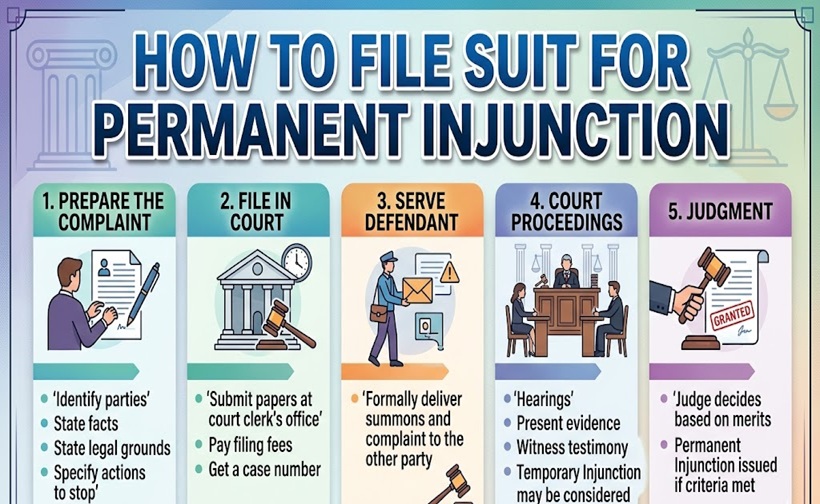
6. Step-by-Step Process to File Suit for Permanent Injunction
Here is the complete, practical, step-by-step process for filing a permanent injunction suit in an Indian District Court or Civil Court:
Step 1: Consult a Civil Advocate
The first and most important step is to engage a qualified civil advocate who practices in the local district court. You can find advocates through the District Bar Association, through bar council listings, or through the e-Courts website at https://ecourts.gov.in. A good civil advocate will assess the strength of your case, advise on the correct court, help you value the suit properly, and draft the plaint accurately. In most districts, you can also approach the District Legal Services Authority (DLSA) for free legal aid if you qualify as per the Legal Services Authorities Act, 1987. The DLSA website is https://nalsa.gov.in.
Step 2: Gather All Evidence and Documents
A permanent injunction suit stands or falls on evidence. You must collect all possible documents before drafting the plaint. Depending on the nature of your case, the following documents may be needed:
- Sale deed, gift deed, or any other title document proving your ownership
- Jamabandi / Khasra / Khatauni extract from the Revenue Department (Patwari Records)
- Site plan or map of the property (can be obtained from the Sub-Registrar Office or Tehsildar)
- Mutation entries (Namantaran) from the Revenue office
- Photographs showing the encroachment, illegal construction, or violation
- Copies of any previous legal notices sent to the defendant
- Any agreements, contracts, or correspondences relevant to the dispute
- FIR copy or complaint copies if any police complaint was made
- Electricity bills, property tax receipts, or Aadhaar card showing address proof of possession
Step 3: Valuation of Suit and Court Fee
The valuation of a permanent injunction suit is a critical procedural step. For suits relating to immovable property, the plaintiff values the suit based on the market value of the property or the value of the relief sought, as per the Court Fees Act, 1870 and the Suits Valuation Act, 1887. Each state has its own scale of court fees. The court fee is typically a percentage of the suit valuation and is paid in the form of Court Fee Stamps affixed to the plaint. An under-valued suit can result in the court returning the plaint for re-valuation, so your advocate must get this right. In many states, court fee calculators are available on the High Court websites.
Step 4: Drafting the Plaint (Written Petition)
The plaint is the formal written document in which the plaintiff states their case before the court. As per Order 7 of CPC, every plaint must contain the following essential elements:
- Name of the Court where the suit is filed
- Full name, father’s name, age, occupation, and address of the Plaintiff
- Full name, father’s name, age, occupation, and address of the Defendant
- Facts constituting the cause of action (what happened and when)
- Facts showing the court has jurisdiction (territorial and pecuniary)
- Relief or reliefs claimed by the plaintiff
- Valuation of the suit for purposes of court fee
- Verification paragraph signed by the plaintiff
In a typical permanent injunction suit for property, the plaint would narrate: the plaintiff’s ownership, the defendant’s illegal acts, the damage being caused, why money alone cannot compensate, and the prayer for a decree of permanent injunction restraining the defendant from encroaching or interfering with the suit property. The plaint must be typed (not handwritten in most courts), signed by both the advocate and the plaintiff, and accompanied by a vakalatnama (authority letter appointing the advocate).
Step 5: Filing Application for Temporary Injunction (Order 39 CPC)
Since a permanent injunction suit takes time to reach a final decree (often years), it is essential to simultaneously file an Application for Temporary Injunction under Order 39 Rules 1 and 2 of CPC. This application asks the court to grant an interim order restraining the defendant from doing the disputed act until the final disposal of the suit. Without this, the defendant may continue causing harm during the pendency of the case. Along with the temporary injunction application, if the situation is urgent, you can also file an Ex Parte Ad Interim Injunction application seeking immediate relief without waiting to hear the defendant. Courts can grant such ex parte orders on the same day in genuinely urgent matters.
Step 6: Submission of Plaint at the Court Filing Counter
Once the plaint is drafted and the court fee stamps are affixed, the following documents are submitted at the filing counter (Nazarat Section) of the District Court: the original plaint in triplicate (or as many copies as required), vakalatnama, list of documents, and certified or true copies of all supporting documents. The court clerk checks the plaint for technical compliance and assigns a suit number. You then receive a receipt with the suit number and the date of first hearing.
Step 7: Service of Summons on the Defendant
After the suit is admitted, the court issues summons to the defendant under Order 5 of CPC, directing them to appear in court and file their written statement. Summons are served by the court process server, or in some modern courts, also by registered post, courier, electronic means, or through the police. If the defendant cannot be found or evades service, the court may order substituted service through newspaper publication. This step ensures that the defendant is given fair notice and an opportunity to be heard, which is a fundamental principle of natural justice.
Step 8: Written Statement by Defendant
Once served, the defendant is given 30 days (extendable to 90 days with court permission as per the Commercial Courts Act or as per the CPC amendment) to file a Written Statement under Order 8 of CPC. In the written statement, the defendant denies the allegations, raises specific defences, and may file a counter-claim if they have any cross-claim against the plaintiff. Your advocate must carefully read the written statement and prepare a replication if necessary.
Step 9: Framing of Issues
After the pleadings are complete (plaint + written statement), the court frames issues under Order 14 of CPC. Issues are specific questions of fact or law on which the parties disagree and which need to be decided by the court. In a permanent injunction suit, typical issues framed are: Is the plaintiff the owner and in possession of the suit property? Has the defendant encroached upon or interfered with the suit property? Is the plaintiff entitled to a decree of permanent injunction? What relief, if any, is the plaintiff entitled to? Framing of issues is a very important stage and determines the scope of evidence that each party must lead.
Step 10: Evidence Stage (Oral and Documentary)
This is the most critical and time-consuming stage of the suit. The plaintiff first leads evidence by filing an Affidavit of Examination-in-Chief (EIC) along with the original documents. The plaintiff’s witnesses are then cross-examined by the defendant’s advocate. After the plaintiff’s evidence is complete, the defendant leads their evidence and their witnesses are cross-examined by the plaintiff’s advocate. Local Commissioner Reports are often ordered in property disputes to inspect the site and prepare a map or report. The commissioner visits the site and submits a report to the court, which becomes an important piece of evidence.
Step 11: Final Arguments (Bahes)
After evidence is complete, both advocates present final oral arguments before the judge. Written arguments or notes can also be submitted. The advocate for the plaintiff summarises the evidence, cites relevant judgements from High Courts and the Supreme Court, and argues why the relief should be granted. The defendant’s advocate similarly argues against. This is the advocate’s opportunity to persuade the judge on every issue framed in the case.
Step 12: Judgement and Decree
After hearing final arguments, the judge pronounces the judgement. In a successful case, the court passes a decree of permanent injunction, permanently restraining the defendant from performing the illegal act. The decree is then drawn up by the court and becomes a formal court order enforceable under Section 51 of CPC. If the defendant violates the decree, you can file a Contempt of Court petition or execution proceedings.
7. Court Fee Structure for Permanent Injunction Suit
Court fee varies from state to state in India. Here is a general overview of how court fee works for injunction suits:
- In Uttar Pradesh, Madhya Pradesh, and Rajasthan, suit valuation for an injunction relating to immovable property is typically done at Rs. 200 per mensem (per month) of the annual income or rent of the property, as per the Suits Valuation Act.
- In Maharashtra, the Bombay Court Fees Act applies. For a permanent injunction suit, court fee is levied on the market value of the property.
- In Delhi, Punjab, and Haryana, there are specific court fee schedules and your advocate must consult the High Court Rules for accurate computation.
- A Process fee is also charged for service of summons, which is usually a fixed amount per defendant.
To find the exact court fee applicable in your state, you can check the website of your respective High Court. For example, Delhi High Court: https://delhihighcourt.nic.in, Allahabad High Court: https://allahabadhighcourt.in, Bombay High Court: https://bombayhighcourt.nic.in, Madras High Court: https://hcmadras.tn.nic.in.
8. Difference Between Temporary and Permanent Injunction
Many people confuse temporary and permanent injunctions. Understanding the distinction is important:
- A Temporary Injunction (Antarim Pratibandh Aadesh) is granted during the pendency of the suit to maintain the status quo until the case is decided. It is not final. It requires only a prima facie case, balance of convenience, and irreparable injury. It is governed by Order 39 CPC.
- A Permanent Injunction (Sthayi Pratibandh Aadesh) is the final relief granted after full trial. It permanently restrains the defendant from doing the act complained of. It requires full proof of the plaintiff’s right and the defendant’s wrongful act.
- A Mandatory Injunction (Badlav ka Aadesh) under Section 39 of the Specific Relief Act orders the defendant to undo something already done, for example to demolish an illegal wall already erected on the plaintiff’s land.
9. Limitation Period for Filing Injunction Suit
One of the most overlooked aspects of filing an injunction suit is the limitation period. Under the Limitation Act, 1963, there are specific time limits within which a suit must be filed. If you miss the limitation period, the court will reject your suit as time-barred, no matter how strong your case is.
- For suits for permanent injunction relating to property, the limitation period is generally three years from the date the right to sue accrues (i.e., the date when the defendant first interfered with your right).
- For suits based on breach of contract, the limitation is three years from the date of breach.
- However, if the violation is continuing (for example, the defendant continues to encroach day after day), a fresh cause of action arises each day and limitation may not be an absolute bar. Courts have held this in numerous cases involving ongoing trespass.
It is always prudent to file the suit as early as possible rather than wait. Delay in filing, even if within limitation, can be used by the defendant to argue laches (deliberate delay) and may weaken your case.
10. What Happens After You Win: Execution of Decree
Getting a decree for permanent injunction is only half the battle. If the defendant continues to violate the order despite having a decree against them, you need to enforce the decree. The following options are available:
10.1 Execution Petition
You can file an Execution Petition under Order 21 of CPC before the same court that passed the decree. The Executing Court can then take various measures to enforce the decree, including attaching property, arresting the judgment debtor, or directing the police to enforce compliance.
10.2 Contempt of Court
If the defendant wilfully disobeys the court’s injunction order, you can file a Contempt of Court application under the Contempt of Courts Act, 1971. The court can punish the contemnor with imprisonment up to six months or fine up to Rs. 2,000 or both. This is a powerful tool and most defendants comply with injunction orders once the contempt threat is real.
11. Appeals Against Permanent Injunction Decree
If the District Court decides the case against you (or if the other side gets an adverse decree and wants to challenge it), the following appellate remedies are available:
- First Appeal to the District Court / High Court: Under Section 96 of CPC, a first appeal lies from the original decree of the trial court to the next higher civil court, which is either the District Court or directly the High Court depending on the pecuniary limits.
- Second Appeal to the High Court: Under Section 100 of CPC, a second appeal lies to the High Court only on substantial questions of law.
- Special Leave Petition (SLP) to the Supreme Court: Under Article 136 of the Constitution of India, in exceptional cases, a party can approach the Supreme Court by filing an SLP.
- Revision under Section 115 CPC to the High Court is available against orders of courts that have committed jurisdictional errors, though it is not a full appeal.
12. Important Landmark Judgements on Permanent Injunction
Indian courts have delivered several important judgements that govern how permanent injunction suits are decided. Your advocate should be aware of these when presenting your case:
- Dalpat Kumar & Anr vs Prahlad Singh & Ors (1992) 1 SCC 719: The Supreme Court laid down the triple test for granting injunctions: prima facie case, balance of convenience, and irreparable injury.
- Gujarat Bottling Co. Ltd. vs Coca Cola Co. (1995) 5 SCC 545: The Supreme Court affirmed the principles governing grant of interlocutory injunctions and the importance of not creating irreversible situations.
- Manohar Lal Chopra vs Rai Bahadur Rao Raja Seth Hiralal AIR 1962 SC 527: The Supreme Court held that a civil court has the inherent power to issue injunctions even beyond Order 39 in appropriate circumstances.
- Satyapal Reddy vs Govt. of A.P.: Dealt with the necessity of proving the right of the plaintiff and the threat or actual infringement by the defendant for granting a permanent injunction in property matters.
13. Useful Online Resources and Contact Numbers for Indian Litigants
The following official government portals and resources are extremely helpful for litigants filing civil suits in India:
- eCourts Services Portal (Case Status, Cause List, Orders): https://ecourts.gov.in | Helpline: 1800-103-0083
- National Legal Services Authority (Free Legal Aid, DLSA): https://nalsa.gov.in | Helpline: 15100
- Bar Council of India (Advocate Verification): https://www.barcouncilofindia.org
- India Code (For reading Acts and Statutes): https://www.indiacode.nic.in
- Supreme Court of India: https://www.sci.gov.in | Tel: 011-23388942
- Department of Justice, Government of India: https://doj.gov.in | Tele-Law helpline: 15100
- Vakalatnama and Plaint Templates: Available at most District Court Bar Association libraries or on your High Court’s website.
14. Common Mistakes to Avoid When Filing Permanent Injunction Suit
Over many years of civil litigation practice in Indian courts, certain recurring mistakes have been identified that can seriously damage a litigant’s case:
- Not filing the temporary injunction application along with the main suit. If you delay this, the defendant may act quickly to create irreversible facts on the ground.
- Filing in the wrong court. Always verify territorial and pecuniary jurisdiction before filing. A suit filed in the wrong court wastes years.
- Incorrect valuation of the suit and wrong court fee. This leads to return of the plaint and delay.
- Not getting documents certified or attested properly. Revenue records should ideally be obtained directly from the concerned Tehsildar or Patwari and should be recent (within 6 months).
- Delaying service of summons on the defendant. Insist with your advocate that process fee is deposited promptly and summons are served without delay.
- Not appearing in court on hearing dates. Frequent non-appearance leads to dismissal for default under Order 9 CPC.
- Choosing an advocate who does not regularly appear in the district court where the case is filed.
15. Alternative Dispute Resolution: Is Mediation Possible?
Indian courts today strongly encourage mediation and alternative dispute resolution before going to full trial. Under Section 89 of CPC and the Mediation Act, 2023, the court may refer the parties to mediation at any stage of the proceedings. Mediation is especially useful in family property disputes, neighbour disputes, and business partner disputes where a negotiated solution can save years of litigation. All District Courts have attached Mediation and Conciliation Centres. Information on mediation centres can be found at https://nalsa.gov.in or through the District Legal Services Authority. However, mediation is voluntary and if the other side refuses or if the dispute is such that only a court order will work, you must proceed with the full trial.
Frequently Asked Questions (FAQ)
Q1. What is the difference between a permanent injunction and a temporary injunction?
A temporary injunction is an interim order passed during the pendency of a case to maintain status quo. It lasts only till the case is decided. A permanent injunction is the final relief granted by the court after full trial and remains operative forever, unless reversed by a higher court.
Q2. How long does a permanent injunction suit take in India?
Realistically, civil suits in Indian district courts can take anywhere from 3 to 10 years depending on the complexity of the case, the pendency of the court, and the number of witnesses. However, the Commercial Courts Act, 2015 mandates disposal of commercial suits within 12 months. For regular civil suits, the CPC aims for disposal within 3 years but this is often not achieved in practice.
Q3. Can I file an injunction suit without a lawyer?
Technically yes, you can appear in person as a party-in-person before the court. However, given the complexity of civil procedure, drafting requirements, evidence laws, and the tactics that opposing lawyers may use, it is strongly advisable to engage an experienced civil advocate. If you cannot afford one, approach the District Legal Services Authority at your district court complex for free legal aid.
Q4. What if the defendant violates the temporary injunction order?
If the defendant violates a court’s temporary or permanent injunction order, you must immediately file a Contempt of Court application. The court can punish the contemnor with imprisonment and fine. You can also approach the court for a Writ of Injunction in execution proceedings and request police assistance to restore status quo.
Q5. Is permanent injunction possible against the government?
Yes, a permanent injunction can be obtained against government authorities acting without legal authority or in excess of their powers. However, there are certain procedural requirements like prior notice under Section 80 CPC before filing a suit against the Government of India or a State Government. Also, a statutory body performing a public duty may not be restrained by injunction in the same way as a private party.
Q6. What is the court fee for a permanent injunction suit in UP, Delhi, and Maharashtra?
Court fee varies. In Uttar Pradesh, it is typically calculated on the basis of 1/3rd of the market value of the relief sought in many cases. In Delhi, fixed court fee schedules apply. In Maharashtra, it is based on the market value of the property. For exact figures, consult a local advocate or visit the respective High Court website. The minimum court fee in most states is at least Rs. 100 and can go up to several lakhs for high-value properties.
Q7. Can a permanent injunction be reversed?
Yes. A permanent injunction decree can be challenged in first appeal before the District Court or High Court, in second appeal before the High Court on substantial questions of law, and ultimately in Special Leave Petition before the Supreme Court. Additionally, if material facts were concealed while obtaining the decree, a review petition can be filed before the same court.
Q8. What documents are most important in a property injunction suit?
The most critical documents are the title document (Sale Deed/Gift Deed/Inheritance documents), updated Jamabandi or Khasra Khatauni from the Revenue Department showing you as the recorded owner, site plan or map of the property, and possession proof like utility bills, property tax receipts, or Aadhaar address proof. Photographs showing the current status of the property can also be very useful.
Official Government Portals & Websites
| Resource | Website Link | Purpose |
|---|---|---|
| eCourts Services Portal | https://ecourts.gov.in | Case status, cause lists, court orders, and finding advocates |
| National Legal Services Authority (NALSA) | https://nalsa.gov.in | Free legal aid, District Legal Services Authority (DLSA) information |
| Bar Council of India | https://www.barcouncilofindia.org | Advocate verification |
| India Code | https://www.indiacode.nic.in | Access to Acts and Statutes |
| Supreme Court of India | https://www.sci.gov.in | Supreme Court information and resources |
| Department of Justice, Government of India | https://doj.gov.in | Government legal services and Tele-Law |
High Court Websites (for Court Fee Information)
| High Court | Website |
|---|---|
| Delhi High Court | https://delhihighcourt.nic.in |
| Allahabad High Court | https://allahabadhighcourt.in |
| Bombay High Court | https://bombayhighcourt.nic.in |
| Madras High Court | https://hcmadras.tn.nic.in |
Helpline Numbers
| Service | Helpline Number |
|---|---|
| eCourts Helpline | 1800-103-0083 |
| National Legal Services Authority (NALSA) | 15100 |
| Tele-Law (Department of Justice) | 15100 |
| Supreme Court of India | 011-23388942 |
Key Contacts for Legal Aid
-
District Legal Services Authority (DLSA): Available at every District Court complex – Contact through NALSA helpline 15100 or visit https://nalsa.gov.in
-
District Bar Association: Located at your local District Court for finding qualified civil advocates
For More Information Visit Home Click Here
LEGAL DISCLAIMER
This article is published purely for general legal information and educational purposes only. It is intended to help ordinary citizens of India understand the general legal process involved in filing a suit for permanent injunction in Indian district courts. Nothing in this article constitutes legal advice, and no advocate-client relationship is created by reading this article.
Laws, court procedures, court fee structures, and pecuniary jurisdictions vary from state to state and are subject to change. The information provided here may not reflect the most recent amendments to law or local court rules. Readers are strongly advised to consult a qualified civil advocate enrolled with the relevant State Bar Council before taking any legal steps.
The author and publisher of this article shall not be liable for any loss, damage, harm, or legal prejudice suffered by any person relying solely on the information provided here without seeking independent legal advice. All website links and contact numbers mentioned are for reference only and may be subject to change.
This article has been written keeping in mind the common queries of Indian citizens regarding civil litigation and injunction suits in District Courts. Every legal case is unique and its outcome depends on the specific facts, evidence, and applicable law. Please consult the District Legal Services Authority (Helpline: 15100) or a practising civil advocate at your local District Court for personalised legal advice.