
How to Protect Your Family with Wills and Trusts
Introduction
Most people spend decades building a life — accumulating assets, raising families, growing businesses, and nurturing relationships. Yet a surprisingly large number never take the crucial step of deciding what happens to all of it when they’re gone. That’s where an estate planning attorney comes in.
Estate planning is far more than drafting a will. It is a structured, legal process that ensures your wishes are honored, your loved ones are protected, and your legacy is preserved exactly as you intend. This guide covers everything you need to know about estate planning attorneys, the services they provide, and why engaging one is among the most important decisions you can make.
What Is an Estate Planning Attorney?
An estate planning attorney is a licensed legal professional who specializes in helping individuals and families plan for the future management and distribution of their assets. They operate at the intersection of law, finance, and family dynamics providing tailored legal strategies that reflect each client’s unique situation.
Unlike general practice attorneys, estate planning lawyers focus specifically on:
- Drafting legally binding documents (wills, trusts, powers of attorney)
- Minimizing estate and inheritance taxes
- Protecting assets from creditors or legal disputes
- Planning for incapacity and long-term care
- Ensuring smooth wealth transfer across generations
They don’t just prepare paperwork — they serve as trusted advisors who guide you through scenarios you may never have considered.
Why You Need an Estate Planning Attorney
1. Legal Precision Matters A will or trust containing errors, ambiguous language, or one that fails to meet your state’s legal requirements can be challenged in court or declared entirely invalid. An estate planning attorney ensures every document is airtight and enforceable.
2. Avoiding Probate Complications Without proper planning, your estate may go through probate — a public, time-consuming, and often expensive court process. An attorney can structure your estate to minimize or completely bypass probate.
3. Tax Efficiency Federal and state estate taxes can significantly reduce what your heirs receive. An experienced attorney implements strategies — irrevocable trusts, gifting programs, charitable vehicles — that legally reduce your tax liability.
4. Protecting Vulnerable Beneficiaries If you have minor children, a spouse with special needs, or a family member with financial challenges, an attorney can set up protective trusts controlling how and when they receive assets.
5. Business Continuity For business owners, estate planning includes succession planning — ensuring the business survives your death or incapacity without legal chaos.
Core Estate Planning Services
✦ Last Will and Testament
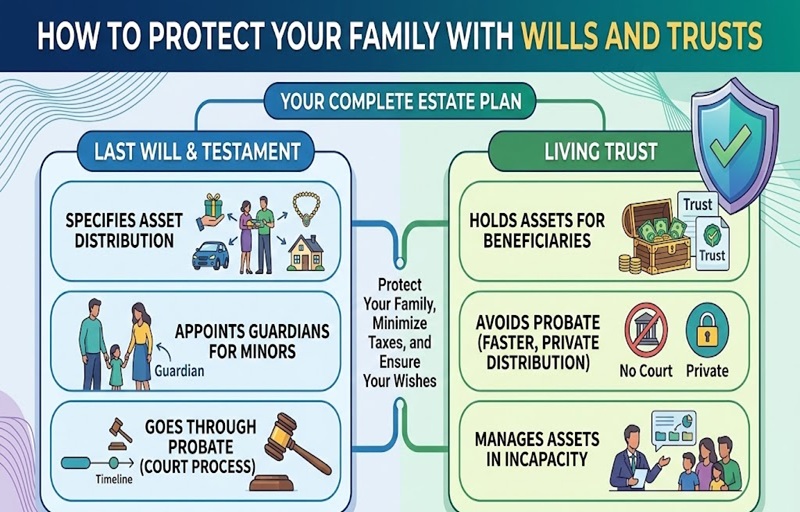
A will is the cornerstone of any estate plan. It legally designates who inherits your assets (beneficiaries), who manages your estate (executor), who cares for your minor children (guardian), and any specific gifts or bequests.
Without a will, your state’s intestacy laws decide who gets what — which often has nothing to do with your wishes. An attorney drafts a legally valid, customized will and ensures it is properly signed, witnessed, and notarized per your state’s requirements.
✦ Revocable Living Trust
A revocable living trust holds your assets during your lifetime and transfers them to beneficiaries at death — without going through probate.
Key benefits include privacy (trusts are not public record), faster asset distribution, continuity if you become incapacitated, and flexibility (it can be modified or revoked during your lifetime). Your attorney drafts the trust, helps you fund it by transferring assets into it, and ensures it integrates with your broader plan.
✦ Durable Power of Attorney (POA)
A durable power of attorney designates someone — your “agent” — to manage your financial affairs if you become mentally or physically incapacitated. This includes paying bills, managing investments, handling taxes, and more.
Without a POA, your family may be forced to pursue a costly, court-supervised guardianship process. An attorney drafts this document to match exactly the scope of authority you intend to grant.
✦ Healthcare Directive / Living Will
A healthcare directive — also called an advance directive or living will — documents your medical preferences if you can no longer communicate them. It addresses life-sustaining treatment, organ donation, pain management, and resuscitation preferences.
A Healthcare Proxy (or Medical Power of Attorney) is a companion document that appoints someone to make medical decisions on your behalf. Both documents must comply with your specific state’s laws — something an experienced attorney handles precisely.
✦ Irrevocable Trusts
Unlike revocable trusts, irrevocable trusts cannot be easily changed once created — but they deliver significant advantages: asset protection from lawsuits and creditors, Medicaid eligibility planning, and reduction of your taxable estate.
Common types include:
- Irrevocable Life Insurance Trust (ILIT) — removes life insurance from your taxable estate
- Special Needs Trust — protects disabled beneficiaries’ access to government benefits
- Charitable Remainder Trust (CRT) — provides income during life, then transfers assets to charity
- Spendthrift Trust — shields assets from financially irresponsible heirs

✦ Beneficiary Designation Review
Life insurance, 401(k)s, IRAs, and bank accounts transfer directly to named beneficiaries — bypassing your will entirely. Outdated designations (such as a former spouse) override even a carefully drafted will.
An estate planning attorney reviews and coordinates all beneficiary designations with your overall plan to prevent costly conflicts.
✦ Estate and Gift Tax Planning
For larger estates, strategic planning is critical to reduce federal estate taxes, state inheritance taxes, and gift tax exposure during your lifetime.
Common strategies attorneys use include annual gift exclusions, Spousal Lifetime Access Trusts (SLATs), Grantor Retained Annuity Trusts (GRATs), and charitable giving structures.
✦ Business Succession Planning
For entrepreneurs, estate planning extends into business succession — ensuring your company transitions smoothly. Attorneys prepare buy-sell agreements, coordinate key-person life insurance, structure ownership transfers to heirs or partners, and arrange business valuations for tax purposes.
✦ Probate and Estate Administration
When someone dies, their estate must be formally administered. An estate planning attorney assists the executor or trustee with filing the will in probate court, notifying and settling debts with creditors, distributing assets to beneficiaries, filing final income and estate tax returns, and resolving any disputes among heirs.
✦ Medicaid and Long-Term Care Planning
Nursing home and assisted living costs can rapidly deplete even a substantial estate. An attorney helps you understand Medicaid eligibility, structure assets so a healthy spouse is not impoverished, and use Medicaid-compliant tools like annuities or special trusts.
This planning works best when started years in advance of need, given Medicaid’s look-back period rules.
The Estate Planning Process: Step by Step
Step 1 – Initial Consultation You meet with your attorney to share your goals, family situation, assets, debts, and concerns.
Step 2 – Information Gathering You provide a full financial picture — real estate, bank accounts, investments, retirement accounts, life insurance policies, and business interests.
Step 3 – Strategy Development Your attorney designs a customized plan, recommending the right combination of legal documents and structures for your situation.
Step 4 – Document Drafting All documents are drafted with legal precision and reviewed together with you for accuracy.
Step 5 – Signing and Execution Documents are executed according to your state’s requirements — usually involving witnesses and a notary.
Step 6 – Funding the Plan Assets are properly titled or transferred — particularly critical for trusts to function as intended.
Step 7 – Periodic Review A good estate plan is revisited every 3–5 years or after any major life event to ensure it remains current and effective.
When Should You Create or Update Your Estate Plan?
Work with an estate planning attorney when you:
- Turn 18 years old — legal adulthood requires basic documents
- Get married or enter a long-term domestic partnership
- Have or adopt a child
- Purchase real estate or accumulate significant assets
- Start or acquire a business
- Go through a divorce or lose a spouse
- Receive a large inheritance or financial windfall
- Face a serious illness or health diagnosis
- Approach or enter retirement
- Relocate to a different state
Choosing the Right Estate Planning Attorney
Specialization: Choose someone who focuses on estate planning, not a generalist. Look for attorneys with an LL.M. in Taxation or recognized estate planning certifications.
Experience: Ask about the volume and complexity of estate plans they’ve handled and their familiarity with your state’s laws.
Communication: Your attorney should make complex legal concepts understandable and genuinely listen to your personal goals.
Fee Transparency: Fees may be flat-rate (for standard plans), hourly (for complex matters), or retainer-based (for estate administration). Always get a written fee agreement upfront.
Referrals and Reviews: Seek recommendations from trusted CPAs or financial advisors, and check online reviews and bar association standing.
Common Myths About Estate Planning
| Myth | Reality |
|---|---|
| “Only wealthy people need estate plans” | Anyone with assets, dependents, or healthcare preferences needs a plan |
| “My spouse automatically gets everything” | Not always — depends on state law, how assets are titled, and whether children are involved |
| “I’m too young for this” | Illness and accidents don’t check your age |
| “A will avoids probate” | Wills go through probate — trusts avoid it |
| “My plan never needs to be updated” | Laws and family circumstances change; your plan must keep pace |
The True Cost of Having No Estate Plan
When no plan exists:
- State law — not you — decides who inherits your assets
- A court may appoint a guardian for your children you would never have chosen
- Your estate may sit in probate for months or years
- Your family faces unnecessary tax burdens
- Relatives may dispute your estate, causing irreparable damage to relationships
- A business you spent a lifetime building may collapse or be liquidated
The professional fee for a well-structured estate plan is almost always far less than what families spend resolving the chaos caused by having none.
Frequently Asked Questions (FAQ)
Q1: What’s the difference between a will and a living trust? A will takes effect only at death and goes through probate court. A living trust takes effect immediately upon creation, avoids probate entirely, and allows faster, private distribution of assets.
Q2: Can I write my own will? You can, but DIY wills frequently fail due to improper execution, missing legal requirements, or ambiguous language. The risk is rarely worth the savings.
Q3: How much does an estate plan cost? A basic plan (will, power of attorney, healthcare directive) typically falls between $500–$2,000. Plans involving trusts, business interests, or complex tax strategies cost more. Fees vary by attorney and location.
Q4: What happens if I die without a will? Your estate passes under intestacy laws — the state formula. Your wishes are irrelevant, and courts may appoint guardians for your children without any guidance from you.
Q5: How often should my estate plan be reviewed? Every 3–5 years, and immediately following major life events: marriage, divorce, new child, death of a named beneficiary, or significant change in assets or law.
Q6: Does a power of attorney work after death? No. A POA — including a durable POA — automatically terminates the moment you die. Estate administration then falls to your executor under the will.
Q7: Why do beneficiary designations matter so much? Because they override your will. An outdated designation — listing an ex-spouse or deceased parent — transfers assets directly to the wrong person, no matter what your will says.
Q8: Can I change my estate plan later? Yes. Wills and revocable trusts can be updated at any time while you have legal capacity. Irrevocable trusts have significant modification restrictions by design.
| Organization/Service Name | Website | Phone Number | Service Description |
|---|---|---|---|
| FreeWill | freewill.com | Online platform | 100% FREE online will creation, living trusts (CA), healthcare directives, and financial power of attorney; supported by nonprofit partners |
| Legal Services Corporation (LSC) | lsc.gov/find-legal-aid | Varies by location | Federal funder of legal aid; find local free estate planning attorneys for low-income individuals |
| LawHelp.org | lawhelp.org | Varies by state | Nationwide directory of free legal aid for wills, estate planning, and elder law |
| Legal Aid of Arkansas | arlegalaid.org | 1-800-9-LAW-AID (1-800-952-9243) | Free wills, powers of attorney, and end-of-life planning for qualifying low-income residents |
| Legal Aid of North Carolina | legalaidnc.org | 866-219-LANC (866-219-5262) | Wills, powers of attorney, and living wills clinics for eligible residents |
| SF-Marin Lawyer Referral Service | sfbar.org/lris | 415-989-1616 | FREE 30-min consultation for estate planning/probate; $35 for other matters; military/veterans assistance available |
| Nevada Lawyer Referral Service | nvbar.org/lrs | Online/Phone referral | $45 for 30-minute consultation with pre-screened estate planning attorney |
| Los Angeles County Bar Association (LACBA) SmartLaw | smartlaw.org | 1-866-SMARTLAW (1-866-762-7852) | FREE 20-minute consultation with qualified estate planning attorney; text/chat: 213-243-1525 |
| Taylor & Leonard Law (Las Vegas) | taylorleonardlaw.com | (702) 982-0880 | FREE consultation for Nevada estate planning, wills, trusts, probate |
| The Marshall Law Office (Las Vegas) | tmloffice.com | Contact via website | FREE consultation for wills, trusts, asset protection, probate in Southern Nevada |
| Law Office of Gil Dozier (Louisiana) | gildozierlaw.com | (337) 232-4600 | FREE consultation for Louisiana wills, trusts, and estate litigation |
| Jacksonville Probate Lawyers (Florida) | jacksonvillelawyer.pro | Contact via website | FREE consultation for Florida estate planning, probate, guardianship |
| Elk & Elk (Cleveland, Ohio) | elkandelk.com | (216) 313-9774 | FREE consultation for Ohio probate, estate planning, wills, trusts |
| LegalZoom Estate Planning | legalzoom.com | Online platform | Affordable estate planning bundles with attorney consultations; will/trust packages with 1-year legal support |
| WealthCounsel (Attorney Resources) | wealthcounsel.com | Member services | Estate planning software and resources for attorneys (not direct public service) |
| NIH/NIA – Getting Your Affairs in Order | nia.nih.gov | Informational guide | Free checklist for estate planning documents; guidance on finding elder law attorneys |
| Alaska Lawyer Referral Service | alaskabar.org | 907-272-0352 | Wills and probate attorney referrals |
Important Notes:
-
FreeWill offers 100% FREE online will creation supported by nonprofit partners; no credit card required
-
For immediate emergencies or elder abuse concerns, call 911 or your local Adult Protective Services
-
Legal Aid organizations typically serve low-income individuals based on federal poverty guidelines; most offer free wills, powers of attorney, and advance directives
-
State Bar Lawyer Referral Services provide pre-screened attorneys; initial consultation fees vary ($0-$45) depending on location and case type
-
Many estate planning attorneys offer FREE initial consultations to discuss your needs and provide fee estimates
-
NIH/NIA provides free educational resources on advance care planning and finding qualified elder law attorneys
For More Update Visit Home Click Here
Disclaimer
The content in this article is provided purely for general informational and educational purposes. It does not constitute legal advice and must not be treated as such. Estate planning laws differ by state and jurisdiction, and every individual’s circumstances are unique. Readers are strongly encouraged to consult with a licensed estate planning attorney in their area before taking any legal or financial action. No attorney-client relationship is established by reading or referencing this article.