Madras High Court Online Entry Pass System: A Comprehensive Guide to Digital Access and Visitor Management
Introduction
The Indian judicial system has undergone significant digital transformation in recent years, with various high courts across the country implementing technology-driven solutions to enhance security, streamline administrative processes, and improve the visitor experience. Among these innovations, the Madras High Court’s online entry pass system represents a notable advancement in court administration and visitor management. Established to address the challenges posed by high-security requirements and large visitor volumes, this digital platform has fundamentally changed how litigants, advocates, government officials, and other stakeholders access one of India’s oldest and most prestigious judicial institutions.
The Madras High Court, located in Chennai, Tamil Nadu, serves as the highest judicial authority in the state, handling thousands of cases annually and hosting numerous visitors daily. The implementation of an electronic visitor pass system marked a significant departure from traditional manual entry processes, offering convenience while maintaining the stringent security protocols necessary for a high court premises. This comprehensive guide examines every aspect of the Madras High Court’s online entry pass system, from its historical development and operational mechanics to practical application procedures and future implications for court administration across India.
Historical Context and the Evolution of Court Security
The Pre-Digital Era of Court Access
Before the implementation of digital solutions, accessing the Madras High Court premises involved cumbersome manual processes that often resulted in long queues, administrative bottlenecks, and security vulnerabilities. Visitors, including litigants, advocates, law students, and government officials, were required to physically present themselves at entry gates, fill out paper forms, provide identification documents, and wait for manual verification before receiving handwritten entry passes. This system, while functional, consumed significant time and resources for both visitors and court administration staff.
The manual process presented particular challenges for frequent visitors such as practicing advocates who needed daily access to court facilities. Law students attending internships or moot court exercises faced similar difficulties, often spending considerable time at entry gates before being permitted to observe proceedings. Government officials from various departments who needed to attend hearings or meet with court officers encountered bureaucratic delays that affected their official duties.
Security concerns also plagued the manual system. Paper passes were susceptible to forgery, and the lack of centralized record-keeping made it difficult to track visitor movements or identify patterns that might indicate security risks. The system provided limited ability to verify visitor credentials in real-time or cross-reference entries against watchlists or restricted categories.
The CISF Takeover and Security Enhancement
A pivotal moment in the evolution of Madras High Court security occurred when the premises were brought under the protection of the Central Industrial Security Force (CISF), a central armed police force in India that provides security to critical infrastructure and sensitive installations. This transition, which occurred approximately seven years prior to the implementation of the online pass system, fundamentally altered the security landscape of the court complex
The CISF deployment followed a Madras High Court order that was subsequently confirmed by the Supreme Court of India, reflecting the national importance of securing judicial institutions. This protection arrangement required the Tamil Nadu government to allocate approximately 33 crore rupees annually for CISF services, representing a substantial investment in court security infrastructure
The presence of CISF personnel necessitated more sophisticated access control mechanisms that could integrate with professional security protocols while accommodating the unique needs of a functioning judicial institution.
The CISF protection introduced multi-layered security checks, baggage screening, and identity verification procedures that, while essential for safety, compounded the delays inherent in the manual pass system. The convergence of heightened security requirements and inefficient administrative processes created an urgent need for technological intervention to balance security imperatives with operational efficiency.
Genesis of the Online Entry Pass System
The online e-visitor pass facility was officially introduced by the Madras High Court administration as a response to years of accumulated operational challenges
The system was launched with the specific objective of providing relief to the thousands of government officials and litigants who regularly visited the high-security premises and suffered through the cumbersome manual process
The introduction of the online system represented a significant modernization effort, leveraging digital technology to streamline visitor management while maintaining security standards. The facility was made accessible through the official Madras High Court website, with the e-pass link prominently displayed on the homepage for easy access
This digital transformation aligned with broader initiatives across the Indian judiciary to embrace technology for improved service delivery.
The timing of the online pass system’s introduction coincided with other digital innovations at the Madras High Court, including the implementation of a neutral citation system for judgments, which began operation on January 1, 2023
This clustering of technological upgrades suggested a comprehensive strategy to modernize court operations and enhance accessibility for legal professionals and the public.
Understanding the Online Entry Pass System Architecture
System Components and Technical Infrastructure
The Madras High Court online entry pass system operates as a web-based application accessible through standard internet browsers. The platform is hosted on the official Madras High Court website, specifically through a dedicated e-services portal designed to handle visitor registration and pass generation
The system architecture comprises several integrated components that work together to facilitate the entire process from application to entry.
At the frontend, the system presents users with a streamlined interface designed for accessibility across various devices, including desktop computers, laptops, tablets, and smartphones. The interface guides applicants through a structured form that collects essential information required for security verification and access authorization. The design prioritizes user-friendliness to accommodate visitors with varying levels of technological proficiency, recognizing that many court users may not be digitally sophisticated.
The backend infrastructure includes databases for storing visitor information, security protocols for data protection, and integration mechanisms with existing court administrative systems. The system maintains records of all applications, approvals, and entries, creating an audit trail that enhances security oversight and operational analysis. This data repository enables the court administration to analyze visitor patterns, identify peak traffic periods, and optimize resource allocation accordingly.
Security features embedded in the system include encryption of sensitive personal data, secure authentication protocols, and measures to prevent unauthorized access or data breaches. The platform must balance the need for comprehensive information collection with privacy protections mandated under Indian data protection norms and constitutional privacy guarantees.
Categories of Entry Passes
The Madras High Court online system accommodates various categories of visitors, each with specific access requirements and pass validity periods. The primary classification distinguishes between different types of court users based on their purpose of visit and frequency of access needs.
For regular visitors such as practicing advocates, the system offers provisions for recurring access that minimize the need for daily applications. Senior advocates and registered advocates may be eligible for specialized entry cards that provide expedited access, recognizing their professional status and frequent presence in court proceedings
These professional passes typically require verification of bar council registration and good standing credentials.
Law students constitute another significant user category, with the system providing specific pathways for academic visitors. The Madras High Court offers monthly pass options for law students, requiring formal applications supported by institutional identification and bonafide certificates from their educational institutions
These passes facilitate educational objectives by allowing students to observe court proceedings and participate in internship programs without daily administrative hurdles.
Litigants and their representatives form the largest category of visitors, with the system designed to accommodate individuals who may be unfamiliar with court procedures. The online platform allows litigants to apply for passes corresponding to their specific case hearings, with options to indicate the purpose of visit and relevant case details. Government officials visiting for official purposes are similarly accommodated through designated application pathways that recognize their official status.
The system also handles miscellaneous visitors, including researchers, journalists, and members of the public seeking to observe court proceedings. Each category is subject to appropriate verification procedures and access restrictions commensurate with security requirements and space limitations.
Integration with Court Operations
The online entry pass system does not operate in isolation but integrates with broader court management systems to ensure coherence with judicial operations. The platform connects with case management databases to verify hearing schedules, enabling litigants to apply for passes corresponding to specific case dates and courtrooms. This integration prevents the issuance of passes for non-existent hearings or closed proceedings.
The system also coordinates with the CISF security apparatus, providing real-time data on expected visitors that assists security personnel in resource deployment and threat assessment. Entry logs generated through the digital pass system feed into security monitoring protocols, enabling pattern analysis and anomaly detection.
For court administration, the system provides valuable data analytics on visitor volumes, peak hours, and category distribution. This information supports facilities management decisions, including staffing levels at entry points, cafeteria operations, and maintenance scheduling. The digital infrastructure thus serves multiple stakeholders beyond its immediate security function.
Step-by-Step Application Process
Prerequisites and Preliminary Preparation
Before initiating an application for a Madras High Court online entry pass, prospective visitors must ensure they meet certain prerequisites and have necessary documentation readily available. The system requires applicants to possess valid identification documents that can be verified during the application process. Acceptable identification typically includes government-issued photo identity cards such as Aadhaar cards, Permanent Account Number (PAN) cards, passports, driving licenses, or voter identification cards
Applicants must also have access to a reliable internet connection and a device capable of accessing the Madras High Court website. While the system is designed to be mobile-responsive, using a device with a reasonably sized screen facilitates easier form completion and document upload. Applicants should ensure their contact information, particularly mobile phone numbers and email addresses, are active and accessible, as these channels are used for pass delivery and communication.
For specific categories of visitors, additional preparatory steps may be necessary. Law students applying for monthly passes should obtain bonafide certificates from their institutions and ensure their institutional identification documents are current
. Government officials should have their official identification and authorization letters ready if required by their department’s protocols. Litigants should note their case numbers, court details, and hearing dates to accurately complete the purpose of visit section.
Navigating the Online Portal
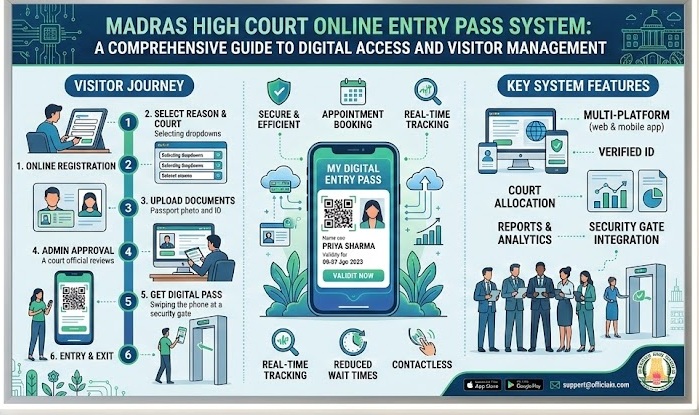
The application process begins with accessing the official Madras High Court website. The e-visitor pass link is prominently displayed on the homepage, directing users to the dedicated portal
Upon clicking the link, applicants are presented with the online application interface that guides them through the registration process.
The first step involves selecting the appropriate bench of the Madras High Court. The Principal Bench in Chennai serves as the primary location, though the system may accommodate applications for other benches depending on current configurations
Applicants must specify the date of their intended visit, allowing the system to check availability and schedule capacity.
Contact information collection forms the next phase of the application. Applicants must provide a valid mobile number and email address, which serve dual purposes as communication channels and verification mechanisms
The system may send one-time passwords (OTPs) or confirmation messages to these contacts to validate their authenticity.
The purpose of visit specification requires careful attention, as this determines the category of pass issued and any additional verification requirements. The system typically offers dropdown menus with options such as “Case Hearing,” “Meeting with Official,” “Research,” or “Observation”
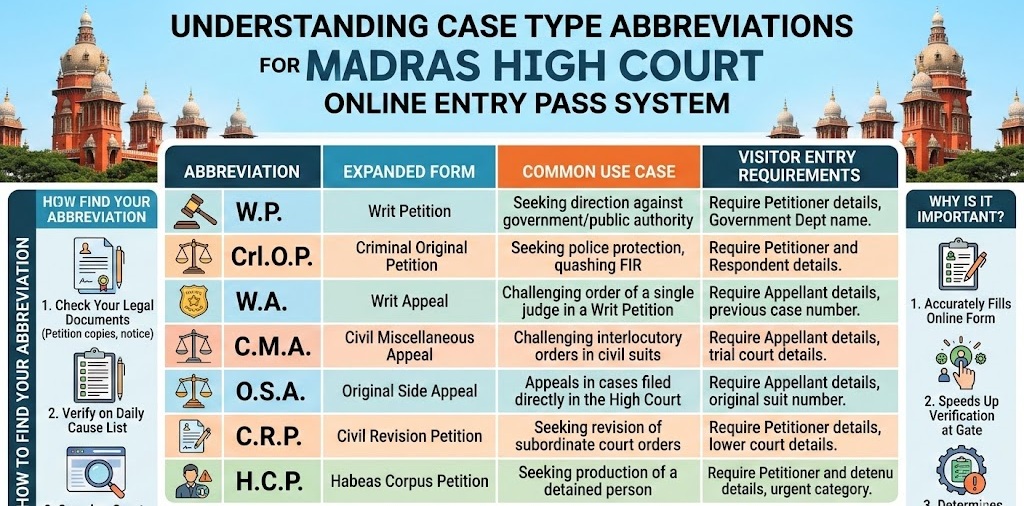
Selection of “Case Hearing” may trigger additional fields requesting case category, case number, or party details to verify the legitimacy of the visit.
Document Upload and Verification
Depending on the category of pass requested, the system may require upload of supporting documents. These typically include scanned copies or clear photographs of identification documents, institutional certificates for students, or official authorization for government visitors. The platform specifies acceptable file formats and size limits to ensure system performance and document readability.
The document upload interface includes preview functionality allowing applicants to verify that uploaded documents are legible and properly oriented. This step is crucial, as unclear or incomplete documentation may result in application rejection or delays in processing. Applicants should ensure that document photographs or scans capture all relevant information clearly, with particular attention to identification numbers, photographs, and validity dates.
Upon completion of form fields and document uploads, applicants review their entries for accuracy before final submission. The system typically presents a summary page for verification, allowing correction of errors before the application enters processing queues. Once submitted, the application receives a unique reference number that applicants should record for tracking purposes.
Pass Generation and Delivery
Following submission, the application undergoes verification processing by court administrative staff or automated systems, depending on the category and risk assessment. Approved applications generate electronic passes that are delivered to applicants through their registered email addresses or made available for download through the portal
. The delivery method ensures that passes reach applicants promptly while maintaining digital records for security purposes.
The e-pass typically contains a unique identification code, QR code for scanning at entry points, applicant photograph, visit date, purpose, and authorized areas of access. Visitors must print the pass or ensure it is accessible on a mobile device with sufficient battery life for presentation at security checkpoints. While color printing is not mandatory, clear visibility of all details and the QR code is essential for smooth entry processing
Applicants who do not receive their passes within expected timeframes can track application status through the portal using their reference number. The system also provides mechanisms for resending passes or regenerating them if technical issues occur during initial delivery.
Madras High Court Online Entry Pass System
Operational Aspects and Visitor Experience
Entry Procedures and Security Protocols
Upon arrival at the Madras High Court premises, visitors with online passes proceed to designated entry gates equipped to handle digital pass verification. CISF personnel and court security staff are stationed at these points to conduct final verification before granting entry. The process involves scanning the QR code on the e-pass, cross-checking the visitor’s physical appearance against the photograph on the pass, and verifying identification documents
The digital pass system integrates with physical security measures including baggage screening and personal searches where warranted. Visitors should be prepared for these additional checks, carrying minimal personal items to expedite the process. Prohibited items typically include electronic devices such as smartphones and cameras in certain areas, weapons, sharp objects, and other items that could compromise court security
The entry process is designed to be efficient, with dedicated lanes for different categories of visitors. Senior advocates and holders of monthly passes may have access to expedited entry procedures, while daily visitors follow standard queues. The system aims to minimize waiting times while maintaining rigorous security standards appropriate for a high court premises.
Validity and Usage Conditions
Online entry passes are typically valid only for the specific date and purpose indicated during application. Single-day passes expire at the end of the court working day and cannot be reused for subsequent visits. Visitors requiring multiple-day access must apply for separate passes for each day or explore options for extended validity passes if available for their category.
The passes specify authorized areas within the court complex that the holder may access. General visitors are typically restricted to public areas, courtrooms, and designated waiting spaces. Access to restricted areas such as judges’ chambers, administrative offices, or record rooms requires specific authorization beyond the standard entry pass.
Visitors must carry the e-pass throughout their stay within the court premises and present it upon request by security personnel or court officials. Failure to produce the pass when required may result in removal from the premises or other administrative actions. The pass also serves as an emergency contact reference, containing information that could assist in locating visitors in case of incidents or evacuations.
Troubleshooting and Support Mechanisms
Despite the system’s design for user-friendliness, applicants may encounter technical difficulties or operational questions during the application process. The Madras High Court provides support mechanisms to address these issues, including helpline numbers and email contacts for technical assistance
Common issues include forgotten login credentials, failed document uploads, non-receipt of passes, or discrepancies in pass details. The system typically provides self-service options for password recovery and application status checking. For more complex issues, applicants can contact the Registry of the High Court during working hours (typically 10:00 AM to 5:45 PM on working days) at the designated telephone number
Applicants who discover errors in their issued passes, such as incorrect names, dates, or case details, should immediately contact court authorities for correction. Using passes with incorrect information may result in entry denial or security concerns. The correction process typically requires submitting a request through the same channels used for original applications, with reference to the original application number.
Comparative Context and Broader Implications
Similar Systems in Other Indian High Courts
The Madras High Court’s online entry pass system is not unique among Indian judicial institutions but represents part of a broader trend toward digitalization of court administration. Several other high courts have implemented similar systems, each adapted to local requirements and infrastructure capabilities.
The Delhi High Court and Kerala High Court were noted as pioneers in implementing neutral citation systems for judgments, and they have similarly led in adopting digital visitor management solutions
The Telangana State High Court operates an e-Visitor Pass portal with comparable functionality, allowing online registration for litigants, representatives, and other visitors
These systems share common objectives of enhancing security, improving efficiency, and creating digital records of court access.
Comparison across jurisdictions reveals both convergences and divergences in implementation approaches. While all systems prioritize security verification, the specific data fields collected, document requirements, and pass validity periods vary based on local security assessments and administrative preferences. Some systems offer more extensive self-service capabilities, while others maintain higher levels of manual oversight in the approval process.
The Madras High Court system distinguishes itself through its integration with CISF security protocols and its specific accommodations for the high volume of visitors characteristic of this major judicial institution. The system’s design reflects lessons learned from other implementations while addressing unique local challenges.
Impact on Access to Justice
The digitalization of court entry procedures carries significant implications for access to justice, presenting both opportunities and potential challenges. On the positive side, the online system reduces physical barriers to court access by allowing visitors to complete administrative formalities remotely, saving time and reducing the need for multiple visits to court premises merely to obtain entry passes.
For litigants from distant locations, the ability to secure entry passes online before traveling to Chennai represents a substantial convenience and cost saving. The system reduces uncertainty about entry procedures, allowing better planning of court visits and associated logistics. These efficiencies particularly benefit economically disadvantaged litigants for whom repeated court visits impose significant financial burdens.
However, the digital system also introduces potential barriers for individuals lacking internet access, digital literacy, or the devices necessary for online applications. Elderly litigants, those from rural areas with limited connectivity, and economically marginalized individuals may find the online process challenging. The court administration must maintain alternative pathways for such individuals, whether through assisted application services, telephone-based registration, or continued provision of manual passes for those unable to use digital platforms.
The COVID-19 pandemic accelerated digital adoption across judicial systems worldwide, and the Madras High Court’s online pass system can be viewed in this broader context of contactless service delivery. Post-pandemic, these systems continue to offer public health benefits by reducing physical crowding at entry points and minimizing person-to-person contact in administrative processes.
Future Developments and Technological Integration
Looking ahead, the Madras High Court online entry pass system is likely to evolve in response to technological advancements and changing operational requirements. Potential developments include integration with national identity systems such as Aadhaar for streamlined verification, implementation of biometric authentication at entry points, and development of mobile applications for pass management.
Artificial intelligence and machine learning applications could enhance the system’s capabilities in anomaly detection, predictive analytics for visitor volume management, and automated processing of routine applications. Blockchain technology might be employed to create tamper-proof records of court access, enhancing security and audit capabilities.
The system may also expand to integrate with other court services, creating unified platforms where visitors can simultaneously schedule appointments, request document access, and register for entry. Such integration would further streamline the experience of interacting with the court system, reducing administrative fragmentation.
As cybersecurity threats evolve, the system will require continuous updates to security protocols, encryption standards, and threat detection mechanisms. Balancing security enhancements with user convenience will remain an ongoing challenge for court administrators.
Practical Guidelines for Different User Categories
For Litigants and General Public
Litigants planning to visit the Madras High Court should initiate their entry pass application well in advance of their scheduled hearing date, ideally several days before the visit to allow processing time and address any potential issues. Accurate completion of case details ensures that passes are issued for the correct dates and courtrooms, preventing last-minute complications.
Visitors should print their e-passes on standard A4 paper, ensuring that all details including the QR code are clearly visible
. While color printing is not required, high-quality printing prevents scanning difficulties at entry points. Carrying original identification documents matching the application details is mandatory, as security personnel verify identity against pass information.
Understanding prohibited items and dress codes before arrival prevents delays and potential entry denial. Visitors should dress in formal or respectful attire appropriate for court premises and avoid carrying bags or electronic devices unless specifically permitted. Planning arrival time to account for security screening queues ensures timely attendance at hearings.
For Advocates and Legal Professionals
Practicing advocates should explore options for extended validity passes or professional entry cards that reduce the need for daily applications
Registration as a practicing advocate with the Madras High Court Bar Association may facilitate access to these streamlined procedures.
For advocates appearing in multiple matters on the same day, the pass system should accommodate access to different courtrooms within the authorized areas. However, advocates should verify that their pass covers the full duration of their court appearances and any necessary waiting periods between hearings.
Senior advocates may be eligible for specialized entry procedures recognizing their professional status. Application for senior advocate entry cards typically requires verification of designation and good standing, but offers long-term convenience for frequent court practitioners
For Law Students and Academic Visitors
Law students seeking to observe court proceedings or attend internship programs should apply for monthly passes through the designated application pathway
These applications require institutional support through bonafide certificates and valid student identification.
Students should familiarize themselves with courtroom etiquette and observation protocols before their first visit. While the entry pass grants physical access, proper conduct within courtrooms requires understanding of standing orders, seating arrangements, and behavioral expectations. Academic supervisors or institutional coordinators can provide guidance on maximizing the educational value of court visits.
Research scholars requiring extended access for academic projects should contact court administration directly to discuss special arrangements beyond standard visitor passes. Such access typically requires detailed project proposals and institutional endorsements.
Challenges and Areas for Improvement
Technical and Infrastructure Limitations
Despite its benefits, the online entry pass system faces technical challenges that affect user experience and system reliability. Server downtime, slow response times during peak application periods, and compatibility issues with certain browsers or devices can frustrate applicants and potentially disrupt court access plans.
Internet connectivity limitations affect applicants in rural areas or those with limited data plans. The system assumes reliable internet access that may not be universally available, potentially excluding certain demographics from the streamlined application process. Mobile network coverage variations in different parts of Tamil Nadu may affect the ability of visitors to receive OTPs or pass delivery messages.
Digital literacy gaps present ongoing challenges, with many potential users unfamiliar with online form completion, document scanning, or email verification procedures. While the system is designed to be user-friendly, significant portions of the population require assisted digital services to navigate the application process successfully.
Administrative and Operational Constraints
Processing delays during high-demand periods, such as when major cases are scheduled or during court vacation periods when staffing is reduced, can result in applicants not receiving passes within expected timeframes. The system’s effectiveness depends on adequate administrative staffing to handle verification and approval workflows.
Coordination between the digital system and physical security operations occasionally experiences friction, with discrepancies between pass information and security personnel records or technical failures in QR code scanning equipment. These operational hiccups can undermine the efficiency gains promised by digitalization.
The system’s reliance on accurate self-reporting by applicants creates vulnerabilities to fraudulent applications or misrepresentation of visit purposes. While verification procedures aim to detect such issues, resource constraints may limit the thoroughness of background checks for every application.
Equity and Inclusion Considerations
The transition to digital systems risks exacerbating existing inequalities in access to justice. Individuals without smartphones, computers, or reliable internet face systematic disadvantages in obtaining entry passes compared to digitally connected applicants. Elderly litigants, persons with disabilities, and those from marginalized communities may experience particular difficulties.
Language barriers present additional challenges, as the online system primarily operates in English, potentially excluding Tamil-speaking applicants with limited English proficiency. While the Madras High Court serves a Tamil-majority jurisdiction, digital interfaces may not fully accommodate linguistic diversity.
Gender considerations also merit attention, as women visitors may face specific security concerns or cultural barriers in accessing digital services independently. Ensuring that the online system does not disadvantage women litigants or advocates requires targeted outreach and support services.
Madras High Court Online Entry Pass System
In view of the abvoe facts Final Conclusion.
The Madras High Court’s online entry pass system represents a significant advancement in judicial administration, demonstrating how digital technology can enhance security, efficiency, and user experience in court operations. Implemented in response to longstanding challenges associated with manual entry processes and heightened security requirements following CISF deployment, the system has streamlined access for thousands of daily visitors while maintaining rigorous security standards.
The system’s architecture, integrating web-based applications with backend verification processes and physical security checkpoints, offers a model for other judicial institutions seeking to modernize their visitor management procedures. Its categorization of visitors, accommodation of different access needs, and integration with broader court operations demonstrate sophisticated understanding of stakeholder requirements.
However, the system also highlights challenges inherent in digital transformation of public services, including equity concerns, technical limitations, and the need for continuous adaptation to evolving threats and technologies. As the Madras High Court continues to refine its online entry pass procedures, attention to inclusive design, robust technical infrastructure, and user support will be essential to realizing the full potential of digitalization.
For litigants, advocates, students, and officials interacting with the Madras High Court, understanding the online entry pass system is now an essential component of court engagement. Successful navigation of this system requires familiarity with application procedures, awareness of documentation requirements, and appreciation of the security protocols that underpin its operation. As digital systems increasingly mediate access to judicial institutions, such competencies become integral to effective participation in the justice system.
The Madras High Court’s experience with online entry passes contributes to broader national and international conversations about technology in judicial administration. By demonstrating both the benefits and challenges of digital visitor management, this implementation provides valuable lessons for ongoing efforts to modernize court systems while preserving their accessibility and legitimacy. The evolution of this system will continue to reflect changing technological capabilities, security imperatives, and societal expectations of judicial institutions in the digital age.
Frequently Asked Questions (FAQ)
Q: How do I apply for an online entry pass to the Madras High Court?
A: Visit the official Madras High Court website and click on the e-visitor pass link on the homepage. Fill out the online application form with your personal details, contact information, purpose of visit, and date of visit. Upload required identification documents and submit the application. Upon approval, you will receive the e-pass via email or through the portal for printing
Q: What documents do I need to carry along with the e-pass?
A: You must carry a printed copy of your e-pass and original photo identification (Aadhaar card, PAN card, passport, driving license, or voter ID) that matches the details provided in your application. For law students, institutional identification and bonafide certificates are required. Government officials should carry official identification
Q: Can I get a same-day entry pass, or do I need to apply in advance?
A: While the system may accommodate same-day applications depending on processing capacity, it is strongly recommended to apply at least 2-3 days in advance to avoid delays. During peak periods or high-profile case hearings, processing times may be longer.
Q: Is the online entry pass mandatory for all visitors?
A: Yes, the online e-pass system is the primary method for obtaining entry to the Madras High Court premises. The system was introduced to replace the cumbersome manual process and is now the standard procedure for visitor access
Q: What should I do if I don’t receive my e-pass after applying?
A: Check your email spam folder first. If not found, use the application reference number to track status on the portal. For further assistance, contact the Madras High Court Registry during working hours (10:00 AM to 5:45 PM) at the designated telephone number or email address
Q: Are there any fees for obtaining the online entry pass?
A: The standard e-visitor pass for court entry is typically provided free of charge. However, specific categories or extended validity passes may have associated fees as determined by court administration. Check the official website for current fee structures.
Q: Can I use the e-pass on my mobile phone, or do I need a printed copy?
A: While digital display on mobile phones may be accepted, it is strongly recommended to carry a printed copy to avoid entry denial due to technical issues such as battery drain or screen visibility problems. Ensure the QR code is clearly printed and scannable
Q: What items are prohibited inside the Madras High Court premises?
A: Prohibited items typically include weapons, sharp objects, cameras, recording devices, and electronic gadgets in certain areas. Specific restrictions may vary by courtroom and security level. Check current security guidelines before your visit
Q: Can I apply for an entry pass for someone else?
A: Generally, entry passes are issued to individual visitors based on their personal identification. Applying on behalf of others may be possible in certain circumstances (such as for minors or persons with disabilities) with appropriate authorization and documentation.
Q: What happens if my case hearing is postponed after I have obtained an entry pass?
A: Entry passes are typically valid only for the specified date. If your hearing is rescheduled, you will need to apply for a new pass for the revised date. Some flexibility may be available for consecutive day passes in specific circumstances.
This article provides general information about the Madras High Court online entry pass system based on publicly available sources and operational patterns typical of such systems. Procedures, requirements, and system functionalities are subject to change at the discretion of the Madras High Court administration. Visitors should always consult the official Madras High Court website (https://www.mhc.tn.gov.in or https://hcmadras.tn.gov.in) for the most current information, application procedures, and specific requirements before planning their visit
The information presented here does not constitute legal advice or official court guidance. The Madras High Court reserves the right to modify entry procedures, security protocols, and pass requirements without prior notice. Visitors are responsible for complying with all current rules and regulations as specified by court authorities and CISF security personnel. The author and publisher disclaim any liability for inaccuracies, omissions, or changes in procedure that may occur after publication. For specific queries or technical support regarding the online entry pass system, please contact the Madras High Court Registry directly through official channels