
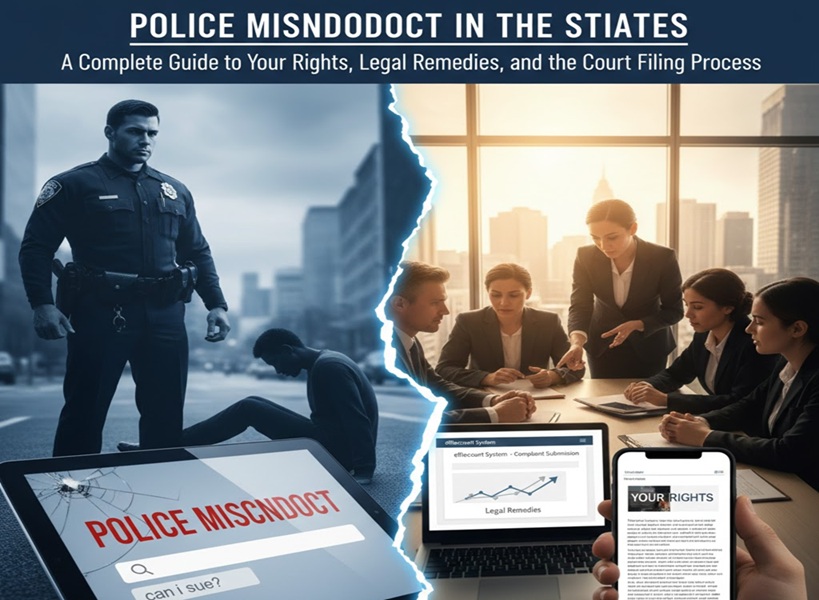
Police Misconduct in the United States
A Complete Guide to Your Rights, Legal Remedies, and the Court Filing Process
Police officers in the United States hold a position of public trust that carries extraordinary authority. They can detain individuals, conduct searches, use force, and make arrests that dramatically affect a person’s freedom and future. Most officers serve professionally and honorably. However, when power is misused, whether intentionally or through negligence, the consequences can be life-altering.
Police misconduct is one of the most frequently searched legal topics in America. People want to understand what qualifies as misconduct, whether they can sue, how much compensation may be available, how qualified immunity works, and how to start the legal process. Many also search practical terms such as how to efile a lawsuit, efiling procedure in federal court, efilecourt system, or where to find efilinginfo.
This comprehensive guide explains police misconduct from every angle: constitutional foundations, types of violations, legal defenses, filing procedures, damages, reform efforts, and step-by-step remedies. It is written in clear language while maintaining legal accuracy.
The Constitutional Foundation of Police Accountability
Police misconduct cases are deeply connected to the United States Constitution. Several amendments protect citizens from government abuse.
The Fourth Amendment protects against unreasonable searches and seizures.
The Fifth Amendment protects against self-incrimination and guarantees due process.
The Eighth Amendment prohibits cruel and unusual punishment.
The Fourteenth Amendment guarantees equal protection and due process under state law.
Official constitutional text can be found at:
https://constitution.congress.gov
Most civil lawsuits against police officers rely on a federal statute known as 42 U.S.C. § 1983, which allows individuals to sue government officials who violate constitutional rights under color of law.
Statute reference:
https://www.law.cornell.edu/uscode/text/42/1983
What Legally Qualifies as Police Misconduct?
Police misconduct occurs when an officer violates constitutional rights, breaks departmental policy, or engages in illegal conduct while performing official duties.
It is important to understand that not every unpleasant encounter with law enforcement amounts to misconduct. Courts evaluate whether an officer’s actions were objectively reasonable under the circumstances.
Misconduct typically involves:
-
Excessive force
-
False arrest
-
Malicious prosecution
-
Unlawful search
-
Fabrication of evidence
-
Racial discrimination
-
Sexual misconduct
-
Failure to provide medical care
-
Retaliation for protected speech
Excessive Force: The Most Common Claim
Excessive force is the most litigated category of police misconduct in the United States.
The U.S. Supreme Court in Graham v. Connor (1989) established that force must be evaluated under an “objectively reasonable” standard from the perspective of a reasonable officer on the scene.
Supreme Court information:
https://www.supremecourt.gov
Courts consider:
-
Severity of the crime
-
Whether the suspect posed immediate threat
-
Whether the suspect resisted arrest
-
Whether the suspect attempted to flee
Force becomes unconstitutional when it exceeds what is necessary to control the situation.
Examples include:
-
Beating a restrained suspect
-
Shooting an unarmed person without threat
-
Excessive use of Tasers
-
Dangerous chokeholds
False Arrest and Wrongful Detention
A false arrest claim arises when someone is arrested without probable cause. The Fourth Amendment requires a reasonable belief that a crime occurred.
Common search queries include:
“Can I sue police for wrongful arrest?”
“What happens if police arrest without evidence?”
If an officer lacks probable cause and detains someone, the victim may seek compensation for lost wages, emotional distress, and reputational harm.
Legal explanation resource:
https://www.law.cornell.edu/wex/false_arrest
Unlawful Search and Seizure
The Fourth Amendment protects individuals from unreasonable searches of homes, vehicles, and digital devices.
Police generally require:
-
A valid warrant
-
Probable cause
-
Or a recognized exception (such as consent or exigent circumstances)
Entering a home without a warrant is one of the most serious constitutional violations.
Search law overview:
https://www.law.cornell.edu/wex/search_and_seizure
Racial Profiling and Discriminatory Policing
Racial profiling involves targeting individuals based on race, ethnicity, religion, or national origin rather than evidence of criminal activity.
The Equal Protection Clause of the Fourteenth Amendment prohibits discriminatory enforcement.
Organizations addressing racial discrimination:
https://www.aclu.org
https://www.naacpldf.org
Discrimination claims can be difficult to prove but may succeed with statistical or pattern evidence.
Police Brutality and High-Profile Cases
Police brutality is often used as a broad term in media discussions. Legally, brutality usually falls under excessive force or civil rights violations.
High-profile cases often spark national debates about use-of-force standards, body cameras, and qualified immunity. While media attention may focus on extreme cases, thousands of smaller claims are filed annually across federal courts.
Failure to Provide Medical Care
If a person is in police custody and requires medical treatment, officers must not act with deliberate indifference to serious medical needs. This principle stems from Eighth and Fourteenth Amendment protections.
Denying treatment after visible injury or ignoring medical emergencies can result in liability.
Sexual Misconduct by Police Officers
Sexual assault, coercion, or exploitation by officers constitutes severe misconduct and criminal behavior. Courts treat such violations seriously, and victims may pursue both civil and criminal remedies.
Qualified Immunity: The Central Legal Defense
Qualified immunity is one of the most debated legal doctrines in America.
It protects officers from civil liability unless they violated “clearly established” constitutional law.
Explanation:
https://www.law.cornell.edu/wex/qualified_immunity
This means plaintiffs must show:
-
A constitutional violation occurred.
-
The right was clearly established at the time.
Many cases are dismissed based on qualified immunity before reaching trial.
Suing a Police Department or City (Monell Liability)
Under the Supreme Court’s decision in Monell v. Department of Social Services, municipalities can be liable if misconduct results from official policy or widespread custom.
To win a case against a city, a plaintiff must prove:
-
A policy or custom existed
-
The policy caused the violation
Criminal Charges vs Civil Lawsuits
Police officers can face criminal charges for misconduct, but prosecutions are relatively rare.
Criminal cases are handled by:
-
Local prosecutors
-
State attorneys general
-
The Department of Justice Civil Rights Division
DOJ Civil Rights Division:
https://www.justice.gov/crt
Civil lawsuits, however, are filed by victims seeking financial compensation.
The Step-By-Step Legal Process After Police Misconduct
Step 1: Preserve Evidence
Immediately document:
-
Date and time
-
Officer names and badge numbers
-
Witness contact information
-
Photos and videos
-
Medical records
Step 2: File Internal Affairs Complaint
Most departments have internal complaint systems.
Example:
https://www.nyc.gov/site/nypd/bureaus/investigative/internal-affairs.page
Step 3: File Civilian Review Complaint
Some cities have independent oversight boards.
Example:
https://www.nyc.gov/site/ccrb/index.page
Step 4: File Federal Civil Rights Complaint
If pursuing a lawsuit, the case is typically filed in U.S. District Court.
Federal court system:
https://www.uscourts.gov
Understanding Efiling and EfileCourt Systems
Modern federal courts operate through electronic systems.
The federal judiciary uses CM/ECF for online case management. Lawyers must register before they can efile documents.
PACER (Public Access to Court Electronic Records):
https://www.pacer.uscourts.gov
The efiling procedure generally includes:
-
Drafting complaint
-
Formatting according to local rules
-
Uploading via CM/ECF
-
Paying filing fee
-
Receiving confirmation notice
Many district courts publish efilinginfo pages explaining formatting rules, deadlines, and login requirements.
In some jurisdictions, pro se litigants may request permission to efilecourt documents electronically. Others still require paper filings.
Understanding the correct efiling procedure is crucial because improper filing can delay or dismiss a case.
Statute of Limitations
Most police misconduct lawsuits must be filed within 1 to 3 years depending on the state’s personal injury statute.
Missing the deadline usually results in permanent dismissal.
Damages and Compensation
Compensation varies widely. Courts may award:
-
Medical expenses
-
Future treatment costs
-
Lost income
-
Emotional distress damages
-
Pain and suffering
-
Punitive damages
-
Attorney’s fees
Some settlements reach millions of dollars, especially in wrongful death cases.
The Role of Body Cameras and Digital Evidence
Body camera footage has become central in modern litigation.
Public access may be available under Freedom of Information laws.
FOIA information:
https://www.foia.gov
Emotional, Social, and Community Impact
Police misconduct affects more than individuals. It can damage community trust, increase fear, and trigger civil unrest.
Mental health resources:
https://www.samhsa.gov
Police Reform Efforts in the United States
Reforms include:
-
Mandatory body cameras
-
Use-of-force reporting
-
Independent prosecutors
-
Civilian oversight
-
Training on de-escalation
Congressional research:
https://crsreports.congress.gov
20 Frequently Asked Questions (FAQ)
-
What is police misconduct?
-
Can I sue a police officer?
-
What is qualified immunity?
-
How long do I have to file?
-
What damages can I recover?
-
Can I file without a lawyer?
-
What is Section 1983?
-
What is excessive force?
-
Is racial profiling illegal?
-
What if police search without warrant?
-
Can cities be sued?
-
What is Monell liability?
-
How do I file in federal court?
-
What is efiling?
-
What is the efiling procedure?
-
Can pro se litigants efilecourt documents?
-
Where can I find efilinginfo?
-
What is PACER?
-
Are police criminally prosecuted?
-
Do most cases settle?
FInal Verdics as per above facts
Police misconduct law in the United States balances two important values: public safety and constitutional liberty. While most officers serve with professionalism, accountability mechanisms exist to protect citizens when violations occur.
Understanding your rights, deadlines, legal remedies, and the correct efilecourt and efiling procedure empowers individuals to seek justice lawfully and effectively.
For More infomation Visit Home Click Here
Short Disclaimer
This article is for informational purposes only and does not constitute legal advice. Laws vary by state and jurisdiction. Individuals should consult a licensed attorney for advice regarding specific circumstances.